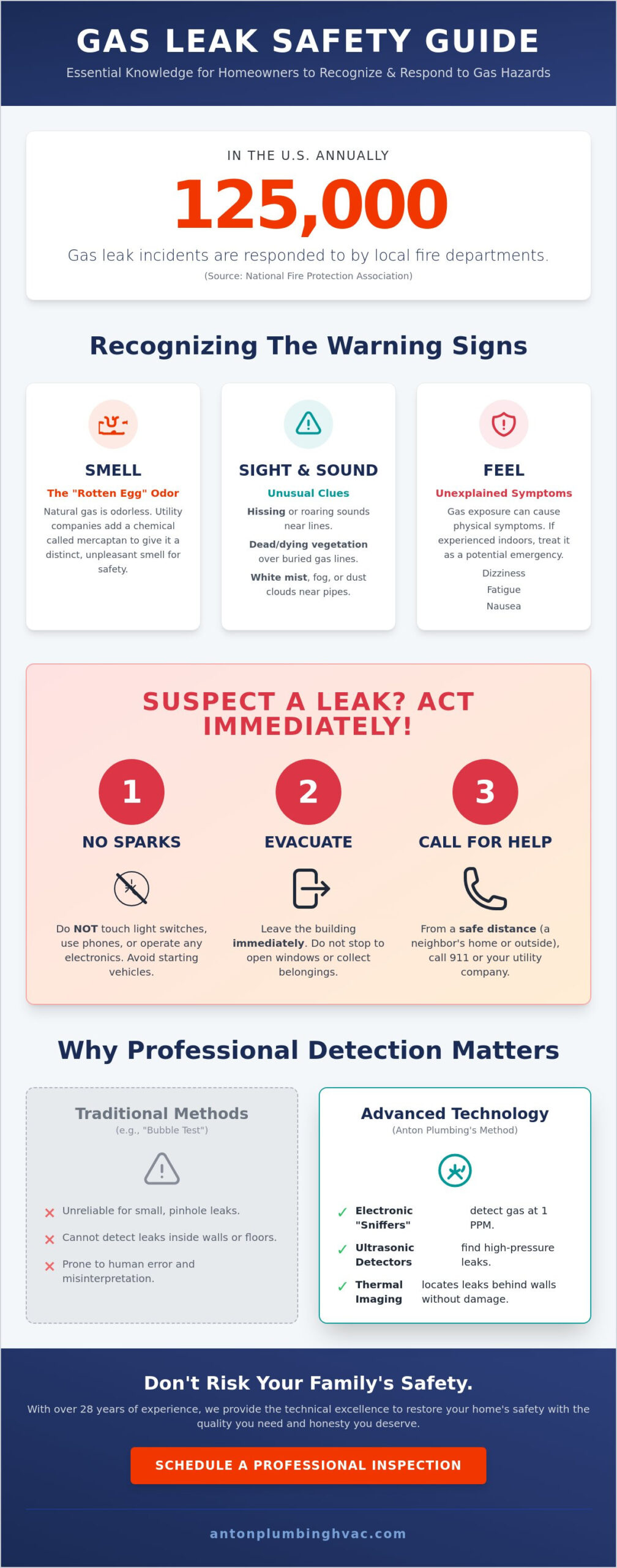
According to the National Fire Protection Association, local fire departments across the country respond to an average of 125,000 gas leak incidents every year. You shouldn’t have to live with the constant worry of a “what if” scenario involving your family’s safety or the integrity of your gas line installation and leak repair. It’s stressful to navigate the complexities of New Jersey building codes or wonder if a faint smell in the basement is a minor issue or a major emergency. At Anton Plumbing Heating & Cooling, we believe every homeowner deserves the peace of mind that comes with a secure, professionally maintained system.
This guide empowers you to master the essentials of gas safety for your Old Bridge home. You’ll learn how to identify the subtle signs of a hidden leak and understand the professional standards required to pass local inspections. Backed by over 28 years of experience, we provide the technical clarity you need to protect your household. We will walk you through the specific steps for leak detection, explain the permit process, and clarify exactly when you should call a Master Plumber instead of the utility company.
Key Takeaways
- Learn to identify the warning signs of a gas leak, including the “rotten egg” scent of mercaptan, to protect your family and property.
- Discover how professional electronic “sniffers” and ultrasonic detectors provide the pinpoint accuracy needed for a safe home environment.
- Understand the importance of load calculations during gas line installation and leak repair to ensure your new high-efficiency appliances perform safely and reliably.
- Navigate the New Jersey Uniform Construction Code and permit process to avoid the major insurance and safety risks of uncertified work.
- See why professional gas services are non-negotiable for household safety and how our expert team delivers the quality you need and honesty you deserve.
Recognizing Gas Line Hazards in Your Old Bridge Home
Professional gas line installation and leak repair serves as the primary safety barrier for your residential infrastructure. Because natural gas is naturally colorless and odorless, utility providers infuse it with mercaptan, a chemical that creates a distinctive rotten egg smell. This safety protocol became standard after the 1937 New London School explosion, ensuring that homeowners have a sensory warning before a situation becomes critical. Recognizing Gas Line Hazards is a fundamental skill for every resident in Old Bridge. Beyond the scent, you should monitor your property for physical signs like hissing sounds near appliances, patches of dead grass in your yard, or an unexplained 20% increase in your monthly energy bills. Physical symptoms are equally telling; if you or your family experience sudden dizziness, fatigue, or nausea while indoors, you must treat it as a potential gas exposure emergency.
The “Rotten Egg” Test and Other Warning Signs
It’s vital to distinguish between a minor appliance issue and a major line leak. A faint, localized smell near a stove might indicate a pilot light that has gone out, but a pervasive odor that fills a room suggests a breach in the piping. While some homeowners use a “bubble test” by applying soapy water to visible joints to check for escaping gas, you don’t want to interfere with the lines or attempt DIY fixes. Watch for non-olfactory signs such as white mist, dust clouds, or fog hovering near your gas lines. These visual markers often indicate a high-pressure leak. At Anton Plumbing Heating & Cooling, we use advanced leak detection sensors and thermal imaging to locate these hidden dangers with precision. We’ve spent over 28 years protecting local families with the quality you need and the honesty you deserve.
Immediate Safety Protocol: What to Do if You Smell Gas
Adhere strictly to the “No Spark” rule by refusing to touch light switches, use your phone inside the house, or start any vehicles in the garage. Evacuation is the only safe first step for Old Bridge families when a leak is suspected. You must leave the premises immediately without stopping to open windows or retrieve belongings. Once you reach a safe distance, follow this specific order of operations: leave the house, call 911 or your utility provider from a neighbor’s phone or a mobile device outside, and then call our team for professional gas line installation and leak repair. Our HVACR-certified experts provide immediate relief and technical excellence to restore your home’s safety. Need a Plumber? Call Anton!
Professional Gas Leak Detection and Repair Methods
Protecting your Old Bridge home requires more than just a keen sense of smell. While the scent of sulfur is your first warning, our team utilizes precision technology to pinpoint the exact source of a failure. Professional gas line installation and leak repair relies on electronic gas sniffers that detect combustible gases at concentrations as low as 1 part per million. These sensors provide an immediate digital readout, allowing us to find microscopic leaks that a simple soap solution might miss. For larger systems, ultrasonic detectors pick up the high-frequency acoustic signatures of escaping gas, even in noisy environments.
We take the guesswork out of the equation by using thermal imaging to scan your walls. When gas escapes a pressurized pipe, it creates a localized temperature drop. Our infrared cameras visualize this “cold spot,” identifying leaks behind NJ drywall without requiring us to cut multiple exploratory holes in your finished rooms. This high-tech accuracy is why we’ve been a trusted partner for local families for over 28 years. Every diagnostic step we take follows the safety protocols established by the National Fuel Gas Code, ensuring your infrastructure remains compliant with national safety standards.
High-Tech Leak Detection vs. Traditional Methods
Traditional “bubble tests” involve brushing soapy water over joints to look for growing suds. While this works for obvious failures, it’s often unreliable for slow, pinhole leaks or sections hidden inside floor joists. Modern electronic sensors provide a definitive numerical value, removing human error from the diagnostic process. To find hidden issues, we perform a process called “isolation.” We temporarily segment the gas system into smaller zones and monitor each one independently. This systematic approach allows us to confirm if a leak is localized to a single appliance or if the entire gas line installation and leak repair strategy requires a more comprehensive piping overhaul.
The Repair Process: From Shut-off to Certification
Once we identify the breach, the repair begins with a total system shut-off to ensure a zero-risk environment. Our Master Plumber evaluates whether the pipe needs a localized joint repair or a full section replacement. If the pipe shows signs of internal corrosion, we cut and remove the compromised length, threading new black iron or CSST piping with precision. After the mechanical work is complete, we perform a rigorous pressure test. We pump the system to a specific pressure, often 15 psi or higher depending on local codes, and monitor it for a minimum of 15 minutes to ensure the gauge doesn’t budge. Only after this verification can gas service be safely restored. If you have concerns about an aging pipe, the experts at Anton Plumbing Heating & Cooling can provide a thorough safety inspection to keep your home secure.
Gas Line Installation for New Appliances and Home Upgrades
Upgrading your Old Bridge home with a high-output professional range or a 199,000 BTU tankless water heater requires more than a simple connection. It demands a professional load calculation. Our team evaluates the total British Thermal Units (BTUs) of every appliance in your home to ensure your existing meter and piping can handle the surge. If the volume is insufficient, your new appliances won’t perform correctly, and your furnace might struggle during the coldest New Jersey nights. We specialize in precision gas line installation and leak repair to prevent these performance bottlenecks before they start.
Outdoor living is a major trend in Middlesex County, but adding a pool heater or a 50,000 BTU fire pit requires specialized underground lines. We follow the New Jersey Administrative Code for gas pipe installation to ensure every exterior run is buried at the correct depth and uses corrosion-resistant materials. During major kitchen or basement renovations, we often find that expert drain cleaning services and gas work overlap. For those interested in specialized sewer maintenance techniques, you can visit San Diego Drain Guys to learn more about professional hydro-jetting solutions. Coordinating these utility upgrades simultaneously saves time and ensures your home infrastructure remains robust. With over 28 years of experience, Anton Plumbing Heating & Cooling provides the technical confidence you need for a safe home environment.
Black Iron vs. CSST: Choosing the Right Piping Material
Sizing Your Gas Lines for Future Growth
A standard 1/2-inch gas line is often insufficient for modern high-efficiency upgrades. While a 1/2-inch line might power an old clothes dryer, a tankless water heater usually requires a 3/4-inch or even a 1-inch dedicated line to maintain consistent pressure. We often implement “manifold” systems, which act like a central distribution hub. This setup delivers a steady, dedicated flow of gas to each appliance, preventing the “pressure drop” that happens when the water heater and furnace kick on at the same time. If you’re planning future upgrades, use this checklist:
- Verify your gas meter’s total BTU delivery capacity with a licensed professional.
- Install larger diameter “trunk” lines to accommodate future outdoor kitchens or generators.
- Ensure every new appliance has a dedicated, accessible shut-off valve.
- Confirm that all underground lines use yellow poly pipe with a tracer wire for future locating.
Need a Plumber? Call Anton! Our family-operated team ensures your gas system is sized correctly the first time, providing the quality you need and the honesty you deserve.
NJ Gas Codes, Permits, and Utility Coordination
Every gas line installation and leak repair in Old Bridge must follow the New Jersey Uniform Construction Code. This isn’t just red tape. It’s a set of rigorous safety standards designed to prevent fires, explosions, and carbon monoxide poisoning. Working without a permit is a massive gamble. If an unpermitted gas line causes damage, your homeowner’s insurance policy can legally deny your claim. You’re left paying for the repairs and the liability out of pocket. When you need professional gas line installation and leak repair, we ensure the job is done right the first time according to state law.
You need to know where your responsibility begins. New Jersey Natural Gas (NJNG) and PSEG own the gas main and the meter. Once the gas passes through that meter into your home, it’s your property. You’re responsible for the maintenance and safety of every pipe, valve, and connector inside your walls and under your floors. Our team acts as the bridge between your home and the utility company, ensuring your internal system is up to the task of handling high-pressure fuel safely. Just as a properly functioning sump pump installation and repair protects your basement from water intrusion, a certified gas system protects your entire home from the risks of fuel leaks and pressure failures.
Navigating Local Permits in Middlesex County
The Old Bridge building department requires specific inspections for all gas work. You can’t hire a handyman for this. New Jersey law requires a licensed Master Plumber to sign off on these permits to guarantee the work meets safety thresholds. Anton brings 28 years of experience to every project, ensuring your home stays in full compliance with local codes. We handle the paperwork and coordinate with town inspectors to keep your project on schedule. This transparency protects your home’s value and your family’s safety.
Working with NJNG and PSEG
If a utility technician from NJNG or PSEG detects a leak during a service call, they’ll “red tag” your system. This means they shut off your gas immediately for safety reasons. They won’t turn it back on until a licensed professional makes the repair and certifies the system is leak-free. Anton works as a trusted partner for local families to resolve these red tags quickly. We perform the necessary pressure tests and repairs to get your service restored. Our goal is to move you from a “red tag” crisis back to total home comfort as fast as possible.
Need a Plumber? Call Anton! Our team provides the quality you need and the honesty you deserve when dealing with complex gas codes and utility requirements.
Why Professional Gas Services are Non-Negotiable for Safety
Attempting a DIY approach to your home’s gas infrastructure isn’t just risky; it’s a gamble with your family’s lives. Gas line installation and leak repair require a level of precision that goes beyond standard home maintenance. A single loose fitting or an improperly sealed joint can lead to catastrophic fires, high-velocity explosions, or silent carbon monoxide poisoning. Beyond the physical dangers, unlicensed work often voids your homeowner’s insurance policy and leaves you legally liable for any damages to neighboring properties in Old Bridge or East Brunswick. When the stakes involve flammable pressurized fuel, professional intervention is the only safe path forward.
At Anton Plumbing Heating & Cooling, we operate on a simple brand promise: “Quality you need, Honesty you deserve.” We don’t cut corners because we understand that your home’s safety is our primary responsibility. For over 28 years, our team has served as the protective expert for local families, ensuring every pipe, valve, and connection meets the strictest New Jersey safety codes. We treat your household’s well-being as if it were our own, providing immediate relief from the stress of utility failures.
The Value of a Master Plumber Certification
In New Jersey, becoming a Licensed Master Plumber is a rigorous process that demands years of dedication. Our technicians have completed the mandatory five-year apprenticeship and passed the comprehensive state board examination to earn their credentials. This level of expertise ensures that your gas line installation and leak repair are handled with technical excellence and modern accuracy. Because we are a neighborly, family-operated business, we maintain extensive professional liability insurance that provides you with an extra layer of financial security. You get the peace of mind that comes from a seasoned veteran who combines high-tech diagnostic tools with old-school integrity.
Schedule Your Gas Safety Inspection Today
If your home in Old Bridge was built more than 40 years ago, your original gas pipes may be reaching the end of their functional lifespan. Corroded lines or outdated materials like galvanized steel can develop pinhole leaks that go unnoticed for months. You should schedule a non-emergency safety check if you notice a sudden 15% increase in utility bills, see dead patches in your lawn near the gas meter, or hear faint hissing sounds near appliances. For major gas line repiping projects, we offer 0% financing options to ensure that budget constraints never stand in the way of your family’s security. If your home also shows signs of moisture intrusion or foundation dampness, pairing your gas safety inspection with a professional sump pump installation and repair evaluation is a smart way to address multiple vulnerabilities in a single service visit.
Don’t wait for a crisis to secure your home infrastructure. We provide 24/7 emergency response for gas leaks and expert installations for new appliances or home additions. Need a Plumber? Call Anton! Contact us for gas line services to experience the relief of working with a trusted local professional who values your safety above all else.
Protect Your Old Bridge Family with Certified Gas Expertise
Your home’s safety depends on proactive maintenance and a rigorous adherence to NJ gas codes. Whether you’re investigating a faint sulfur odor or installing high efficiency appliances, professional gas line installation and leak repair ensures your property remains a secure environment. Anton’s licensed NJ Master Plumbers leverage over 28 years of technical experience to manage every permit and utility coordination requirement. We use advanced diagnostic sensors to provide the precise accuracy your household deserves.
Don’t wait for a minor concern to become a major hazard. Our team provides 24/7 emergency availability for immediate leak detection and repair. We prioritize your financial peace of mind with upfront pricing and 0% financing options on qualifying upgrades. It’s our mission to serve as your long term partner in home safety and comfort. Schedule your professional gas line service with Anton today!
We look forward to providing the quality you need and the honesty you deserve for your next project.
Frequently Asked Questions
Is a gas leak an emergency I should call 911 for?
Yes, any suspected gas leak is a life-safety emergency that requires an immediate call to 911 and your utility provider from a safe location outside the home. According to the National Fire Protection Association, fire departments respond to an average of 125,000 natural gas leaks annually. Don’t use phones, light switches, or garage door openers inside the house. Once emergency responders clear the site, contact us for professional gas line installation and leak repair to secure your home.
Can I install my own gas line for a new stove or dryer?
No, New Jersey state law and Old Bridge building codes require a licensed Master Plumber to perform all gas line work. DIY attempts account for a high percentage of residential utility accidents and will void your appliance warranty. Our team handles the permits and pressure testing required by the 2021 International Fuel Gas Code to ensure your family stays safe. Quality you need, Honesty you deserve.
How much does it cost to repair a gas leak in Old Bridge, NJ?
Repair costs vary based on the leak’s location and the piping material used in your home. HomeAdvisor reports that national averages for gas line repairs typically range from $150 to $700, though complex underground leaks can exceed these figures. We provide upfront pricing after a physical inspection of your system. This transparency ensures you understand the scope of work before any repairs begin. Need a Plumber? Call Anton!
What happens if NJNG or PSEG turns off my gas because of a leak?
If NJNG or PSEG detects a leak, they’ll shut off your service and place a warning tag on your meter for safety. You can’t restore service until a licensed professional completes the repair and passes a municipal inspection. We specialize in rapid gas line installation and leak repair to get your heat and hot water back online. We coordinate with local inspectors to ensure your system meets the 100 percent safety standard required for reconnection.
How long does a typical gas line installation take?
A standard gas line installation for a single appliance usually takes 4 to 6 hours to complete. This timeframe includes the physical piping, connection to the main supply, and the mandatory pressure test. More complex projects, like running lines for a whole-house generator, can take 1 to 2 full workdays. Our technicians work efficiently to minimize disruption while maintaining our 28 year record of excellence.
Does my homeowners insurance cover gas line repair or replacement?
Most standard homeowners insurance policies don’t cover gas line repairs resulting from age, corrosion, or normal wear and tear. However, coverage often applies if the line is damaged by a covered peril like a sudden explosion or a falling tree. Review your specific policy for service line coverage endorsements, which 25 percent of modern policies now offer. We provide detailed documentation and invoices to assist with any claims you file.
What is the difference between a gas leak and a carbon monoxide leak?
A natural gas leak involves the escape of raw fuel, which smells like rotten eggs due to added mercaptan. A carbon monoxide leak is a colorless, odorless byproduct of incomplete combustion from appliances like furnaces. Both are deadly threats to your household. The CDC reports that over 400 Americans die annually from accidental CO poisoning. Install dual-sensor detectors on every level of your home to monitor both hazards effectively.
Can a plumber fix a gas leak, or do I need a special technician?
A licensed Master Plumber is the qualified professional for all residential gas piping issues. In New Jersey, plumbers undergo 5 years of apprenticeship and rigorous testing to earn the credentials needed to handle combustible fuel lines safely. Our team brings over 28 years of experience to every job site. We use advanced tools like electronic combustible gas detectors to find leaks that traditional methods might miss. Need a Plumber? Call Anton!