
In New Jersey, a neglected HVAC system isn’t just a comfort risk; it’s a financial liability waiting for the next 100-degree heatwave or freezing blizzard to strike. You might wonder if annual maintenance is actually necessary or if you can safely skip a year to save a few dollars. However, when you see those climbing PSEG or NJNG bills, it’s clear that an inefficient system costs more in the long run. If you’re asking how often should you service your HVAC in NJ, you’re taking a vital step toward protecting your family from the stress of a mid-season breakdown.
We understand the anxiety that comes with potential system failures or safety risks like carbon monoxide leaks. This 2026 maintenance guide provides a clear roadmap to lower your energy costs while ensuring your equipment meets all warranty requirements. We’ll break down the specific service needs for furnaces versus boilers and explain why a bi-annual schedule is the most effective strategy for our state’s extreme temperature swings. You’ll gain the technical confidence to manage your home infrastructure with ease and keep your household secure throughout the year.
Key Takeaways
- Determine why the professional consensus for New Jersey homes is a bi-annual schedule rather than just once a year.
- Learn how often should you service your HVAC in NJ to offset the corrosive effects of coastal salt air and extreme humidity.
- Protect your manufacturer’s warranty and prevent rising utility costs by maintaining professional service records throughout 2026.
- Identify the essential 2026 safety protocols, including electrical tightening and lubrication, that prevent emergency system failures.
- Understand the importance of hiring a licensed Master HVACR contractor to ensure your system complies with the latest New Jersey building codes.
The New Jersey Standard: How Often Should You Service Your HVAC?
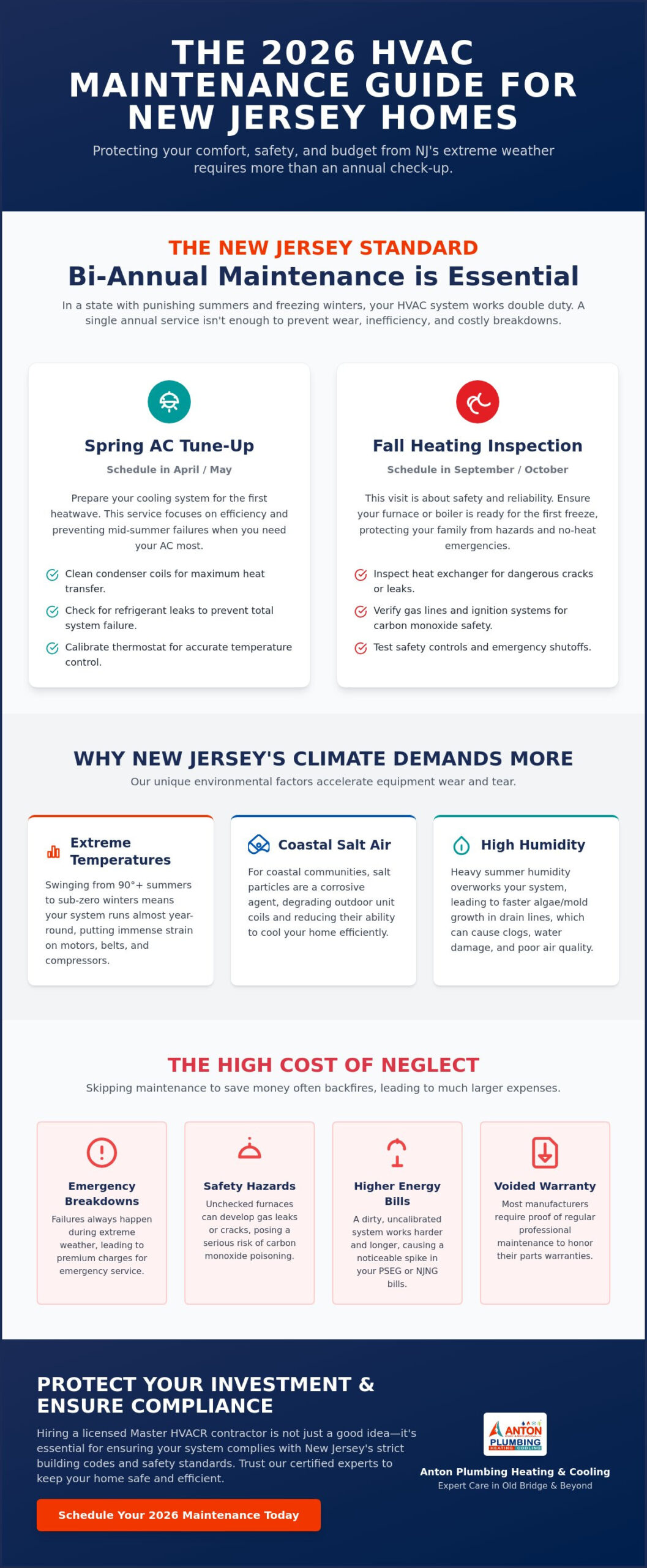
New Jersey residents face a unique set of environmental challenges that demand a high level of vigilance. When you consider how often should you service your HVAC in NJ, you must account for the fact that your system never truly gets a break. Our weather patterns swing from humid, tropical-like summers to bone-chilling, arctic winters. This dual-demand cycle means your Heating, ventilation, and air conditioning (HVAC) equipment works much harder than systems in more temperate states. A single annual checkup simply isn’t enough to catch the wear and tear that accumulates during both peak seasons.
The professional consensus for New Jersey homeowners is a bi-annual maintenance schedule. While a “once a year” rule might suffice in milder climates, it fails in the Mid-Atlantic zone. Here, your system must pivot from heavy cooling in August to intense heating by November. This constant cycling puts immense strain on mechanical components. Without a dedicated visit before each season, small issues like a worn belt or a dusty sensor quickly escalate into expensive emergency repairs.
Local environmental factors in communities like Old Bridge and East Brunswick play a significant role in equipment longevity. High summer humidity levels often lead to moisture buildup within the air handler, which can cause evaporator coils to corrode or condensate drains to overflow. Beyond that, the heavy pollen counts and local pollutants common in Central Jersey can choke your system’s airflow. If these contaminants aren’t cleared every six months, they force your motor to work twice as hard, leading to the high utility bills many families struggle to pay during peak months.
The Spring AC Tune-Up
Scheduling your cooling maintenance in April or May provides a critical window of protection. This proactive approach allows technicians to identify tiny refrigerant leaks before they turn into total system failures during the first June heatwave. We ensure your central air conditioning installation is fully optimized, calibrated, and cleaned to handle consecutive 90-degree days without a hitch. A clean system runs more efficiently, directly lowering your monthly cooling costs.
The Fall Heating Inspection
As the nights turn cold, your focus must shift to the integrity of your boilers and furnaces. This visit is about more than just efficiency; it’s about domestic safety. Technicians perform rigorous safety checks on gas lines and heat exchangers to verify that your family is safe from carbon monoxide leaks or electrical fire hazards. A Fall tune-up serves as your primary defense against mid-winter emergency calls. By verifying the combustion process and clearing ignition components before the first freeze, you gain the peace of mind that your home will remain a warm sanctuary all winter long.
Why NJ Climate Demands a Bi-Annual Maintenance Schedule
New Jersey’s geography places a heavy burden on residential climate systems. When you ask how often should you service your HVAC in NJ, the answer is rooted in our state’s extreme seasonal shifts. We experience everything from sub-zero winter blasts to triple-digit summer heatwaves. This means your system never has an “off” season. It transitions directly from heavy heating to intense cooling, which accelerates the wear on internal components. Without professional oversight every six months, these environmental stressors lead to premature mechanical failure.
Proximity to the coast adds another layer of complexity. In Jersey City and surrounding coastal areas, the salt air acts as a silent corrosive agent. Salt particles settle on the aluminum fins of your outdoor condenser unit, causing them to pit and degrade. This corrosion reduces the system’s ability to shed heat, forcing the compressor to run longer and hotter. Regular cleaning is the only way to neutralize these deposits before they eat through your equipment. Expert HVAC repair in East Brunswick, NJ often involves addressing these specific local stressors to ensure your system survives the decade.
High humidity also plays a major role in system health. Drier climates don’t face the same mold and drainage challenges we do in the Garden State. In New Jersey, HVAC drain lines clog faster because they are constantly flushing out gallons of condensation. If that moisture sits, it becomes a breeding ground for biological growth. Following U.S. Department of Energy maintenance tips can help you manage basic filter changes, but professional cleaning is required to keep those internal lines clear.
Humidity and Your AC System
In humid Middlesex County summers, your air conditioner doesn’t just cool the air; it dehumidifies it. This moisture removal process forces the system to work significantly harder than it would in a dry environment. We pay close attention to condensate pumps, which can fail under the pressure of a humid July. If these pumps aren’t checked, you risk water damage in your basement or attic. Additionally, bi-annual service prevents “Dirty Sock Syndrome,” a common NJ issue where bacteria build up on damp coils and release a foul odor throughout your home.
Winter Prep for Steam and Hot Water Boilers
Jersey City brownstones and older homes in East Brunswick often rely on steam or hot water boilers. These systems have unique requirements, such as checking water levels and testing low-water cutoffs before the first frost. A malfunction here isn’t just a comfort issue; it’s a safety risk. Specialized boiler repair and installation expertise is vital for these older units to ensure they operate safely under high pressure. If you haven’t had a professional inspection this year, securing HVAC repair in East Brunswick, NJ now is the best way to protect your family before the next blizzard arrives.
The High Cost of Skipping HVAC Service in New Jersey
Ignoring maintenance is a gamble that rarely pays off for New Jersey homeowners. When you’re weighing how often should you service your HVAC in NJ, it’s essential to look beyond the immediate appointment fee. The true cost of neglect shows up in your monthly PSEG or NJNG utility bills. A layer of dust as thin as a dime on your evaporator coils can force your system to run longer cycles, which industry reports suggest can increase energy consumption by up to 15%. Over a single summer or winter, these incremental costs often exceed the price of a professional tune-up.
Beyond the financial drain, skipping service introduces significant safety risks. In older New Jersey furnaces, a cracked heat exchanger is a silent threat that can leak carbon monoxide into your living space. Without a professional inspection, these hairline fractures remain invisible until a crisis occurs. Protecting your family’s safety requires more than just a quick filter change; it requires the trained eye of a technician who knows how to spot these structural failures before they become dangerous. If a neglected system leads to a pipe burst or a secondary leak, you might find yourself searching for an emergency plumber in Old Bridge, NJ to handle the fallout.
Protecting Your Manufacturer Warranty
Most homeowners don’t realize that their HVAC warranty is a conditional contract. If you read the fine print of a 2026 manufacturer’s agreement, you’ll likely find that professional maintenance is a requirement, not a suggestion. DIY efforts or hiring unlicensed handymen won’t suffice when you try to file a claim for a failed compressor. You must provide documented service logs from a licensed NJ technician to keep that coverage active. Consistent, professional care can extend the operational life of your equipment by 5 to 7 years, saving you from a premature replacement that could cost thousands of dollars.
Avoiding Peak-Season Emergency Fees
Waiting until your system fails during a New Jersey blizzard is a recipe for stress and high expenses. During extreme weather events, the demand for HVAC specialists and emergency responders skyrockets. You’ll likely face long wait times and premium surge pricing that far exceeds the cost of a scheduled visit. Preventative care effectively puts you at the front of the line. By identifying weak capacitors or failing motors in October, you avoid the “emergency premium” and the anxiety of a freezing home while you wait for a technician to become available.
Professional HVAC Maintenance Checklist for 2026
Understanding how often should you service your HVAC in NJ is the first step, but knowing what happens during that visit ensures you’re getting true value. A professional 2026 tune-up is a meticulous technical audit designed to catch failures before they happen. We start by cleaning and tightening all electrical connections. Loose wiring is a leading cause of system failure and domestic fire hazards. Next, we lubricate all moving parts. This simple step reduces mechanical friction, which lowers the energy draw and prevents your motor from burning out during a heatwave.
Calibration is equally vital for modern efficiency. In the many zoned homes across Middlesex and Hudson counties, an uncalibrated thermostat leads to uneven temperatures and wasted utility spend. We also inspect refrigerant levels and use electronic leak detectors to find microscopic pinholes that a visual check would miss. Finally, we perform a comprehensive ductwork inspection. Many older NJ builds suffer from leaky ducts in crawl spaces or attics. These leaks can waste a significant portion of your conditioned air before it ever reaches your living room, forcing your system to work overtime.
What Homeowners Can Do (DIY)
You play a vital role as the guardian of your home’s comfort between professional visits. Follow the 90-day rule for air filter replacement. In homes with pets or high occupancy, you might need to swap them every 30 days to maintain airflow. If you live near the coast, keep your outdoor condenser unit clear of Jersey Shore sand, salt, and wind-blown debris. Rinse the fins gently with a garden hose to maintain clear passage for heat exchange. Always monitor for unusual grinding noises or “musty” smells. These are early warning signs that require professional attention before a total breakdown occurs.
What Requires a Licensed NJ Professional
Certain tasks are strictly for experts holding a New Jersey state HVACR license. Handling high-voltage components and complex control boards carries significant risk and requires specialized diagnostic tools. Refrigerant charging is another restricted task; it requires EPA certification to ensure environmentally safe handling and precise pressure levels. For families using gas furnaces or boilers, we perform a combustion analysis. This technical check measures the efficiency of the burn and ensures your heat exchanger is venting dangerous gases safely. When deciding how often should you service your HVAC in NJ, remember that these technical safety checks are non-negotiable for a secure household. Schedule your HVAC repair in East Brunswick, NJ today to ensure every component meets 2026 safety standards.
The Anton Advantage: Expert HVAC Care in Old Bridge & Beyond
Choosing a maintenance partner is about more than just finding a technician; it’s about trusting a guardian for your home. We bring over 28 years of experience to every service call, supporting families across Middlesex and Hudson counties with a level of local expertise that generic national chains can’t match. Our team consists of fully licensed and insured professionals holding valid NJ state HVACR credentials. This means every inspection we perform meets the highest ethical and technical standards in the industry. As a family-operated business, we prioritize integrity and transparency—values also championed by industry peers like Peninsula Air Conditioning (PenAir)—ensuring you receive clear financial expectations before any work begins.
We provide comprehensive solutions that go beyond simple checkups. Whether you need a high-efficiency HVAC upgrade or a professional water heater replacement, our technicians are equipped with advanced diagnostic technology to ensure modern accuracy. If you’re still wondering how often should you service your HVAC in NJ, our 28-year history in this climate proves that a bi-annual schedule is the only way to avoid the high stakes of a mid-season emergency. We treat your home as if it were our own, providing the steady professionalism you need to keep your family safe and comfortable.
Maximizing NJ State Rebates and Programs
Navigating the financial side of home maintenance shouldn’t be stressful. We help you take full advantage of the NJ Clean Energy Program for 2026, which offers significant cash-back incentives for energy-efficient upgrades. For homeowners looking to modernize their infrastructure, we offer zero-interest financing options that make high-efficiency systems more accessible; additionally, learning from industry leaders like Commodus about selecting the right heat pump can help you make an informed decision for your 2026 upgrades. Our deep familiarity with New Jersey utility requirements allows us to guide you through the paperwork so you can qualify for the maximum rebates available for your specific equipment. This proactive financial guidance ensures that your commitment to home efficiency pays for itself over time.
Schedule Your 2026 Tune-Up Today
Preparation is the key to peace of mind. We offer easy online booking for residents in Old Bridge, East Brunswick, and Jersey City, allowing you to secure your preferred time slot before the seasonal rush. While we focus on preventative care to keep you out of crisis, we also maintain 24/7 emergency availability for those moments when total system failure occurs during a blizzard or heatwave. If you’re a first-time maintenance customer, ask about our special seasonal offers designed to make your initial service even more affordable. Don’t wait for your utility bills to climb or your system to fail; contact us today to establish a reliable maintenance rhythm for your home.
Secure Your Home’s Comfort for the Seasons Ahead
New Jersey’s unpredictable weather demands a proactive approach to home maintenance. By committing to a bi-annual service schedule, you effectively shield your family from the stress of seasonal breakdowns and the burden of rising energy costs. Professional inspections ensure your system remains efficient while keeping your manufacturer’s warranty fully intact for the years to come. Knowing how often should you service your HVAC in NJ is the first step toward a worry-free home; the second is choosing a partner who understands our local environmental stressors.
We bring 28+ years of experience to every household we serve. Our team of licensed and insured NJ HVACR professionals is dedicated to your safety, offering technical excellence and 24/7 emergency service when you need it most. Don’t wait for the next heatwave or blizzard to test your system’s limits. Schedule Your NJ HVAC Maintenance with Anton Plumbing Heating & Cooling today and gain the peace of mind that comes with expert, ethical care. We’re ready to act as your long-term maintenance partner and guardian of your domestic well-being.
Frequently Asked Questions
Do I really need HVAC maintenance twice a year in New Jersey?
Yes, a bi-annual schedule is the professional standard for New Jersey homes. When you consider how often should you service your HVAC in NJ, you must account for our state’s extreme 100-degree temperature swings. A spring visit prepares your cooling system for intense summer humidity, while a fall inspection ensures your furnace or boiler can safely handle freezing winter nights. This dual-visit approach prevents small mechanical issues from turning into mid-season emergencies.
What happens if I skip my annual AC tune-up?
Skipping your tune-up leads to a steady decline in efficiency and a significant increase in your monthly PSEG bills. Dust and debris accumulate on the evaporator coils, which forces your compressor to run longer cycles to achieve the same cooling effect. This extra strain often results in a premature system failure. Most importantly, neglecting professional care can provide a basis for manufacturers to nullify your equipment warranty in 2026.
How much does a typical HVAC service call cost in NJ?
Service costs in New Jersey vary based on your location and the complexity of your heating or cooling system. Labor rates in North Jersey counties like Bergen or Hudson are often 15 to 20 percent higher than the state average. You should expect to pay for a diagnostic fee plus the cost of any necessary parts. We recommend working with a licensed Master HVACR contractor who provides clear financial expectations before starting any technical work.
Can I service my own HVAC system to save money?
You should limit your DIY maintenance to basic tasks like changing air filters every 90 days and clearing leaves from your outdoor condenser. More complex tasks, such as handling high-voltage electrical components or testing gas line integrity, require specialized diagnostic tools. In New Jersey, a Master HVACR license is required to legally perform most repairs. Attempting to service these technical components yourself can lead to safety hazards or accidental damage to your system.
How long does a professional HVAC maintenance visit take?
A comprehensive maintenance visit typically takes between 60 and 90 minutes to complete. This timeframe allows a technician to perform a rigorous multi-point inspection, including cleaning coils, tightening electrical connections, and calibrating the thermostat. If your home has multiple zones or an older boiler system, the process may take longer. This thorough approach ensures every safety and performance component is verified before the peak season begins.
Will regular servicing lower my NJ electric and gas bills?
Regular servicing is one of the most effective ways to lower your NJNG or PSEG utility costs. A clean, well-lubricated system moves air more efficiently and reaches your desired temperature faster. This reduces the overall energy draw of your motors and compressors. By keeping your equipment in peak condition, you also avoid the “emergency premium” costs associated with urgent repairs during a New Jersey heatwave or blizzard.
What are the signs that my NJ HVAC system needs immediate service?
You should call for service immediately if you notice unusual grinding, squealing, or banging noises coming from your vents or unit. Other red flags include musty odors, sudden spikes in your energy bills, or “short cycling,” where the system turns on and off frequently. These symptoms often indicate a failing capacitor or a blocked drainage line. Addressing these signs early prevents a total system shutdown and protects your domestic well-being.
Does HVAC maintenance include cleaning the air ducts?
Standard HVAC maintenance focuses on the mechanical health and safety of the unit itself rather than the interior of your ventilation system. During a routine visit, a technician will inspect your ductwork for visible leaks or disconnected sections that waste conditioned air. However, a deep, professional cleaning of the entire duct system is a separate, specialized service. This ensuring your mechanical components are optimized for performance before addressing the distribution network.