
That traditional central air system you’ve always relied on might actually be the primary reason your utility bills are skyrocketing. While most homeowners assume a standard AC replacement is the only path to comfort, the reality is that sticking with old ductwork often leads to wasted energy and hot upstairs bedrooms. In the heat of a Middlesex County summer, choosing between a ductless mini-split vs central air Old Bridge requires looking past the surface to see what your home’s structure actually needs for long-term efficiency.
We understand the frustration of opening a PSEG or NJNG statement only to see costs rising alongside the humidity. You want a cooling solution that provides immediate relief and quiet operation without the stress of a massive construction project. This guide compares both systems to help you find the most efficient fit for your family’s well-being and budget. We will explore how modern high-efficiency units can lower your monthly costs, the specific installation benefits for multi-story homes, and how to leverage New Jersey’s Whole Home Energy Solutions program for rebates up to $7,500. By the end, you’ll have a clear, professional roadmap to a cooler, more secure home before the next heatwave hits.
Key Takeaways
- Determine the most effective solution for your home’s unique layout by comparing the zoned precision of a ductless mini-split vs central air Old Bridge.
- Secure significant financial relief through the NJ Whole Home Energy Solutions program, offering rebates up to $7,500 for qualifying high-efficiency upgrades.
- Compare the quiet operation and energy-saving benefits of modern inverter technology against the uniform cooling of traditional ducted systems.
- Identify the best installation path to avoid invasive construction while ensuring your new system meets the latest 2026 SEER2 efficiency standards.
- Gain peace of mind by partnering with protective experts who prioritize your family’s domestic well-being and long-term utility savings.
Cooling Your Old Bridge Home: Ductless Mini-Split vs. Central Air
Old Bridge families face a critical decision when their aging cooling systems finally fail during a humid July. Choosing between a ductless mini-split vs central air Old Bridge isn’t just about the hardware; it’s about how your home was built. Central air is a unified system that uses a network of ducts to distribute cooled air through vents in every room. In contrast, a ductless mini-split consists of individual indoor units mounted on walls or ceilings, connected directly to an outdoor condenser without any bulky ductwork.
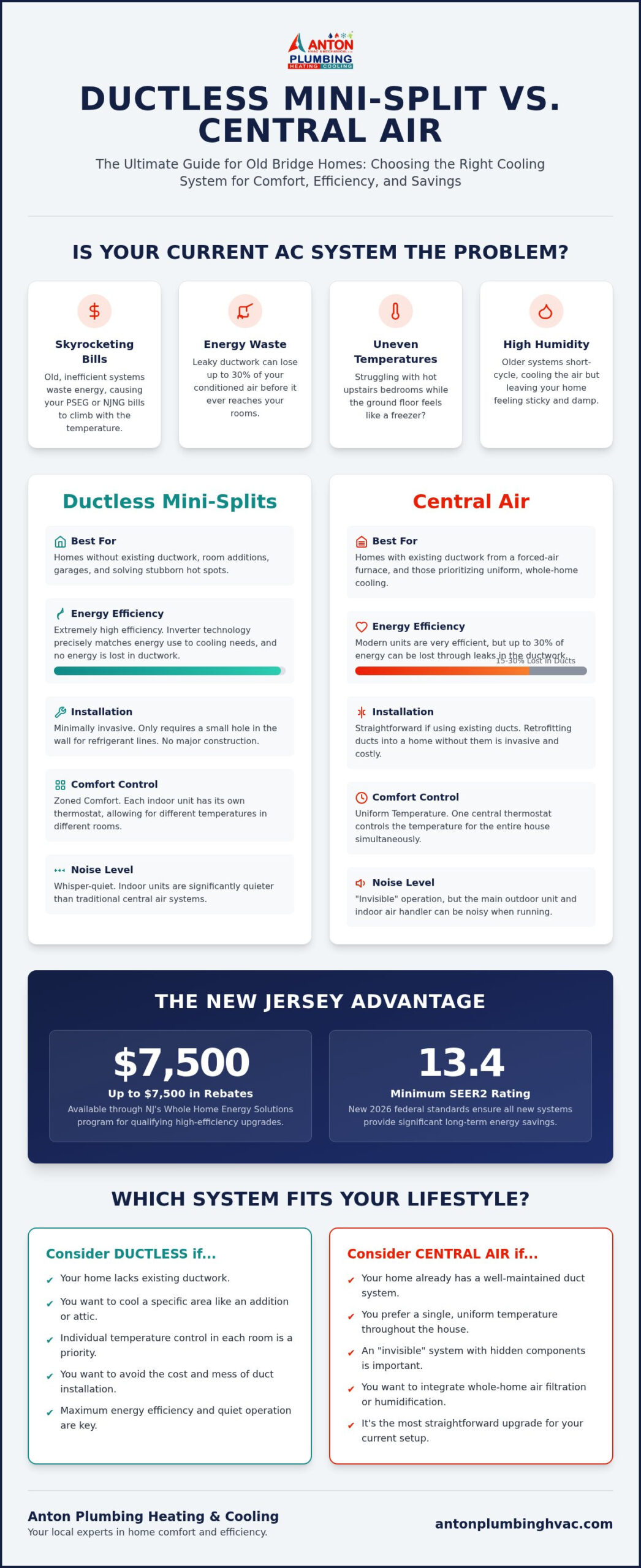
As of 2026, all new installations in New Jersey must meet the updated SEER2 (Seasonal Energy Efficiency Ratio 2) standards. The minimum requirement for northern states like ours is now 13.4 SEER2. This change ensures that any system you choose today will be significantly more efficient than units installed just a decade ago. Whether you live in a newer development or a classic neighborhood, understanding these baseline standards helps you protect your long-term investment and secure your domestic well-being.
The Central Air Advantage
If your home already has a forced-air furnace, central air is often the most straightforward path to whole-home comfort. It integrates seamlessly with your existing infrastructure, using the same vents to deliver chilled air. This setup offers an “invisible” operation, as the mechanical components remain tucked away in the basement or attic. For families prioritizing air quality, central systems allow for high-grade filtration and humidity control that treats every square foot of the house simultaneously. It is a reliable solution that maintains a uniform temperature throughout the entire floor plan with minimal visual impact on your living space.
The Rise of Ductless Technology
Many of the older Capes and Ranches throughout Old Bridge were built before central cooling was standard, meaning they lack the wall cavities required for traditional ducts. Retrofitting these homes with ductwork can be messy, invasive, and expensive. Ductless systems solve this problem by utilizing advanced air source heat pump technology to cool specific zones without the need for major construction.
These systems are ideal for home additions, finished garages, or those stubborn second-floor bedrooms that never seem to stay cool. By eliminating ducts, you also eliminate the 15 to 30 percent of conditioned air that typically leaks out of gaps in traditional ductwork. This efficiency makes ductless units a powerful tool for lowering utility bills while maintaining a quiet, peaceful environment. They offer a flexible way to upgrade your home’s infrastructure without compromising its original character or your family’s daily routine.
Performance and Efficiency in the New Jersey Climate
New Jersey summers bring a heavy, thick humidity that makes 85 degrees feel much hotter. When you compare a ductless mini-split vs central air Old Bridge, the way each system handles this moisture is just as critical as how it lowers the temperature. Traditional central air units act as powerful dehumidifiers for the entire home, pulling air through a central return to strip away moisture. However, if your current central system uses an older single-stage compressor, it only runs at full blast. This often leads to short cycles where the air feels cool, but the house still feels “sticky” because the system didn’t run long enough to remove the humidity.
Modern energy-efficient mini-splits utilize inverter technology to bypass this problem. Instead of a simple on-off switch, the compressor modulates its speed to match the exact cooling needs of the room. This results in a steady, quiet operation that keeps your PSEG or NJNG utility bills from spiking during a heatwave. If you’re tired of uneven temperatures between floors, it’s time to speak with a dedicated HVAC specialist about upgrading to a system that adapts to your home’s specific climate needs.
Managing Humidity and Airflow
Central air provides a uniform approach to comfort, making it a strong choice for open floor plans where you want a consistent feel in every corner. Many ductless units now offer a specialized “Dry Mode” that focuses specifically on moisture removal without over-cooling the space. This is a lifesaver on those damp Middlesex County days when the temperature is mild but the air is heavy. Choosing a system with a high SEER2 rating directly impacts your cooling costs, as higher ratings indicate the unit requires less electricity to move the same amount of heat out of your home.
Energy Loss: Ducts vs. Ductless
Utility waste is often invisible, hiding inside your walls. In many older New Jersey homes, unsealed or poorly insulated ductwork leads to a 20 to 30 percent loss of conditioned air before it ever reaches your bedroom. Ductless systems eliminate this distribution loss entirely because there are no pipes for the air to travel through. This provides a massive boost to your return on investment, as every dollar you spend on electricity goes directly into cooling your living space. While high-end central systems now feature variable-speed fans to improve consistency, they still can’t match the localized efficiency of a ductless unit that only cools the rooms you’re actually using.
Comparing Installation Complexity and Upfront Costs
The timeline for your cooling upgrade depends heavily on what sits behind your walls. If you are performing a straightforward central air replacement in an Old Bridge home with existing, functional ductwork, our team can typically complete the swap in one to two days. However, the complexity shifts dramatically if you are looking to add cooling to a home that never had it. Retrofitting metal ductwork into a two-story Cape Cod or a historic property is a major construction undertaking. It involves cutting into drywall, the sacrifice of closet space for air handlers, and several days of significant dust and disruption.
A ductless mini-split installation offers a much faster, one-day solution for most individual rooms. Because these systems only require a small three-inch hole through an exterior wall, the mess is minimal. You won’t have to worry about repainting ceilings or repairing plaster after we leave. When weighing a ductless mini-split vs central air Old Bridge, consider your tolerance for construction. For many families, the ability to have a quiet, cold bedroom by dinner time without a week of renovations is the deciding factor.
Retrofitting Challenges in Older Homes
Older NJ properties often lack the overhead clearance for bulky ductwork. Installing a traditional system in these spaces can feel like trying to solve a puzzle where the pieces don’t fit. You might lose valuable square footage to bulkheads or dropped ceilings just to hide the pipes. We prioritize non-invasive methods to preserve the integrity of your home’s architecture. Mini-splits allow us to provide modern comfort while keeping your original floor plan intact, ensuring your domestic well-being without the stress of a major remodel.
Maintenance and Longevity
Both systems require professional care to survive the harsh Northeast seasons. Central air units need annual coil cleanings and regular filter changes to maintain airflow. Ductless units feature washable filters that you can easily maintain yourself; however, they still require professional deep-cleans to keep the blowers efficient. Proper sizing is the most critical part of longevity. If a unit is too large, it will short-cycle, turning on and off too frequently. This wears out the compressor and leaves your home feeling humid.
System choice also plays a role in your home’s resale value. In the New Jersey real estate market, central air is often viewed as a standard expectation for modern living. However, high-efficiency ductless systems are increasingly seen as a premium feature, especially in finished basements or attic conversions where traditional cooling often fails to reach. Investing in the right technology now protects your property value for the future.
Which System Fits Your Lifestyle? Zoned Comfort vs. Uniformity
End the “Thermostat War” in your household by choosing a cooling system that matches your family’s daily habits. When comparing a ductless mini-split vs central air Old Bridge, the biggest lifestyle shift is how you control the temperature. Central air is the classic set-it-and-forget-it option, ideal for families who want a uniform 72 degrees in every room. However, this often leads to friction when one person wants the bedroom freezing while another prefers the living room a bit warmer. Ductless systems eliminate this problem by giving every room its own remote. You can save money by turning off units in guest rooms or the basement while keeping your home office perfectly chilled. Noise is another factor; mini-splits operate at a whisper-quiet 19 to 32 decibels, which is significantly softer than the 35 to 55 decibels typical of central blowers.
Solving the Hot Second Floor Problem
Many Old Bridge Capes and multi-story homes suffer from a massive temperature gap between floors. Because heat rises and central air blowers often struggle to push air to the furthest vents, your upstairs bedrooms might stay five degrees warmer than the kitchen. A hybrid approach is often the smartest way to protect your comfort. You can keep your existing central air for the main floor and install a ductless unit specifically for the master suite or a finished attic. Zoned cooling is a precise solution for multi-generational households where grandparents and children often have very different temperature needs for their health and well-being.
Aesthetics and Interior Design
We understand that visual impact matters. Central air is the champion of the “invisible” look because only the floor or ceiling vents are visible. If you choose ductless, you have several options beyond the standard wall-mounted unit. Modern designs include floor-mounted consoles that resemble radiators or recessed ceiling cassettes that sit flush with the drywall. These sleek, high-tech units blend easily with modern NJ home decor while providing the diagnostic accuracy and efficiency we’ve discussed in previous sections. To find the perfect aesthetic and functional match when deciding between a ductless mini-split vs central air Old Bridge, schedule a home comfort assessment with our licensed team today.
Navigating NJ Rebates and Expert Installation with Anton
Securing the right cooling system is only half the battle; ensuring it fits your household budget is just as vital for your peace of mind. When deciding between a ductless mini-split vs central air Old Bridge, you must consider the significant financial incentives currently available to New Jersey residents. While federal tax credits for these systems expired at the end of 2025, our state has stepped up with robust programs designed to make high-efficiency upgrades accessible. At Anton Plumbing Heating & Cooling, we don’t just install equipment. We act as a professional guide to help you capture every available dollar through the NJ Clean Energy Program.
The most important step in your purchase isn’t picking a brand, but ensuring a professional load calculation is performed. Many contractors skip this, leading to oversized systems that short-cycle and die prematurely. Our licensed NJ HVACR professionals evaluate your home’s insulation, window orientation, and square footage to recommend the exact capacity you need. This precision protects your domestic well-being and ensures your new system qualifies for the highest possible rebate tiers based on projected energy savings.
NJ-Specific Incentives and Financing
New Jersey currently offers the Whole Home Energy Solutions program, which provides substantial relief for Old Bridge families. You can qualify for rebates starting at $2,000, with the potential to reach as high as $7,500 if your project achieves 33% or more in projected energy savings. These rebates are capped at 50% of the total eligible project cost for most households. To cover the remaining balance, you can leverage 0% financing for up to $25,000 through on-bill repayment programs offered by PSEG and NJNG. These 7 to 10-year terms allow your high-efficiency system to essentially pay for itself through lower monthly utility costs.
Why Local Expertise Matters
Choosing a family-operated business with 28+ years of local experience means you are partnering with a neighbor who understands the specific demands of Middlesex County infrastructure. We maintain 24/7 emergency availability because we know that a system failure in the peak of a Jersey summer is a high-stakes crisis for your family. Our deep roots in the community ensure we provide ethical, transparent service that corporate franchises often lack. We handle the complex paperwork required for state rebates and ensure every installation meets the strict 2026 SEER2 standards required for warranty protection.
Don’t wait for the next heatwave to realize your old AC isn’t up to the task. Take control of your home’s comfort and your energy bills today. Schedule your Old Bridge HVAC consultation with Anton today!
Secure Your Home Comfort for the Seasons Ahead
Deciding between a ductless mini-split vs central air Old Bridge ultimately comes down to your home’s existing infrastructure and your family’s specific comfort goals. Whether you choose the seamless, whole-home uniformity of central air or the high-efficiency, zoned precision of a ductless system, your priority should be long-term reliability and lower utility bills. By leveraging modern 2026 SEER2 standards and the NJ Whole Home Energy Solutions program, you can transform your domestic well-being while capturing significant state rebates. These upgrades don’t just cool your rooms; they protect your household budget from rising energy costs.
Anton Plumbing Heating & Cooling stands as your protective expert, offering 28+ years of NJ experience and the technical precision of licensed and insured HVACR experts. We understand the high-stakes urgency of summer humidity and maintain 24/7 emergency service availability to keep your household safe. Our team is ready to guide you through clear financial expectations and high-tech accuracy to find the perfect fit for your property.
Get a Professional AC Estimate in Old Bridge
Take the first step toward a cooler, more efficient home today. We look forward to serving your family with the professional integrity you deserve.
Frequently Asked Questions
Is a ductless mini-split cheaper to run than central air in Old Bridge?
Yes, ductless systems are generally more affordable to operate. They avoid the 15 to 30 percent energy loss that occurs in leaky ductwork and offer SEER2 ratings as high as 33. When comparing a ductless mini-split vs central air Old Bridge, the ability to cool only the rooms you are currently using leads to significant monthly savings on your PSEG or NJNG utility bills.
Can I add ductless mini-splits to a home that already has central air?
Absolutely. Many local homeowners use this hybrid approach to solve the common “hot second floor” problem. You can keep your central system for the main floor and install a ductless unit in a specific bedroom, finished attic, or garage. This provides targeted comfort in problem zones and reduces the overall strain on your main air conditioning unit during intense New Jersey heatwaves.
How long does it take to install central air in an older house?
A standard replacement takes one to two days if your home has functional ductwork. However, if we need to retrofit a historic house with new metal ducts, the project can take several days and involve minor construction. Our team prioritizes a clean, efficient process to minimize disruption to your family’s routine and ensure your new high-efficiency system is running before the peak summer heat hits.
Do ductless mini-splits also provide heating during NJ winters?
Yes, modern cold-climate heat pumps are highly effective at heating homes even in freezing temperatures. Some advanced models are rated to operate in temperatures as low as -22°F. This makes a ductless mini-split an excellent year-round solution for your domestic well-being, providing whisper-quiet cooling in July and reliable warmth throughout the Middlesex County winter months without the need for a separate furnace.
What maintenance do I need for a ductless system vs. central AC?
Both systems require annual professional inspections to maintain their warranties and efficiency. Central air requires regular filter changes and coil cleanings to ensure proper airflow. Ductless units have washable filters that you should clean every month yourself. However, they also need a professional deep-clean of the indoor blower wheels and outdoor coils once a year to prevent dust buildup and maintain high-tech accuracy.
Will a mini-split system increase my home value in Middlesex County?
Yes, adding high-efficiency cooling is a premium upgrade in the New Jersey real estate market. Potential buyers value zoned comfort and lower energy costs, especially in finished basements or home additions where traditional central air often fails. Installing a ductless system demonstrates a commitment to modern infrastructure, making your property more attractive to families looking for a move-in-ready home with lower overhead costs.
What are the current NJ Clean Energy rebates for air conditioning in 2026?
As of August 2026, the NJ Whole Home Energy Solutions program offers rebates up to $7,500 for projects achieving 33% or more in projected energy savings. Homeowners can also access 0% financing for up to $25,000 through on-bill repayment programs with 7 to 10-year terms. These incentives are designed to reward comprehensive upgrades that combine high-efficiency HVAC replacement with better insulation and professional air sealing for your home.


