
Imagine it’s a freezing January morning in Old Bridge and you’re the last one in the shower, only to be met with a sudden, icy blast of water. It’s a frustrating reality for many local families who rely on aging infrastructure that simply can’t keep up with modern demand. When weighing the choice of a tankless water heater vs tank Old Bridge homeowners often feel torn between the familiar comfort of a traditional unit and the high-tech promise of on-demand heat. You shouldn’t have to choose between a warm home and a manageable utility bill.
We understand that your home’s hot water system is more than just plumbing; it’s the backbone of your family’s daily comfort and security. This guide compares the performance, upfront costs, and complex installation requirements of both systems to ensure you make an informed investment for 2026. You’ll learn how to maximize NJ state rebates of up to $750 and why local expertise is vital for a safe gas line conversion. We’ll explore basement space savings and long-term energy efficiency to help you decide which system truly protects your household’s well-being. By the end of this guide, you’ll have a clear path toward endless hot water and lower monthly expenditures.
Key Takeaways
- Understand how on-demand heating eliminates standby energy loss to provide a continuous, “endless” supply of hot water for your household.
- Compare “First Hour Rating” against “Gallons Per Minute” to determine which system best manages your family’s peak morning demand.
- When evaluating a tankless water heater vs tank Old Bridge residents must consider infrastructure upgrades like 3/4-inch gas lines and specialized venting.
- Identify the professional installation steps required for a safe conversion, from wall-mounting units to installing mandatory service valves.
- Learn how to maximize your 2026 investment by securing up to $750 in NJ state rebates and utilizing zero-interest programs for high-efficiency upgrades.
What is a Tankless Water Heater and How Does it Work?
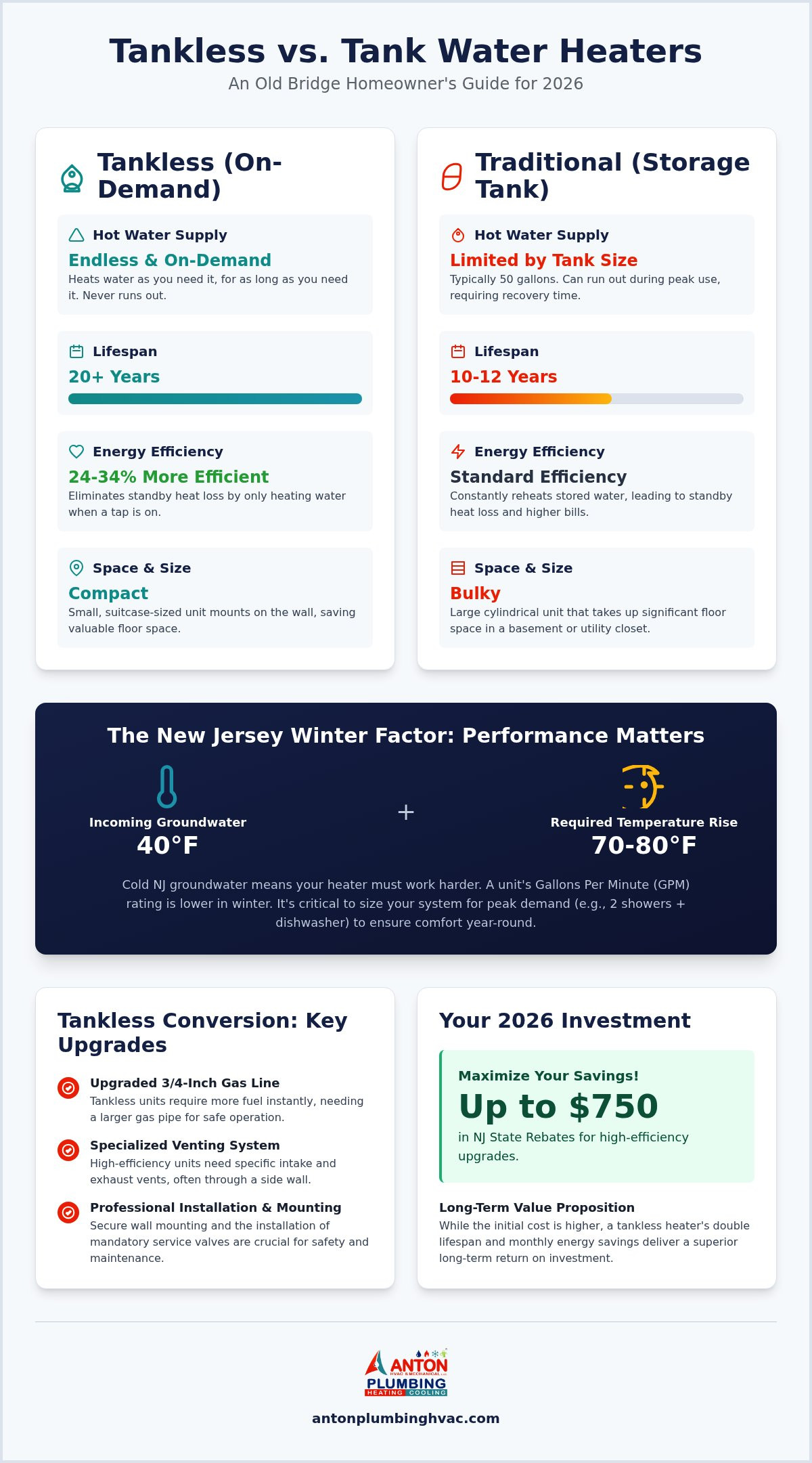
A tankless water heater is an on-demand system that provides hot water only when you need it. Traditional units keep 50 gallons of water hot 24/7, which leads to significant standby heat loss and higher utility bills. As you compare the physical profile of a tankless water heater vs tank Old Bridge residents will immediately notice the space savings. While a standard tank is a bulky cylinder that dominates a basement corner, a tankless unit is roughly the size of a carry-on suitcase and mounts directly to the wall. The heat exchanger is the critical component that flash-heats incoming cold water using gas or electricity as it travels through the internal copper or stainless steel piping.
The Mechanism: Flow Sensors and Heat Exchangers
The genius of this system lies in its sophisticated sensors. The unit remains completely dormant until a hot water tap is opened somewhere in your home. At that moment, a flow sensor detects the water movement and triggers the heating element or gas burner. This creates the “Endless Hot Water” effect; since the unit isn’t limited by a storage capacity, it keeps heating water as long as the faucet is open.
Understanding the engineering behind Tankless water heating helps clarify why these units are so reliable. You’ll generally choose between two types of heat exchangers:
- Non-Condensing: These units use a single heat exchanger and vent hot exhaust gases outside. They’re reliable but slightly less efficient than their counterparts.
- Condensing: These high-efficiency models include a secondary heat exchanger to capture heat from the exhaust. This makes them ideal for the cold NJ groundwater we experience during winter months.
Energy Efficiency Gains for NJ Homeowners
Energy efficiency is the primary driver for homeowners making the switch in 2026. For households using 41 gallons or less of hot water daily, tankless systems are 24% to 34% more energy efficient than storage tanks. This translates to direct savings on your monthly energy expenditures. Beyond the immediate bill reduction, the long-term value is undeniable. A traditional tank often requires replacement after 10 to 12 years due to sediment buildup and corrosion. In contrast, a well-maintained tankless unit offers an expected lifespan of 20 years or more. These units meet the rigorous 2026 NJ sustainability and building standards, ensuring your home remains compliant with modern energy codes while providing superior comfort.
Tank vs. Tankless: Performance and Lifestyle in Old Bridge
When you evaluate a tankless water heater vs tank Old Bridge families often start by looking at performance metrics. Traditional tanks rely on a “First Hour Rating,” which tells you how much hot water is available before the unit needs to recover. Once that 50-gallon reservoir is depleted, your family is stuck waiting. Tankless units operate on a “Gallons Per Minute” (GPM) basis. This means they provide a continuous stream of hot water that never runs out, regardless of how many people are in line for the shower. For a busy household in Central Jersey, this shift from “limited storage” to “unlimited flow” completely changes the morning routine.
You might have heard about the “cold water sandwich,” a brief lapse in temperature when a tap is turned off and on again. While this was an issue with early models, modern high-end units solve this with internal buffer tanks or recirculation pumps that maintain a steady temperature. Even though the initial installation cost is higher, the long-term ROI is compelling. A tankless system typically lasts 20 years, nearly double the lifespan of a traditional tank. This longevity, combined with lower monthly energy bills, makes it a strategic investment for homeowners planning to stay in their properties for the next decade.
GPM and the New Jersey Winter Factor
In Old Bridge, the incoming groundwater temperature drops significantly during the winter, often reaching 40 degrees. This “NJ Factor” is vital because your heater must work harder to raise that water to a comfortable 120 degrees. A unit that provides 7 GPM in a warmer climate might only deliver 4 GPM during a Jersey January. To protect your home’s comfort, you must calculate your peak demand. If you plan to run two showers (2.5 GPM each) and a dishwasher (1.0 GPM) simultaneously, you’ll need a unit capable of handling at least 6.0 GPM at a 70-degree temperature rise. We recommend sizing up to ensure your system never struggles when the temperature outside plunges.
Space-Saving Advantages for Local Homes
Reclaiming 10 to 15 square feet of floor space is a major win for homeowners with finished basements or limited utility closets. By moving the water heater from the floor to the wall, you open up room for storage or living space. Some NJ properties even benefit from exterior mounting options, though this requires specialized freeze protection. If you are currently planning a renovation, our guide on Water Heater Replacement in Old Bridge, NJ provides deeper insights into how these units integrate into modern home designs. If you’re unsure if your current utility room can accommodate a conversion, a quick professional assessment can clarify your options.
Critical Infrastructure Requirements for Tankless Installation
While the benefits of on-demand heat are clear, the transition involves technical upgrades that go beyond a simple swap. When comparing a tankless water heater vs tank Old Bridge homeowners must account for the infrastructure needed to support high-intensity heating. Traditional tanks heat water slowly over hours, while tankless units must heat it instantly. This requires significantly more power in a shorter window. Most older homes in our community feature a standard 1/2-inch gas line, but a tankless unit typically demands a 3/4-inch upgrade to supply enough fuel for the burner. You’ll also need a dedicated 120V electrical outlet nearby to power the sophisticated control boards and electronic ignition systems. As your Protective Expert, we verify these requirements during our initial assessment to ensure your home’s safety and the unit’s longevity.
Gas Load and NJ Utility Meter Considerations
Tankless units are rated by BTUs (British Thermal Units), and they can pull up to 199,000 BTUs at peak demand. This is a massive jump from the 40,000 BTUs required by a standard tank. Depending on the other gas appliances in your home, such as your furnace or kitchen range, your existing meter from PSE&G or NJNG might not be sufficient. “A professional load calculation ensures your gas system handles the tankless unit without starving other appliances.” If a meter upgrade is necessary, we guide you through the process of coordinating with your utility provider to ensure your home infrastructure remains robust and reliable.
Venting Standards and Indoor Air Quality
Traditional tanks often use atmospheric venting, where exhaust rises naturally through a chimney. High-efficiency tankless units utilize direct-vent technology, which uses a fan to pull in fresh outdoor air and push out exhaust through dedicated PVC or stainless steel pipes. This creates a sealed combustion system, preventing carbon monoxide from ever entering your living space. NJ building codes are strict about where these vents terminate. They must be specific distances from windows, doors, and air intakes to maintain indoor air quality for your family and your neighbors. Our licensed professionals ensure every installation meets these safety standards, protecting your household from potential exhaust hazards while maximizing system performance.
The Professional Tankless Installation Process
Choosing a tankless water heater vs tank Old Bridge residents must realize that the physical installation is where technical expertise translates into long-term safety. A professional conversion is a multi-stage process that requires both a NJ plumbing license and an HVACR license to handle the complex gas and venting requirements. We begin with the safe removal and eco-friendly disposal of your existing storage tank, ensuring it’s drained and transported according to local environmental standards. Once the space is cleared, we mount the new unit to a structural wall. This step is precise; the unit must be perfectly level to ensure the internal condensate drainage system functions correctly without causing internal corrosion.
Our technicians then retrofit your home’s infrastructure to meet 2026 NJ building codes. This includes the gas line upgrades and specialized venting discussed in previous sections. We don’t just connect pipes; we engineer a system designed for the specific flow requirements of your household. After the hardware is in place, we conduct a rigorous testing phase. This involves checking gas pressure with electronic manometers and performing a high-pressure water leak test. Finally, we provide a thorough homeowner orientation. We’ll show you how to navigate the digital control board, adjust temperature settings, and recognize when it’s time for routine maintenance.
The Role of Service Valves in Maintenance
One of the most critical components we install is the isolation valve kit. These specialized service valves allow our team to descale and flush your unit annually without needing to shut off the water supply to your entire house. In New Jersey, where mineral content in the water can vary, regular flushing is essential to prevent scale buildup on the heat exchanger. Many discount installers skip these valves to save on costs, but Anton Plumbing includes them as a standard feature. We believe in setting your home up for success from day one, ensuring your investment remains efficient for its full 20-year lifespan.
Safety Checks and Combustion Analysis
Safety is our primary mandate as your Protective Expert. We use advanced diagnostic technology to perform a full combustion analysis once the unit is live. This ensures the gas-to-air ratio is optimized for peak efficiency and that exhaust gases are being vented safely out of your home. We also verify that the sealed combustion system is maintaining proper pressure. This level of precision distinguishes a professional installation from a generic swap. If you ever have questions about your system’s performance after we leave, our Emergency Plumber Old Bridge NJ team is available 24/7 to provide immediate support. For a system that protects your family’s comfort and safety, schedule your professional tankless installation with our licensed experts today.
Maximizing Savings: NJ Rebates and Expert Selection
Deciding between a tankless water heater vs tank Old Bridge residents often prioritize the bottom line. While the initial investment for on-demand technology is higher, 2026 offers a unique window where state and federal incentives significantly offset these costs. You can currently secure a federal income tax credit of up to $600 under the Energy Efficient Home Improvement Credit. Locally, utility providers like NJNG and PSE&G are offering rebates of up to $750 for qualifying high-efficiency models. We encourage our neighbors to act now while these programs are at their peak, as they provide an immediate path to a more sustainable, cost-effective home.
Beyond standard utility offers, we provide an exclusive Anton Plumbing Zero-Interest Rebate program. This initiative is designed to lower the barrier to entry for local families, making high-efficiency upgrades accessible without the burden of high upfront interest. Our goal is to ensure every household in Old Bridge can enjoy the security of a reliable hot water system that doesn’t drain their bank account through wasteful standby energy loss. By combining these savings with our professional oversight, you’re making a choice that protects both your family’s comfort and your financial future.
Navigating New Jersey Clean Energy Incentives
To qualify for the most lucrative NJ rebates, your new system must meet specific performance benchmarks. For instance, PSE&G requires a Uniform Energy Factor (UEF) of 0.87 or greater. Navigating these technical requirements and the subsequent paperwork can be overwhelming for most homeowners. Our team handles the entire application process for you, ensuring every detail is correct so you receive your funds without delay. This synergy between your home upgrade and NJ’s broader efficiency goals ensures you contribute to a greener community while reaping direct financial rewards.
Why a Family-Owned Licensed Pro is Essential
A tankless conversion isn’t a simple “plug and play” job. It requires a deep understanding of both plumbing and HVACR systems. We hold state licenses in both disciplines, which is a rare qualification that ensures your gas lines, venting, and water connections are all handled by one accountable team. Big-box retailers often rely on anonymous subcontractors who lack our 28-year heritage and commitment to the Old Bridge, East Brunswick, and Jersey City communities. We don’t just finish a job and disappear; we act as your long-term maintenance partner, offering 24/7 emergency support to protect your domestic well-being.
Don’t settle for a system that leaves you in the cold or drives up your monthly bills. Schedule your tankless consultation with Anton Plumbing today and let our experts guide you through a safe, efficient, and cost-effective upgrade that will serve your home for decades to come.
Securing Your Household’s Comfort for the Next Decade
Choosing between a tankless water heater vs tank Old Bridge homeowners must decide based on long-term value and daily lifestyle needs. While traditional tanks offer familiarity, on-demand systems provide the security of endless hot water and significantly lower monthly energy expenditures. Success depends on navigating technical infrastructure requirements like gas line upgrades and specialized venting with a professional partner. You’ve seen how 2026 NJ state rebates and federal tax credits make this the ideal time to upgrade your home’s efficiency.
Anton Plumbing brings 28+ years of local NJ Plumbing and HVAC expertise to every project. We are fully licensed, bonded, and insured in New Jersey; this ensures your gas conversion meets every safety standard. Our exclusive zero-interest rebate program is available to help qualified NJ homeowners manage initial costs without financial stress. We take pride in acting as the guardian of your household infrastructure and domestic well-being.
Ready to reclaim your basement space and never run out of hot water again? Get a Free Estimate on Tankless Installation in Old Bridge today. Our team is ready to provide the professional, ethical service your family deserves.
Frequently Asked Questions
How long does a tankless water heater installation take in Old Bridge?
A standard tankless water heater installation in Old Bridge typically takes between one and two full business days. While a simple tank swap might take only a few hours, converting your home to on-demand heating requires infrastructure upgrades like larger gas lines and specialized venting. Our licensed professionals work efficiently to minimize downtime, ensuring your family has hot water restored as quickly as possible without compromising on safety or building code compliance.
Can I install a tankless water heater myself in New Jersey?
You shouldn’t attempt a DIY tankless installation in New Jersey because it involves complex gas line modifications and high-efficiency venting. Local building codes in Old Bridge require permits and inspections from licensed professionals to ensure the system is safe. We hold both NJ state Plumbing and HVACR licenses, which are essential for handling the gas, water, and electrical components of a conversion. Professional installation protects your home from gas leaks and improper combustion hazards.
Will a tankless water heater really save me money on NJ utility bills?
Yes, switching to on-demand heating can reduce your energy expenditures significantly. Since these units eliminate standby heat loss by only heating water when a tap is opened, they are often 24% to 34% more energy efficient than traditional tanks. When comparing a tankless water heater vs tank Old Bridge homeowners find that these monthly savings, combined with a 20-year lifespan, offer a much stronger return on investment despite the higher initial installation cost.
Does a tankless water heater provide instant hot water at the tap?
A tankless unit provides endless hot water, but it isn’t always instant at the faucet. The water still needs to travel from the unit through your pipes to the tap. However, modern high-efficiency models can be paired with recirculation pumps to provide hot water almost immediately. This eliminates the cold water sandwich and ensures that once the hot water arrives, it never runs out, no matter how many people in your household need to shower.
What kind of maintenance does a tankless water heater require?
Tankless systems require an annual descaling and flushing to remove mineral deposits from the heat exchanger. This is especially important in parts of New Jersey where hard water can lead to scale buildup that reduces efficiency. We install dedicated service valves as a standard feature, allowing our technicians to clean the system without disrupting your home’s entire water supply. Regular maintenance is the key to ensuring your unit reaches its full 20-year expected lifespan.
Can I switch from an electric tank to a gas tankless unit?
Yes, you can convert from an electric tank to a gas tankless unit, though it requires significant infrastructure changes. Our team must install a new gas line and a dedicated venting system to meet NJ safety standards. This conversion is often highly beneficial for Old Bridge families looking for lower monthly utility costs and better performance. We’ll assess your home’s current gas load to ensure your meter can handle the increased BTU demand.
What is the lifespan of a tankless water heater vs. a traditional tank?
A tankless water heater typically lasts 20 years or more, while a traditional storage tank usually requires replacement after 10 to 15 years. This longevity is a primary reason why many local families choose a tankless water heater vs tank Old Bridge installations are often viewed as a permanent home improvement. Because parts are easily replaceable on tankless units, they can often be repaired rather than replaced, further extending their total service life.
Are there specific NJ rebates for tankless water heaters in 2026?
In 2026, New Jersey homeowners can access several financial incentives for high-efficiency upgrades. Utility providers like NJNG and PSE&G offer rebates of up to $750 for units with a Uniform Energy Factor of 0.87 or higher. Additionally, federal tax credits can provide up to $600 in savings. Our team manages the complex paperwork for the NJ Clean Energy Program to ensure our customers receive every dollar they are entitled to for their installation.


