
What if the small puddle under your air conditioner is actually a sign that your cooling system is becoming obsolete? On a humid July afternoon in New Jersey, the last thing you want to deal with is an ice-covered coil or a system that just won’t blow cold air. You know a service call is necessary, but the fear of an unpredictable AC refrigerant leak repair cost in Old Bridge can be just as stifling as the heat itself. It’s completely normal to feel stressed when you’re caught between an expensive emergency and the complex new EPA regulations governing home cooling.
We believe every homeowner deserves a cooling system that provides peace of mind, not just a temporary fix. This 2026 guide is designed to remove the guesswork by explaining the specific factors that drive repair expenses, including the major differences between R-410A and the newer R-32 refrigerants. You’ll learn how to evaluate the long-term value of a repair versus a system replacement. We’ll also highlight how modern high-efficiency upgrades can help you avoid future leaks while taking advantage of current New Jersey state rebate programs to protect your household budget.
Key Takeaways
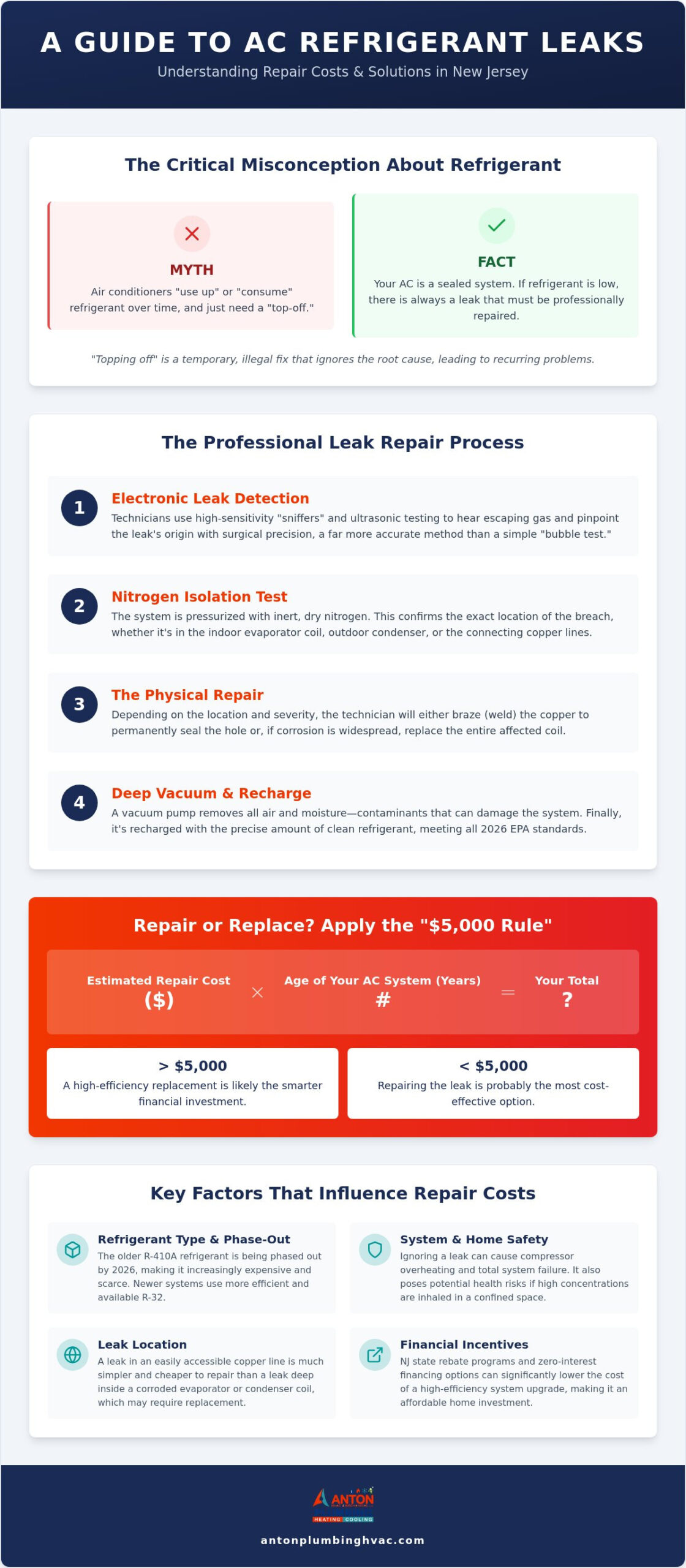
- Learn why “topping off” is a temporary and illegal fix, and discover how advanced ultrasonic testing pinpoints leaks with surgical precision.
- Understand the specific variables affecting your AC refrigerant leak repair cost Old Bridge, including how the 2026 R-410A phase-out impacts local pricing.
- Apply the “$5,000 Rule” to determine if your aging system is worth fixing or if a high-efficiency upgrade is the smarter financial move.
- Explore NJ state rebate programs and zero-interest options that can turn a stressful repair into an affordable home comfort investment.
- See why working with a dual-licensed NJ professional ensures your system is fixed right the first time, preventing recurring leaks and high utility bills.
Understanding AC Refrigerant Leaks in Old Bridge Homes
A common misconception among Middlesex County residents is that air conditioners “use up” refrigerant like a car consumes gasoline. In reality, your AC is a sealed system designed to circulate the same chemical charge for its entire lifespan. Much like how specialized vehicles require expert care from a shop like Euro Performance Auto Shop LLC to maintain their peak efficiency, your home’s cooling system needs professional attention when its sealed integrity is compromised. If your refrigerant level is low, you have a leak. Simply adding more gas, often called “topping off,” is an ineffective and illegal practice that ignores the underlying hole in your coils. This approach only leads to recurring service calls and a higher total AC refrigerant leak repair cost Old Bridge families shouldn’t have to bear.
Old Bridge homes are particularly susceptible to refrigerant issues due to our unique New Jersey climate. The high summer humidity and proximity to coastal air can accelerate formicary corrosion. This is a specific type of microscopic pitting that occurs on copper evaporator coils. Over time, these tiny holes allow gas to escape, forcing your system to work harder while providing less cooling. You’ll likely notice the signs through hissing sounds near the air handler, ice forming on the outdoor copper lines, or a sudden, unexplained spike in your monthly PSEG bills.
Why Your AC is Blowing Warm Air
Refrigerant serves as the lifeblood of your cooling system, acting as a heat transfer medium rather than a fuel source. When levels drop, the heat exchange process breaks down. You might notice your vents blowing lukewarm air even while the outdoor unit is humming loudly. While a mechanical failure like a blown capacitor can cause similar symptoms, a low charge is a frequent culprit. Our team utilizes advanced water leak detection techniques adapted for HVAC systems to find these hidden breaches quickly and accurately.
The Health and Safety Risk of Leaks
Ignoring a leak does more than just raise your utility costs; it creates significant safety hazards for your household. Modern systems use different types of refrigerants that, while safer for the ozone than older chemicals, can still be toxic if inhaled in high concentrations within a confined space. Beyond indoor air quality, a leak causes the compressor to overheat. Without the proper amount of refrigerant to cool the motor, the compressor will eventually seize, leading to a total system failure. Shut off your AC immediately if you see ice on the coils or hear a persistent bubbling sound. Continuing to run a leaking system is the fastest way to turn a manageable repair into a complete equipment replacement.
The Professional Leak Repair Process: Beyond the ‘Freon’ Top-Off
Fixing a refrigerant leak is a multi-stage technical procedure that requires precision and specialized tools. It’s far more involved than simply adding gas to the system. A professional repair ensures your home stays cool without the risk of the leak returning next month. This process is essential for managing the long-term AC refrigerant leak repair cost Old Bridge homeowners face, as doing it right the first time prevents repeated service calls and premature equipment failure.
The repair follows a rigorous four-step protocol to restore system integrity:
- Step 1: Electronic Leak Detection. Technicians use high-sensitivity sensors to sniff out chemical traces. Ultrasonic testing may also be used to hear the high-frequency sound of escaping gas.
- Step 2: Nitrogen Isolation Test. Once a potential leak is found, the system is pressurized with dry nitrogen. This confirms the exact location, whether it’s in the evaporator coil, the condenser, or the copper line set.
- Step 3: The Physical Repair. Depending on the location, we either braze the copper lines to seal the breach or replace the entire coil if the corrosion is too widespread for a patch.
- Step 4: Deep Vacuum and Recharge. We use a vacuum pump to remove all air and moisture from the lines. Finally, the system is recharged with fresh refrigerant according to 2026 EPA standards.
Advanced Diagnostic Technology
Precision is the hallmark of a professional repair. We apply the same high-tech sensor technology used for underground water leak detection to our HVAC diagnostics. While some contractors still rely on a simple “bubble test” with soapy water, this is rarely enough for modern high-pressure systems. Our NATE-certified technicians use electronic sniffers that can detect leaks as small as 0.1 ounces per year. This accuracy ensures we don’t miss a secondary leak that could sabotage your repair.
Recharging the System
Once the system is sealed, it must be recharged using the “weighing in” method. This involves using a digital scale to add the exact amount of refrigerant specified by the manufacturer. If a system is even slightly overcharged or undercharged, it can lead to 20% higher energy consumption and increased wear on the compressor. During this phase, we also replace the filter drier. This component acts as a guardian, capturing any microscopic debris or moisture that could have entered the circuit while it was open. If you suspect your system is losing its cooling power, reach out for a professional diagnostic before a small leak turns into a major breakdown. This is especially critical for older units, as the government is still actively phasing out R-22 and other older refrigerants, making them increasingly difficult and expensive to source.
Factors Influencing AC Refrigerant Leak Repair Cost in NJ
Determining the total AC refrigerant leak repair cost Old Bridge homeowners can expect depends on several variables beyond a simple hourly rate. Every home in Middlesex County presents a unique set of circumstances, from the age of the cooling unit to the specific location of the breach within the system. While some repairs involve a simple fix on a loose fitting, others require extensive labor to access and replace vital components. Understanding these cost drivers helps you avoid “sticker shock” when a professional technician provides an estimate.
The first major factor is the balance between diagnostic fees and actual repair labor. A professional leak search is a specialized service that utilizes electronic “sniffers” or nitrogen isolation tests to find microscopic holes. This initial investment ensures that the repair is targeted and effective, preventing you from paying for refrigerant that will simply leak out again. Once the leak is identified, the labor cost shifts to the physical repair, which varies significantly based on complexity. For instance, fixing a leak on an accessible outdoor line set is a straightforward task, whereas replacing an evaporator coil buried deep within a furnace cabinet requires several hours of precision work.
The “Refrigerant Tax” is another critical element in 2026. As the EPA continues to tighten regulations on high-GWP (Global Warming Potential) chemicals, the supply of older refrigerants has decreased. This supply-and-demand shift has caused AC leak repair costs to rise, particularly for systems that rely on phased-out materials. Beyond the parts and labor, New Jersey residents must also account for state-mandated disposal fees for any recovered refrigerant, ensuring that these chemicals are handled in an environmentally responsible manner.
Refrigerant Types and 2026 Pricing
The type of chemical your system uses is perhaps the biggest price differentiator. If you own an older “Freon” unit, you’ll find that R-22 is now priced as a rare commodity, often costing between $90 and $200 per pound from reclaimed supplies. In contrast, R-410A remains more accessible but is currently seeing its own price spikes as the industry transitions to newer A2L refrigerants like R-32 and R-454B. While these modern chemicals are more environmentally friendly, they are only compatible with newer equipment designed to handle their specific pressure and safety requirements.
Accessibility and Parts Availability
Your home’s layout also plays a role in the final bill. Units located in tight crawlspaces or finished attics require more time to service, which naturally increases labor hours. Additionally, supply chain factors for major brands like Carrier or Lennox can influence the price and lead time for OEM (Original Equipment Manufacturer) parts. While universal replacement parts are sometimes an option, we typically recommend OEM components to maintain your system’s original efficiency ratings and warranty protections. This commitment to quality ensures your system doesn’t just work for the rest of the summer, but for years to come.
Repair vs. Replace: When Is a Leak the Final Straw?
Faced with a significant repair bill, many homeowners feel paralyzed by the decision to fix their current unit or invest in a new one. This choice becomes even more complex when you consider the rising AC refrigerant leak repair cost Old Bridge residents are seeing in 2026. To simplify this choice, we recommend using the “5,000 Rule.” Multiply the age of your air conditioner by the total estimated repair cost. If the resulting number exceeds $5,000, a replacement is typically the more responsible financial path. For example, a $600 repair on an 8-year-old system equals $4,800, making a repair a viable option. However, that same repair on a 12-year-old unit totals $7,200, signaling that it’s time for an upgrade.
Before making a final decision, always verify your current warranty status. Many manufacturers provide a 10-year parts warranty on compressors and evaporator coils. If your system is still covered, your out-of-pocket expenses might only include labor and the cost of new refrigerant. If your warranty has expired, you’re responsible for the full cost of specialized parts that are becoming increasingly difficult to source for older models. Transitioning to a high efficiency HVAC system eliminates these legacy costs and provides you with a fresh 10-year protection plan.
Benefits of Upgrading in 2026
Modern cooling technology has advanced significantly, especially regarding SEER2 efficiency standards. A new installation offers more than just cold air; it provides superior dehumidification, which is essential for surviving a humid New Jersey summer. Variable-speed compressors allow the system to ramp up or down based on the actual cooling demand, preventing the constant on-and-off cycling that wears out older units. You’ll notice the difference immediately through lower monthly utility bills and a much quieter outdoor environment. If your current unit is struggling to keep up, consult with a licensed expert to see if a replacement makes more sense for your family’s comfort.
NJ State Rebates and Financing
The upfront cost of a new system is often the biggest hurdle for local families. Fortunately, we can help you take advantage of the Rebate program zero interest options available in 2026. New Jersey state programs, along with utility-specific rebates from PSEG or NJNG, can provide thousands of dollars in savings for high-efficiency upgrades. We handle the complex paperwork and technical documentation required to ensure you receive every available credit. These financial incentives, combined with federal tax credits, often make a new, leak-free system more affordable than a series of expensive repairs on an obsolete unit.
Why Choose Anton for AC Leak Repair in Old Bridge?
Trusting a contractor with your home’s cooling infrastructure is a significant decision. For over 28 years, our family-operated team has served as the protective experts for Middlesex County. We hold both NJ State Plumbing and HVACR licenses, ensuring that every technician who enters your home possesses the highest level of technical credentials. This dual expertise allows us to view your home as a complete system, providing a level of domestic security that a standard repair shop simply can’t match. We don’t just fix parts; we protect the families we serve.
When your cooling fails during a brutal New Jersey heatwave, you need immediate relief. Refrigerant leaks don’t follow a 9-to-5 schedule, which is why we offer 24/7 emergency availability. We understand the high-stakes urgency of a home that’s reaching dangerous temperatures inside. Our goal is to restore your comfort with steady professionalism. We provide an honest assessment of your AC refrigerant leak repair cost Old Bridge, giving you the facts you need to make a safe, ethical choice for your household budget.
This commitment to rapid response is shared by Legacy Home Comfort, which specializes in emergency HVAC repairs and comprehensive system diagnostics to ensure residential systems are restored quickly and safely.
Our Local Old Bridge Reputation
Our commitment to the community extends from the heart of Old Bridge to our neighbors in East Brunswick and Jersey City. We’ve built our reputation on steady professionalism and clear communication. If your system suffers a catastrophic failure that makes a repair financially unwise, we offer Same Day HVAC Replacement to restore your home’s safety immediately. We treat every household as if it were our own, prioritizing long-term reliability over quick, temporary fixes.
To learn more about the standards of professional care expected from residential HVAC specialists, check out Caribbean Heating & Cooling.
Transparent, No-Surprise Pricing
We eliminate the fear of “surprise” HVAC bills through a transparent, upfront diagnostic process. Before any repair begins, we provide a clear breakdown of the work required and the associated costs. To help manage the investment of a major system fix or upgrade, we offer flexible payment plans and a zero-interest rebate program. This ensures that essential home infrastructure repairs remain accessible to every family in our service area. Schedule your AC leak diagnostic with Anton today and experience the peace of mind that comes with professional, local expertise.
Secure Your Home Comfort for the 2026 Season
You shouldn’t have to guess when it comes to your family’s domestic well-being. Understanding the specific factors that influence the AC refrigerant leak repair cost Old Bridge homeowners pay is the first step toward a cooler, more efficient home. Whether you’re applying the “5,000 Rule” to evaluate an older unit or navigating the complex 2026 EPA standards for new refrigerants, having a clear plan prevents emergency stress and financial surprises. A small leak today doesn’t have to become a total system failure tomorrow if you act with precision and expert guidance.
Our team brings over 28 years of local experience and dual NJ state licensing in both HVACR and plumbing to every service call. We specialize in finding permanent solutions rather than temporary patches that fail when the humidity peaks. If a high-efficiency replacement is the safer choice for your budget, we’ll help you navigate zero-interest rebate programs to make the transition seamless and affordable. Get a Professional AC Leak Diagnostic in Old Bridge today to protect your household from the rising summer heat. You deserve a cooling system that works perfectly every time you flip the switch, providing the security and relief your family needs.
Frequently Asked Questions
How much does a typical AC refrigerant leak repair cost in Old Bridge?
The total AC refrigerant leak repair cost Old Bridge homeowners encounter depends on the leak location and the amount of gas lost. While industry averages for finding, fixing, and recharging a system often fall between $250 and $1,600, complex issues like evaporator coil replacements can reach higher ranges. A professional diagnostic call typically costs between $75 and $150 to pinpoint the breach accurately before any work begins.
Is it worth fixing a refrigerant leak in a 10-year-old AC unit?
Deciding to fix a 10-year-old unit depends on the cost of the repair and the type of refrigerant it uses. If the unit uses R-22, which now costs $90 to $200 per pound from reclaimed supplies, replacement is almost always the smarter financial choice. For R-410A systems, use the “5,000 Rule” mentioned earlier; if the age multiplied by the repair estimate exceeds 5,000, you should invest in a modern, high-efficiency system instead.
Can I just add more refrigerant to my AC without fixing the leak?
No, you cannot simply add more refrigerant because “topping off” a leaking system is both illegal under EPA regulations and an ineffective waste of money. Since air conditioners are sealed systems, a low charge proves there’s a hole that must be sealed. Adding gas without a repair ensures the chemical will simply leak out again, potentially damaging your compressor and harming the environment in the process.
How long does it take to find and fix an AC refrigerant leak?
Most professional leak repairs take between three and five hours to complete once the technician is on-site. This timeframe includes the specialized steps for electronic detection, a nitrogen isolation test to confirm the location, the physical repair or part replacement, and the final vacuum and recharge process. More complex leaks in inaccessible areas like finished attics or tight crawlspaces may require additional labor time to resolve safely.
What are the signs that my AC is leaking refrigerant?
Common signs of a leak include lukewarm air coming from your vents, hissing or bubbling noises near the indoor unit, and a sudden increase in your monthly utility bills. You might also see ice forming on the copper refrigerant lines or the evaporator coil. If your system is running constantly but the temperature in your home isn’t dropping, a low refrigerant charge is a likely culprit that requires immediate professional attention.
Are AC refrigerant leaks dangerous to breathe?
Refrigerant is heavier than air and can be dangerous if it leaks into a confined space because it displaces oxygen. While small leaks in well-ventilated areas are less likely to cause immediate harm, high concentrations can cause dizziness, headaches, or more severe respiratory issues. If you suspect a major leak, shut off the system and open windows to clear the air while waiting for a licensed technician to arrive and secure the system.
Does homeowner’s insurance cover AC refrigerant leak repairs?
Homeowner’s insurance rarely covers an AC refrigerant leak repair cost Old Bridge families face because these issues are typically classified as normal wear and tear. However, if the leak was caused by a specific “covered peril” such as a fallen tree limb during a storm or vandalism, you might be able to file a successful claim. Always check your specific policy details or consult with your insurance agent to confirm your coverage limits for HVAC failures.
What is the difference between R-410A and the new refrigerants used in 2026?
The primary difference is their environmental impact, measured by Global Warming Potential (GWP). R-410A has a high GWP of 2,088, while the newer 2026 standards favor refrigerants like R-32 (GWP 675) or R-454B (GWP 466). These new “A2L” refrigerants are more efficient and environmentally friendly, but they require modern equipment specifically designed with safety features like leak sensors and automatic shutoffs to handle their different operating pressures.


