
Is your air conditioner actually broken, or is it just another victim of a record-breaking Garden State heatwave? It’s exhausting to toss and turn through a humid night while your PSEG or NJNG bill climbs, yet you still find your AC not cooling house in NJ summer conditions. You deserve a home that feels like a sanctuary, not a sauna, especially when electricity rates are projected to hit 18.9¢/kWh by the end of 2025. Many homeowners fear being scammed by emergency contractors during a crisis, but you simply need a reliable environment for your family and a professional you can trust.
This guide will help you discover the exact reasons your home isn’t staying cool and show you how to fix these issues before the next heatwave hits. We believe in providing an honest diagnosis so you can enjoy lower energy bills and a consistent 72-degree interior. We will examine how the R-410A refrigerant phase-out impacts your current unit, why humidity is the real enemy in Climate Zone 4A, and the specific maintenance gaps that lead to total system failures during a New Jersey peak summer.
Key Takeaways
- Learn the “20-Degree Rule” to determine if your system is actually failing or simply hitting its physical cooling limit during an extreme heatwave.
- Use our 5-point DIY checklist to troubleshoot common issues like dirty filters and thermostat ghost readings before you spend money on a technician.
- Pinpoint why your AC not cooling house in NJ summer might be due to a failing capacitor or low refrigerant rather than a total system collapse.
- Discover how New Jersey’s unique humidity levels impact “latent heat,” making your home feel warmer even when the thermometer says otherwise.
- Identify the specific warning signs that signal it is time to stop DIY attempts and bring in a local expert to save your compressor.
NJ Summer Cooling Physics: Is Your AC Struggling or Truly Broken?
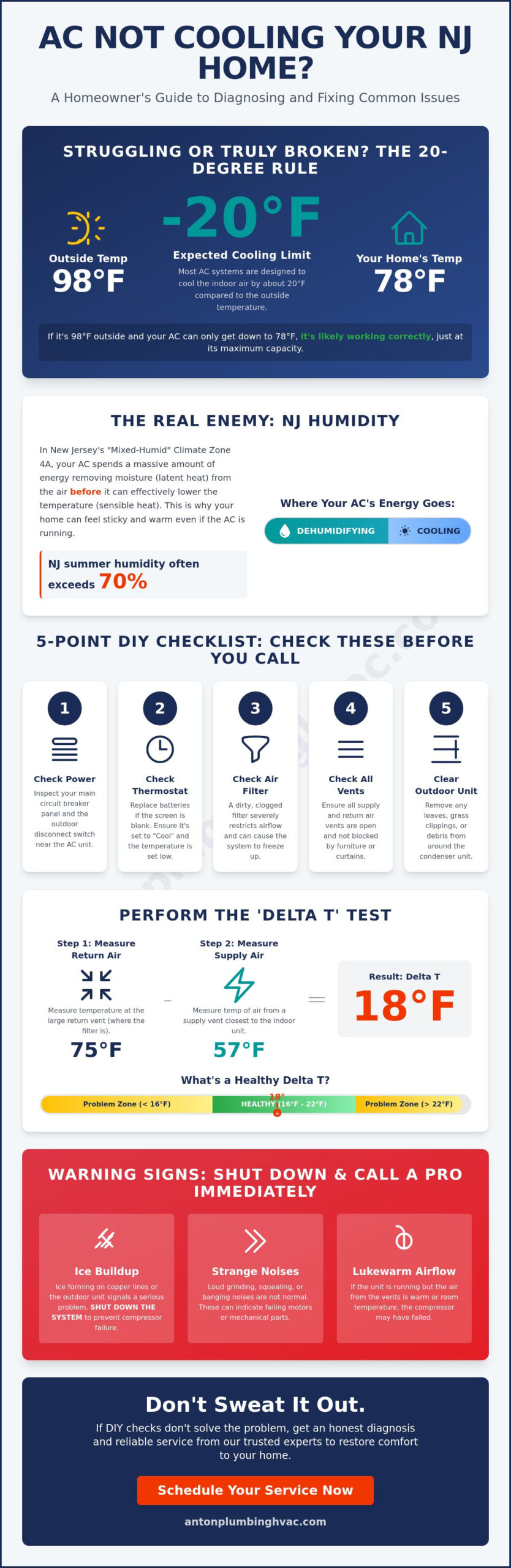
New Jersey summers have changed. With local electricity rates projected to reach 18.9¢/kWh by the end of 2025, every minute your system runs matters. When you notice your AC not cooling house in NJ summer conditions, your first instinct might be panic. However, your equipment might be fighting a losing battle against physics rather than suffering a mechanical failure. Most central air systems are designed to create a 20-degree difference between the outdoor temperature and your indoor air. If it is a 98-degree afternoon in Old Bridge, your unit is doing its job perfectly even if the thermostat won’t budge past 78 degrees.
Humidity is the silent factor that makes our “mixed-humid” Climate Zone 4A so difficult to manage. In New Jersey, relative humidity often exceeds 70% during July and August. Your air conditioner must act as a massive dehumidifier before it can effectively lower the temperature. It spends a massive amount of energy pulling gallons of water out of the air. To understand the technical side of how air conditioning works, you have to look at the heat exchange process. If the air is too wet, the heat exchange is less efficient, leaving you feeling sticky even if the vents are blowing air.
Recent regulatory shifts also play a role in how your home feels. As of January 1, 2026, the R-410A refrigerant phase-out is in full effect, and new systems in New Jersey must meet a minimum 13.4 SEER2 efficiency rating. If your unit is over a decade old, it likely lacks the cooling capacity to handle the increasingly frequent 90-degree streaks we now experience. You may find your AC not cooling house in NJ summer as effectively as it did five years ago simply because the components are nearing the end of their functional lifespan.
The ‘Delta T’ Explained for NJ Homeowners
You can diagnose your system’s health with a simple kitchen thermometer by measuring the “Delta T.” Delta T is the temperature difference between the air entering your return vent and the air exiting your supply registers. To get an accurate reading, follow these steps:
- Measure the air temperature at the large return intake where your filter lives.
- Measure the temperature of the air coming directly out of a vent closest to the unit.
- Subtract the supply number from the return number.
A healthy system should show a 16 to 22-degree difference. If your reading is below 16 degrees, your system is likely struggling with a mechanical issue. If it is within that range but your house is still warm, the heat load on your home is simply higher than the system can handle.
Normal Operation vs. Red Flags
It is perfectly normal for your AC to run 24/7 during a heatwave. This is often more efficient than letting the house heat up and trying to “recover” the temperature later. However, there are definitive signs of a crisis. If you see ice forming on the copper lines or the outdoor unit, shut the system down immediately. Running an iced-over system can destroy your compressor. Similarly, if the air coming from your vents is lukewarm while the outdoor fan is spinning, your compressor may have timed out or failed. These are the moments when professional intervention is necessary to prevent a total system replacement.
Immediate DIY Checklist: 5 Things to Check Before Calling a Tech
Before you commit to a service call, perform a quick sweep of your home. Sometimes the reason for your AC not cooling house in NJ summer is a simple maintenance oversight rather than a mechanical failure. These five checks can often restore your comfort in minutes without the need for professional tools. Start by verifying that your system actually has power. Check your main electrical panel and the outdoor disconnect switch near the condenser unit. A local power surge during a North Jersey thunderstorm can easily trip a breaker, leaving your system silent while you sweat indoors.
Next, examine your thermostat. If the screen is blank or flashing, replace the batteries immediately. Low voltage can cause “ghost readings” where the device appears to be working but fails to send a strong signal to the outdoor unit. You should also ensure that every supply register and return vent in your home is wide open. Many homeowners believe the myth that closing vents in unused rooms saves money. In reality, this practice increases internal duct pressure and can lead to a variety of Common Air Conditioner Problems, including a blown blower motor or frozen coils.
The Air Filter Deep Dive
A clogged air filter is the number one cause of “frozen” systems in Middlesex County. When air cannot flow freely over the evaporator coil, the refrigerant temperature drops too low, turning humidity into a solid block of ice. While high-MERV filters are excellent for allergies, they can be too restrictive for older HVAC units, effectively suffocating the system. During the peak of a humid NJ July, you should change your filter every 30 days instead of the standard 90 day recommendation. If you see your filter has “collapsed” or bowed inward, your blower is working too hard and needs immediate relief.
Outdoor Unit Triage
Your outdoor condenser needs a two-foot “breathing zone” to shed heat effectively. Clear away any tall grass, weeds, or stored items that have crowded the unit over the spring. You can safely use a garden hose on a low-pressure setting to rinse away grass clippings and “Jersey dust” from the metal fins. Never use a power washer, as the high pressure will flatten the delicate fins and ruin your heat exchange capacity. Additionally, check for signs of corrosion at the base. In suburban NJ neighborhoods, acidic dog urine is a frequent but overlooked cause of coil damage that eventually leads to your AC not cooling house in NJ summer effectively.
If these basic steps don’t bring the temperature down, you may be facing a deeper electrical or refrigerant issue. For a professional diagnosis that gets your home back to 72 degrees, you can schedule a precision inspection with a local expert who understands the specific demands of our climate.
The Technical Culprits: Why Your Central Air Isn’t Cooling
If you have cleared the debris and swapped the filter but still find your AC not cooling house in NJ summer, the issue likely sits within the technical components of your system. High-cycle environments like a central Jersey July put immense strain on electrical and mechanical parts. When these parts fail, the system might stay on but lose its ability to move heat effectively. Following the U.S. Department of Energy maintenance guidelines can prevent many of these failures, but once a component like a capacitor or contactor reaches its limit, professional replacement is the only path forward.
Electrical Failures in the Heat
NJ heatwaves often lead to “brownouts” or subtle voltage drops as the grid struggles to keep up with demand. These fluctuations are lethal to your system’s electrical heart. An HVAC capacitor acts like a high-voltage battery to jumpstart the compressor and fan motors. If this part fails, you might hear a faint humming sound while the outdoor fan remains stationary. Similarly, the contactor acts as a bridge for electricity. Over time, the high heat causes “pitting” or carbon buildup on the contact points. This prevents the unit from starting even if the thermostat is calling for cooling.
Refrigerant Leaks and the R-410A Phase-out
As of January 1, 2026, the manufacturing and import of new equipment using R-410A refrigerant is banned in the United States. This regulatory shift means that “topping off” an old system is becoming increasingly expensive as supplies decrease. If you find your AC not cooling house in NJ summer, look for oily residue around the copper line connections. This is a tell-tale sign of a refrigerant leak. Since air conditioners are closed systems, they don’t consume refrigerant like a car consumes gas. A low level always indicates a leak that must be sealed. Simply recharging the system without a leak test is a temporary band-aid that wastes money as the gas eventually escapes again.
Finally, consider the condensate line and evaporator coils. In our humid climate, your AC pulls gallons of water from the air every day. If the drain line clogs with algae or sediment, a safety float switch will cut power to the entire system to prevent a flood in your basement. If your unit suddenly goes dead on a humid afternoon, a clogged drain is a highly likely culprit. Additionally, while it sounds counterintuitive, ice can form on your evaporator coils even when it is 90 degrees outside. This paradox occurs when airflow is restricted or refrigerant is low, causing the coil temperature to drop below freezing and turn moisture into a solid block of ice.
The NJ Humidity Factor: Why It Feels Like Your AC is Failing
In New Jersey’s mixed-humid climate, your air conditioner has two distinct jobs: lowering the temperature and removing moisture. If you experience your AC not cooling house in NJ summer effectively, you’re likely feeling the effects of “latent heat.” This is the heat energy held by water vapor in the air. While “sensible heat” is what your thermostat measures, latent heat is what makes your skin feel sticky and uncomfortable. Your system’s evaporator coil, often called the A-coil, must stay cold enough to condense this moisture into liquid water. However, local environmental factors like cottonwood seeds or coastal salt air can coat your outdoor condenser. This reduces its ability to shed heat, which in turn prevents the indoor A-coil from reaching the temperatures necessary for effective dehumidification.
Many older homes in neighborhoods like Edison or Woodbridge suffer from oversized AC units. While a larger unit sounds like a benefit, it often leads to a problem called “short-cycling.” A system that is too powerful for the square footage will cool the air to the target temperature very quickly and then shut off. It doesn’t run long enough to pull those gallons of water out of the air. This leaves you with a house that is technically 72 degrees but feels like a swamp. A properly sized unit should run in longer, steady cycles to balance both temperature and humidity levels for true domestic well-being.
Managing Indoor Humidity Levels
You should aim for an indoor humidity range between 45% and 55%. This is the “sweet spot” that prevents mold growth while keeping your family comfortable. If your home feels clammy, a technician can often adjust your blower motor to a slightly slower fan speed. This adjustment allows the humid air to spend more time in contact with the cold evaporator coil, which maximizes the amount of moisture removed during each cycle. Integrating a whole-home dehumidifier into your hvac repair east brunswick strategy ensures your system handles the heavy NJ moisture load even on days when the temperature isn’t at its peak.
Ductwork Integrity
Your ductwork is the delivery system for your comfort, but it’s often the weakest link in NJ basements and attics. Disconnected joints or crushed flex-ducts mean you’re paying high PSEG or NJNG bills to cool your crawlspace while your bedroom remains warm. Even worse, leaky return ducts can create a “negative pressure” effect. This literally sucks hot, humid air from your attic or the outdoors directly into your living space through wall cavities and light fixtures. Sealing these leaks is frequently just as effective as upgrading to a new high-efficiency unit. If your house feels like a sauna despite a running AC, you need an expert who looks beyond the mechanical unit to the infrastructure behind your walls. You can request a comprehensive duct and humidity analysis to stop wasting money on ineffective cooling.
Professional HVAC Solutions: Restoring Comfort to Your NJ Home
When you have exhausted the DIY checklist and still find your AC not cooling house in NJ summer, you have reached the “point of no return.” Continuing to run a struggling system risks catastrophic compressor failure, which is the most expensive component to replace. At Anton Plumbing Heating & Cooling, we act as the guardians of your household comfort. We combine decades of local heritage with modern efficiency to provide an honest diagnosis that stops the cycle of high bills and sleepless nights. Our neighborly approach ensures you receive the technical excellence of a seasoned veteran without the fear of being scammed by “emergency” contractors.
The Anton Professional Diagnostic
Our technicians don’t rely on guesswork. The Anton Professional Diagnostic uses digital manifold gauges and thermal imaging to pinpoint refrigerant leaks and electrical weaknesses faster than traditional methods. If your cooling failure is linked to a backed-up condensate line or a failed secondary drain, we also provide emergency plumber Old Bridge NJ services to prevent water damage to your home infrastructure. We value clarity, which is why we provide transparent pricing for our Middlesex County neighbors before any work begins. This commitment to ethical standards ensures you know exactly what to expect regarding your domestic well-being.
Preventative care is the most effective way to save your system from the scrap heap. Our 21-point AC tune-up is a comprehensive health check that includes cleaning coils, testing capacitors, and verifying refrigerant levels. This proactive approach is essential given the 2026 transition away from R-410A. As supplies of older refrigerants tighten and costs rise, maintaining your current unit’s integrity becomes a financial necessity. A well-maintained system runs shorter, more efficient cycles, which is the only way to keep your house at a steady 72 degrees when NJ humidity peaks. This principle of preventative care is universal; for example, in the intense humidity of Southwest Florida, Ultra Air Heating and Cooling emphasizes similar proactive maintenance to ensure peak performance.
Planning for the Future: Repair vs. Replace
If your system is more than 12 years old, you should consider the “50% rule.” If the cost of a repair exceeds half the value of the unit, a new air conditioning jersey installation is often the smarter long-term investment. Modern units must now meet a minimum 13.4 SEER2 efficiency rating in New Jersey. These high-efficiency systems often qualify for significant rebates through the NJ Clean Energy Program or local utilities like PSEG and NJNG. These programs are designed to offset the initial cost of upgrading to environmentally friendly equipment that uses R-454B or R-32 refrigerants.
For homes with specific “hot zones” or older NJ colonials with poor upstairs airflow, we also specialize in ductless mini-split system installation. These systems provide targeted relief and high-tech accuracy without the need for invasive ductwork. Whether you need a precision repair or a full system modernization, our local expertise ensures your equipment is sized perfectly for the unique demands of the Jersey shore and inland corridors. Don’t wait for the next record-breaking heatwave to discover your AC not cooling house in NJ summer. Schedule your priority service now and restore the cool, secure environment your family deserves.
Take Control of Your Home Comfort Today
Understanding the physics behind the 20-degree rule and the heavy impact of New Jersey humidity is the first step toward a cooler home. Identifying technical failures early prevents the high cost of a total compressor failure and keeps your energy bills manageable. If you find your AC not cooling house in NJ summer despite your best DIY efforts, it’s time to move beyond guesswork. Our team brings over 28 years of service in NJ to every diagnostic call, acting as licensed and insured protective experts for your household infrastructure.
We provide 24/7 emergency availability for Old Bridge and the surrounding areas to ensure you are never left in a crisis. Our technical confidence and transparent approach take the stress out of complex HVAC repairs. It’s time to stop the cycle of high energy bills and restore your home to a steady, comfortable 72 degrees. Schedule Your AC Diagnostic with Anton Plumbing Heating & Cooling Today and experience the immediate relief of a professionally maintained system. You deserve a sanctuary that remains cool and dry regardless of how high the temperature climbs outside.
Frequently Asked Questions
Is it normal for my AC to run all day when it’s 95 degrees in NJ?
Yes, it’s perfectly normal for your system to run continuously during extreme heat. Most units are sized to maintain a 75-degree indoor temperature when it’s 95 degrees outside. Running all day prevents your home from “heat soaking,” where walls and furniture absorb heat that is difficult to remove later. This steady operation is often more efficient than letting the house warm up and trying to recover the temperature in the evening.
Why is my AC blowing air but the house isn’t getting any cooler?
This usually indicates a failure in the outdoor unit or a refrigerant issue. If the indoor blower is moving air but the temperature isn’t dropping, check if the outdoor fan is spinning. A failed capacitor or a tripped outdoor breaker often causes the system to blow lukewarm air while the indoor unit remains active. You should also check for a clogged outdoor condenser that might be preventing heat exchange.
How much should the temperature drop be between my intake and vents?
You should see a temperature drop of 16 to 22 degrees between the air entering your return vent and the air exiting your supply registers. This is known as the “Delta T.” If your drop is less than 16 degrees, your system is likely struggling with a mechanical problem or low refrigerant. If the drop is higher than 22 degrees, you may have a severe airflow restriction that needs immediate attention.
Can a dirty air filter really cause my AC to stop cooling entirely?
Yes, a clogged filter is the most common reason for a system to stop cooling. Restricted airflow causes the evaporator coil to drop below freezing, which turns condensation into a block of ice. This ice eventually blocks all air from passing through your vents, leading to your AC not cooling house in NJ summer. Changing your filter every 30 days during peak summer is the best way to prevent this failure.
My AC unit is frozen with ice—what should I do immediately?
Turn the system off at the thermostat immediately and switch the fan setting to “On” rather than “Auto.” This allows room-temperature air to melt the ice safely without running the compressor. Do not restart the system until the ice has completely melted, as running a frozen unit can cause permanent damage to your compressor. Once it’s thawed, check your air filter before attempting to run it again.
Should I turn my AC off when I leave for work in the morning to save money?
No, you should never turn the system completely off during a heatwave. Instead, raise the thermostat by 4 or 5 degrees while you are away. Turning it off allows the structure of your home to heat up, forcing the unit to work much harder for several hours to recover once you return. This “recovery period” often consumes more energy than maintaining a slightly higher temperature throughout the day.
Why does my upstairs stay hot even when the AC is running downstairs?
Heat naturally rises, and many NJ homes have ductwork that isn’t balanced for two-story cooling. Your upstairs often stays warmer due to poor attic insulation or leaky ducts that lose cold air before it reaches the top floor. To see how these principles apply to home efficiency, you can discover Around the Clock Heating and Air Conditioning and their detailed guide on the importance of thermal barriers. A professional can often adjust your duct dampers to force more air upstairs or suggest a ductless mini-split system to provide targeted relief for that specific floor.
How do I know if my AC is low on refrigerant (Freon)?
Look for ice on the outdoor copper lines or listen for a faint hissing or bubbling sound near the indoor unit. These are classic signs of a refrigerant leak that lead to your AC not cooling house in NJ summer. Since modern systems are closed loops, any drop in refrigerant levels indicates a leak that requires a professional repair. Simply adding more gas without fixing the leak is a temporary and expensive mistake.