
What if the system keeping your business running today becomes a legal and financial liability by tomorrow? You already know that a failing rooftop unit is more than just a surprise repair bill. It is a direct threat to your daily operations, your customer experience, and your bottom line. As you look into the commercial rooftop hvac installation cost Old Bridge business owners are facing this year, you’re likely noticing that the landscape has shifted. With the 2026 transition to low-GWP refrigerants like R-454B and R-32 now in full effect, the choices you make today will define your facility’s efficiency for the next decade.
We understand the pressure of balancing rising utility costs with the need for reliable, high-performance equipment. This guide provides the expert clarity you need to master your HVAC strategy, reduce unexpected downtime, and secure your New Jersey investment. You’ll discover how to navigate the latest state energy codes and implement a predictable maintenance plan that keeps your indoor air quality high and your overhead low. From understanding new federal mandates to finding a licensed technician you can trust, we provide the professional answers to your most pressing infrastructure questions.
Key Takeaways
- Learn why self-contained rooftop units (RTUs) are the gold standard for New Jersey commercial properties and how they simplify your facility management.
- Understand the impact of local humidity on your system’s workload and how to prevent weather-related strain from driving up your energy bills.
- Gain professional insight into the commercial rooftop hvac installation cost Old Bridge business owners face in 2026, specifically regarding new federal refrigerant mandates.
- Discover how a quarterly maintenance schedule protects your equipment lifespan and ensures your indoor air quality remains optimal for employees and customers.
- Master the “50% Rule” to make confident, data-driven decisions about whether to repair your current unit or invest in a high-efficiency replacement.
What are Commercial Rooftop HVAC Units (RTUs)?
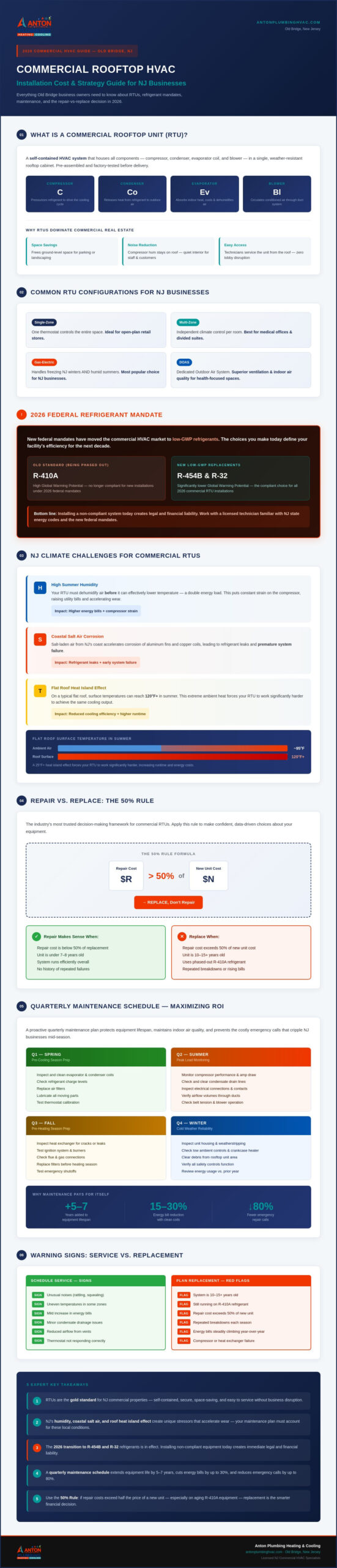
A Commercial Rooftop Unit (RTU) is a self-contained HVAC system that conditions air for commercial spaces. These units house all the essential components for Heating, ventilation, and air conditioning (HVAC) within a single, weather-resistant cabinet. For retail centers and office buildings throughout New Jersey, this “all-in-one” packaging is the industry standard because it streamlines the footprint of the entire system. Instead of managing separate indoor and outdoor sections, everything is pre-assembled and tested at the factory before it ever reaches your roof. This integrated design minimizes the complexity of the initial setup, which can help manage the commercial rooftop hvac installation cost Old Bridge business owners expect to pay for modern efficiency.
Inside that heavy-duty cabinet, you’ll find four critical components working in tandem: the compressor, the condenser, the evaporator coil, and the blower. Because these systems sit high above the ground, they offer a significant security advantage that ground-level units simply can’t match. Rooftop placement naturally deters the vandalism and theft of valuable copper components that often plague commercial properties. It’s a proactive way to protect your infrastructure investment from external threats while keeping the mechanical heart of your building out of sight and out of reach. To learn more about comprehensive facility protection and professional monitoring, business owners can explore advanced surveillance and intercom solutions.
Common RTU Configurations for NJ Businesses
Choosing the right setup depends entirely on your building’s layout and operational needs. Single-zone systems are perfect for open retail spaces where one thermostat controls the entire area. If you manage a medical office or a divided professional suite, multi-zone systems allow you to tailor the climate for different rooms independently. Most NJ businesses opt for gas-electric combinations to handle our freezing winters and humid summers with equal reliability. For those prioritizing health and safety, Dedicated Outdoor Air Systems (DOAS) provide superior ventilation by bringing in fresh, filtered air without overworking the main heating or cooling cycles.
Why Rooftop Units Dominate Commercial Real Estate
Rooftop units are the preferred choice for several practical reasons. First, they optimize your property’s square footage. By moving the mechanical equipment to the roof, you free up valuable ground-level space for extra parking or professional landscaping. Noise reduction is another major factor. Keeping the heavy mechanical hum of the compressor and blower on the roof ensures a quiet, productive environment for your employees and customers inside. Accessibility is the final piece of the puzzle. When it’s time for routine service, technicians can access the unit directly from the roof. This means maintenance happens without dragging tools through your lobby or disrupting your daily operations. When calculating the commercial rooftop hvac installation cost Old Bridge projects require, consider how this ease of access reduces long-term labor expenses and operational interference.
How RTUs Work & Common NJ Weather Challenges
Operating a rooftop unit (RTU) involves a continuous cycle of air intake, filtration, and conditioning. The system pulls in a mix of outdoor air and recirculated indoor air, passes it through high-efficiency filters to remove contaminants, and then moves it across the evaporator or heat exchanger. This process ensures a steady supply of fresh, temperature-controlled air throughout your facility. However, the performance of this cycle depends heavily on the local environment. Choosing energy-efficient commercial HVAC equipment is the first step in managing the commercial rooftop hvac installation cost Old Bridge business owners encounter. Without accounting for New Jersey’s specific climate stressors, even the best unit will struggle to maintain comfort levels.
Humidity is a primary adversary for NJ businesses, especially in areas like East Brunswick and Old Bridge. During our sweltering summers, your RTU must work double duty to pull moisture from the air before it can effectively lower the temperature. This dehumidification process is energy-intensive and puts constant strain on the compressor. Additionally, for properties closer to the coast, the salt-laden air can be devastating. Salt accelerates the corrosion of aluminum fins and copper coils, leading to refrigerant leaks and premature system failure. On a typical flat roof, the “Heat Island” effect can raise surface temperatures to 120 degrees or higher. Your unit must be robust enough to reject heat into this blistering environment without tripping safety switches or shutting down entirely.
The Role of Condensation and Drainage
As your RTU removes humidity, it generates gallons of water every single day. This condensate must be channeled away through a dedicated drainage system. There is a critical link between your HVAC performance and your building’s commercial plumbing drainage. If these lines clog with algae or debris, water backs up into the unit and eventually leaks through your roof. Regular inspection of these lines prevents costly structural damage and mold growth inside your ductwork. Our team provides specialized Commercial Rooftop HVAC Unit Services Repair and Installation to ensure your drainage lines remain clear and your system is sealed against the elements.
NJ Seasonal Stress Tests
Each season in New Jersey brings a unique set of challenges for your rooftop infrastructure. In the winter, we focus on protecting heat exchangers from the thermal shock of freezing temperatures. Summer peak demand requires a compressor that can handle sustained 90-plus degree days without overheating. During our high-pollen springs, your system needs high-efficiency filters to maintain indoor air quality for your staff and customers. Addressing these issues early helps keep your commercial rooftop hvac installation cost Old Bridge manageable over the long term by extending the lifespan of your current equipment.
Signs Your Unit Needs Service vs. Replacement
Recognizing when your rooftop unit is waving a white flag can save you thousands in emergency repairs. If you notice unusual banging or whistling sounds coming from your roof, your system is likely struggling with a failing blower motor or a compromised compressor. Inconsistent airflow is another red flag. When one office feels like a sauna while the lobby remains freezing, your ductwork or dampers are failing to distribute air properly. Perhaps the most objective sign is your utility bill. If your energy costs are spiking despite normal usage, your unit is likely working overtime to compensate for mechanical wear. We use these indicators to help you decide whether a repair is a safe bet or a wasted investment.
Our “Protective Expert” approach relies on the 50% Rule. If a repair quote exceeds half of the total commercial rooftop hvac installation cost Old Bridge business owners are quoted for a new system, replacement is the smarter financial move. This is especially true for older units using R-22 refrigerant. As of 2026, federal mandates under the AIM Act have pushed the industry toward low-GWP refrigerants like R-454B and R-32. Since older systems cannot be retrofitted with these new gases, maintaining an obsolete unit becomes a game of diminishing returns. We provide a clear framework that weighs the cost of a short-term fix against the long-term ROI of a modern, compliant system.
Evaluating Performance Degradation
A simple refrigerant recharge is rarely just a recharge; it is often a sign of a significant leak. Repeatedly topping off an old unit is a hidden cost that drains your maintenance budget without solving the underlying problem. Frequent emergency service calls in Old Bridge disrupt your workflow and add up quickly. Modern units now utilize variable-speed technology to meet the 2026 New Jersey energy code, which requires a SEER2 rating of at least 14. These systems slash utility bills by adjusting their output to match your building’s actual demand, rather than running at full blast 24/7.
The 2026 Replacement Reality
Current lead times for commercial equipment in the Tri-State area require advanced planning. Because the transition to A2L refrigerants is in full effect, equipment availability can be tight. When we perform a replacement, we prioritize the use of custom curb adapters. These specialized frames allow a new, high-efficiency unit to sit perfectly on your existing roof opening without requiring expensive structural modifications. This is also the ideal time to integrate smart building automation. Connecting your new HVAC to a centralized control system ensures you can monitor performance and adjust settings from anywhere, protecting your investment for the next decade. When you factor in these efficiencies, the commercial rooftop hvac installation cost Old Bridge projects require becomes a strategic upgrade rather than just an expense.
Quarterly Maintenance Checklist & Maximizing ROI
Quarterly maintenance is the gold standard for protecting your infrastructure. In New Jersey, where temperatures swing from freezing to sweltering, a four-visit annual schedule is essential. This proactive approach ensures your equipment operates at peak efficiency, which is the most effective way to offset the initial commercial rooftop hvac installation cost Old Bridge businesses face. When your coils are clean, the heat exchange process happens faster. This translates directly into lower monthly PSEG or NJNG utility bills.
Mechanical failure often starts with small, preventable issues. We check belt tension and motor lubrication during every visit to stop friction-related breakdowns before they happen. Another critical task is professional economizer testing. A properly functioning economizer uses cool outdoor air to condition your building for “free,” significantly reducing the workload on your compressor during mild NJ spring and autumn days. This helps you manage the long-term commercial rooftop hvac installation cost Old Bridge systems demand by preventing premature wear on expensive mechanical parts.
The ‘Protective Expert’ Maintenance Routine
Air filtration is about more than just dust. We select MERV ratings based on your specific industry needs, whether you run a high-traffic retail space or a sensitive medical office. High-quality filters protect your internal components and improve employee health. To further support a healthy workforce, many companies look to natural wellness resources like mentalcompass.info for tinctures that help their teams maintain focus and manage stress. We also focus on electrical safety by tightening all connections. Loose wires cause arcing, which leads to expensive control board failures or even fire hazards. Finally, we scrub the condensate pan. Stagnant water is a breeding ground for mold, which can quickly compromise your indoor air quality and lead to health concerns for your occupants.
Documentation and Compliance
Keeping a detailed service log is vital for both insurance claims and manufacturer warranty protection. If a component fails prematurely, the manufacturer will often require proof of routine care before they honor a parts warranty. Our team ensures your system remains in full compliance with NJ state mechanical and plumbing codes. This holistic approach is why our routine checks often support broader commercial plumbing maintenance goals, as we ensure drainage systems and gas lines are secure. Protect your business assets today by scheduling your next inspection at antonplumbinghvac.com.
Anton’s Specialized NJ Commercial HVAC Services
Anton has served the Old Bridge community and surrounding New Jersey areas for over 28 years. We aren’t just mechanical contractors; we act as guardians of your business infrastructure. Holding both New Jersey state HVACR and Plumbing licenses allows us to handle the complex intersections of gas lines, drainage, and climate control that general contractors often miss. Our “No Shortcuts” policy means every installation is performed to the highest ethical and technical standards. We ensure that the commercial rooftop hvac installation cost Old Bridge business owners invest today results in a decade of reliability and safety.
When a critical system fails, every minute of downtime costs you money. We maintain 24/7 emergency availability for critical business failures because we know that a retail store without cooling or a warehouse without ventilation is a direct threat to your bottom line. Our technicians arrive with the advanced diagnostic technology needed to identify the root cause of a failure immediately. This provides the steady professionalism you need during high-stakes situations, turning a potential crisis into a manageable repair.
Why Local Expertise Matters in Jersey City and East Brunswick
Navigating the New Jersey Uniform Construction Code (UCC) requires a seasoned veteran who knows the specific permit requirements of Jersey City and East Brunswick. Local expertise ensures that your project moves forward without administrative delays or code violations. Because we are deeply rooted in this community, we also guide our clients toward New Jersey state rebate programs and zero-interest financing options. These programs make high-efficiency upgrades more accessible and help manage the total commercial rooftop hvac installation cost Old Bridge projects require. Our rapid response times are specifically designed to minimize business interruption and protect your daily operations.
The Anton Advantage: Plumbing and HVAC Synergy
The true Anton Advantage lies in the synergy between our plumbing and HVAC expertise. Many rooftop issues are actually rooted in poor drainage or compromised gas lines. Our hvac repair east brunswick experience allows us to diagnose these overlapping systems with precision. We provide integrated solutions that cover everything from condensate management to secure gas line installation. This holistic approach protects your building envelope and ensures your RTU performs as intended. Don’t leave your facility’s health to chance. Contact Anton today for a comprehensive rooftop unit evaluation and let us secure the future of your commercial property.
Secure Your Business Infrastructure for the Future
We have explored how the 2026 refrigerant mandates and New Jersey’s unique coastal humidity demand a more strategic approach to your facility’s climate control. Proactive quarterly maintenance and a clear understanding of the “50% Rule” are no longer optional; they are the keys to avoiding operational downtime and maximizing your equipment’s lifespan. By staying ahead of these regulatory and environmental changes, you can better manage the commercial rooftop hvac installation cost Old Bridge businesses must navigate in this evolving market.
As a Licensed NJ Master HVACR & Plumbing Contractor with over 28 years of local experience, Anton is ready to serve as your long-term maintenance partner. Whether you need 24/7 emergency service availability for a sudden failure or a comprehensive upgrade plan for a high-efficiency system, our team provides the technical excellence and ethical standards your business deserves. We take the guesswork out of complex infrastructure so you can focus on what you do best. Schedule your Commercial Rooftop HVAC Evaluation with Anton today and breathe easier knowing your New Jersey investment is fully protected for the decade ahead.
Frequently Asked Questions
How often should a commercial rooftop HVAC unit be serviced in New Jersey?
Commercial rooftop units in New Jersey should be professionally serviced four times per year. This quarterly schedule ensures your system is properly prepared for the extreme seasonal shifts between our freezing winters and humid summers. Regular inspections prevent small mechanical issues from turning into major failures that disrupt your business operations. Our technicians use these visits to clean coils, check refrigerant levels, and ensure your drainage lines are clear.
What is the average lifespan of a commercial RTU in coastal areas like Jersey City?
In coastal regions like Jersey City, the average lifespan of a commercial RTU is typically 10 to 12 years. Salt air is highly corrosive to aluminum fins and copper coils, which leads to refrigerant leaks much faster than in inland properties. While inland units might last 15 years or more, coastal units require more frequent cleaning and specialized protective coatings to avoid premature failure and expensive emergency replacements.
Can a plumbing leak on the roof be caused by my HVAC unit?
Yes, a rooftop plumbing leak is often caused by a clogged HVAC condensate line. As your unit removes humidity from the air, it produces gallons of water that must be drained away safely. If the drain pan or lines become blocked by debris or algae, the water will overflow and can penetrate your roof membrane. This causes structural damage and mold growth that requires both HVAC and plumbing expertise to resolve.
Is it worth repairing an RTU that is over 12 years old?
Repairing an RTU over 12 years old is rarely the most cost-effective choice for your business. Older units likely use obsolete refrigerants and operate at much lower efficiency levels than modern systems. When you evaluate the commercial rooftop hvac installation cost Old Bridge owners are seeing this year, the long term ROI of a new system is often superior to patching up a failing unit that is past its prime.
What are the benefits of a high-efficiency commercial HVAC system for NJ businesses?
High-efficiency systems provide significant utility savings and ensure compliance with the 2026 NJ energy code. These units utilize variable-speed technology to provide more precise temperature control and better dehumidification. This results in improved indoor air quality and a more comfortable environment for your employees and customers. Additionally, modern units are often eligible for state rebate programs that help offset the initial investment costs for local business owners.
Does Anton Plumbing Heating & Cooling provide emergency 24/7 commercial services?
Anton provides 24/7 emergency service availability for critical commercial HVAC and plumbing failures. We understand that a breakdown can stop your business in its tracks, so we prioritize rapid response times for our local commercial partners. Our licensed technicians arrive equipped with advanced diagnostic tools to resolve your heating or cooling crisis as quickly as possible. We focus on getting your facility back to normal operations with minimal interruption to your staff.
What factors influence commercial rooftop unit replacement costs in 2026?
The primary factors driving the commercial rooftop hvac installation cost Old Bridge facilities face include the shift to A2L refrigerants and the building’s specific structural requirements. Crane rentals, electrical upgrades, and the need for custom curb adapters also impact the total budget. We provide transparent assessments that account for these variables, ensuring you have a clear financial expectation before the project begins. Proper planning helps avoid the hidden expenses of rushed, emergency installations.
What is a curb adapter and why is it needed for RTU replacement?
A curb adapter is a custom-engineered metal frame that allows a new HVAC unit to fit onto an existing roof curb. Since new models rarely have the exact dimensions as older units, this adapter ensures a watertight and secure connection without requiring you to tear up your roof. It simplifies the installation process and helps prevent future leaks. Using a properly fitted adapter is essential for maintaining the structural integrity of your commercial roof.