
Did you know that while 75% of New Jersey homes rely on natural gas for heating as of February 2026, the responsibility for that infrastructure is often misunderstood until a crisis hits? If you’ve ever smelled that faint, rotten-egg odor and felt a surge of anxiety about your family’s safety, you aren’t alone. It’s natural to worry about the high stakes of a potential leak or the daunting prospect of ripping up finished walls for a repair. You deserve to feel like a guardian of your household rather than a victim of aging pipes.
This guide helps you master the essentials of gas safety and code-compliant installations. You’ll learn how to distinguish between PSE&G or NJNG responsibilities and your own obligations as a homeowner. We will preview the latest high-tech leak detection tools and explain why a professional gas line inspection NJ is the most reliable way to ensure your system passes municipal standards. From sizing lines for new HVAC equipment to navigating the 2026 permit fees in your local township, we provide the technical clarity you need for a leak-free, secure home.
Key Takeaways
- Learn the critical “No-Spark Protocol” to protect your family during a suspected leak and identify the exact sensory cues that signal immediate danger.
- Discover how a professional gas line inspection NJ uses electronic sniffers and ultrasonic technology to locate hidden micro-leaks without damaging your drywall.
- Master the technical requirements for sizing gas lines correctly when installing modern, high-efficiency HVAC systems to ensure your home passes municipal code.
- Understand the legal boundaries of New Jersey utility responsibility and why all gas work must be supervised by a licensed Master Plumber.
Gas Leak Safety: Immediate Emergency Steps for NJ Homeowners
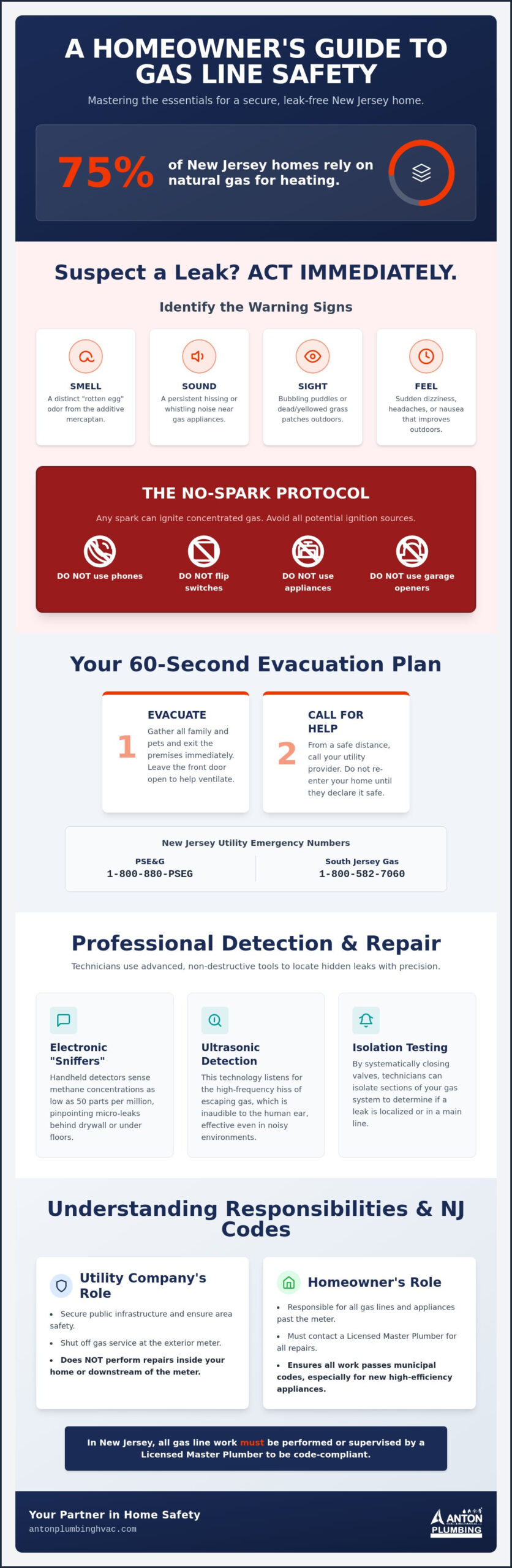
Natural gas is odorless by nature, so utility companies add a chemical called mercaptan to give it that unmistakable “rotten egg” smell. If you catch even a faint whiff, you must treat it as a potential emergency. Understanding the dangers of a gas leak is the first step in protecting your household. In New Jersey’s densely populated neighborhoods, a leak doesn’t just threaten one home; it can impact the entire block. If you’re ever unsure about a scent or a sound, scheduling a professional gas line inspection NJ is the only way to gain definitive peace of mind and ensure your system is secure.
Identifying the Warning Signs of a Leak
Leaks aren’t always signaled by smell alone. You might notice physical symptoms like sudden dizziness, headaches, or nausea that dissipate when you step outside. Pay attention to auditory cues, such as a persistent hissing or whistling sound near your furnace, boiler, or water heater. Outside your home, look for unusual environmental signs. Bubbling puddles on a dry day or patches of dead, yellowed grass in an otherwise healthy lawn often indicate an underground line failure. For those managing large estates who use aerial monitoring to spot these issues, you can check out Caswell Aviation Ltd to ensure your inspection equipment is in top shape. Since 75% of New Jersey homes rely on natural gas for heating, these signs are more common than many homeowners realize and require immediate attention.
Modern technology has introduced new risks that traditional safety guides often overlook. Your smart doorbell, cell phone, and even a light switch can create a tiny spark sufficient to ignite concentrated gas. This is why we emphasize the “No-Spark Protocol.” Don’t use your phone inside the house. Don’t touch any appliances, thermostats, or light switches. Don’t even use your garage door opener. In high-density areas, these small actions are critical for preventing a catastrophic event. Your priority is to remove your family from the environment without introducing any potential ignition source.
Your 60-Second Emergency Action Plan
When you suspect a leak, move quickly. Gather your family and pets and exit the premises immediately. Leave the front door open to help ventilate the space, but don’t waste time opening windows if it delays your exit. Once you’re at a safe distance from the property, call your utility provider. If you’re a PSE&G customer, dial 1-800-880-PSEG. South Jersey Gas customers should call 1-800-582-7060. The utility company will arrive to shut off the gas at the meter and ensure the area is safe.
It’s vital to understand the hierarchy of responsibility. The utility company’s job is to stop the leak and secure the public infrastructure, but they generally won’t perform repairs inside your home or downstream of the meter. Once the immediate danger is cleared and the gas is off, you must contact a licensed Master Plumber. They will perform a comprehensive gas line inspection NJ to locate the specific failure point and restore your service according to current New Jersey codes.
Professional Gas Line Detection and Repair Techniques
Once the immediate evacuation is complete and the utility has secured the exterior meter, the focus shifts to professional restoration. Finding the specific failure point requires more than a keen sense of smell. At Anton Plumbing Heating & Cooling, we use high-precision technology to identify failures that are invisible to the naked eye. A comprehensive gas line inspection NJ involves a series of diagnostic steps designed to protect your home’s infrastructure without unnecessary destruction of your walls or flooring.
Our team utilizes electronic gas sniffers as a first line of defense. These handheld combustible gas detectors can sense methane concentrations as low as 50 parts per million, allowing us to pinpoint micro-leaks behind drywall or under floorboards before they escalate into major hazards. For larger residential systems or commercial environments, we employ ultrasonic leak detection. This technology listens for the high-frequency hiss of escaping gas, even in noisy environments where standard tools might fail. Adhering to New Jersey’s gas safety regulations ensures that every diagnostic step we take meets the highest state standards for reliability and public protection.
Advanced Diagnostic Tools Used by Anton Plumbing Heating & Cooling
We don’t rely on guesswork when your family’s safety is on the line. We use isolation testing to systematically check different sections of your home’s gas system. By closing off valves to specific appliances, we can determine if a leak is localized to a single furnace or if it exists within the main trunk line. We also verify our findings using specialized, non-corrosive leak detection solutions that create visible bubbles at the site of a leak. If you suspect your system is aging or inefficient, you can schedule a professional assessment with Anton Plumbing Heating & Cooling to catch these issues early.
The Repair Process: Restoring Safety and Integrity
Repairing a gas line is a high-stakes task that demands absolute precision. We often work with black iron pipe, which requires expert cutting and re-threading to create permanent, airtight seals. Many modern leaks occur at flexible appliance connectors that have become kinked or corroded over time. We replace these outdated components with high-quality, code-compliant stainless steel connectors that offer superior durability.
Every repair concludes with a rigorous pressure drop test. We pressurize the system with air and monitor a gauge for a specific duration. If the pressure remains constant, we know the system is 100% airtight. This final verification is a non-negotiable part of our process. It ensures that when we restore your gas service, your family returns to a home that is fundamentally secure and fully operational.
Gas Line Installation for High-Efficiency Appliances
Modern high-efficiency appliances are marvels of engineering, but they are also incredibly demanding. If you are planning a water heater replacement, you can’t assume your existing pipes are sufficient. Many older New Jersey homes were piped for standard atmospheric tanks that pull relatively low BTUs. When you upgrade to a high-performance tankless unit, the fuel demand can triple. Without a professional gas line inspection NJ to verify your system’s capacity, your new equipment may fail to reach its advertised efficiency or, worse, shut down entirely during peak demand.
Similar infrastructure challenges arise during comprehensive hvac repair east brunswick projects. A furnace that is “starving” for fuel will short-cycle, leading to premature wear on expensive internal components. We also see a growing trend in New Jersey for outdoor lifestyle upgrades. Whether you’re adding a 60,000 BTU fire pit, a high-output pool heater, or a full outdoor kitchen, these extensions require precise calculations to ensure they don’t compromise the gas pressure inside your home.
Capacity Planning for Modern NJ Homes
Calculating BTU loads is a technical necessity, not a suggestion. We look at the “total connected load,” which is the sum of every gas-burning appliance in your home running at maximum capacity. Standard tankless water heaters often require a dedicated 3/4-inch or 1-inch gas line to maintain consistent pressure. If your trunk line is undersized, you’ll notice flickering pilot lights or underperforming burners on your stove when the shower is running. We perform these calculations during every gas line inspection NJ to ensure your home’s infrastructure supports your family’s daily needs without interruption.
Material Selection: Durability and Code Compliance
Choosing the right material for your gas system depends on the specific layout of your home. Traditional black iron pipe remains the gold standard for durability and is often required for main trunk lines. However, for complex retrofits, we may utilize Corrugated Stainless Steel Tubing (CSST). While CSST offers incredible flexibility for navigating tight spaces, it carries strict New Jersey code requirements for grounding and bonding. Proper electrical bonding is essential to protect your gas system from lightning strikes and power surges. Our team ensures that every manifold system and support bracket meets these safety standards, providing a professional installation that passes municipal inspections on the first try.
Navigating New Jersey Gas Codes and Utility Boundaries
One of the most common points of confusion for homeowners is the “Meter Line.” This invisible boundary determines who is responsible for repairs when a failure occurs. In New Jersey, your utility provider, whether it is PSE&G, NJNG, or Elizabeth Gas, is responsible for the service line running from the street to your gas meter. Everything downstream of that meter, including the piping inside your walls and the lines running to your backyard appliances, is your legal responsibility. A professional gas line inspection NJ is the only way to verify that your portion of the system is safe and up to current standards.
New Jersey law is very clear about who can touch these lines. Performing DIY gas work is illegal and extremely dangerous. All gas line installations and repairs must be supervised by a licensed Master Plumber. This isn’t just about following the rules; it’s about protecting your family and your financial future. Most New Jersey homeowners insurance policies will deny a claim if a fire or explosion is traced back to unpermitted or unlicensed gas work. If you are planning a renovation or have been flagged by a utility technician, contact Anton Plumbing Heating & Cooling to schedule a code-compliant inspection today.
Understanding NJ State Regulations
Municipal inspectors in Jersey City, Old Bridge, and across the state play a vital role in home safety. When we pull a permit for your gas work, it triggers a formal review by a local plumbing subcode official. This process ensures your system complies with N.J.A.C. 14:6-7.9, which mandates specific protections for your gas meter and piping. For outdoor projects, we strictly follow Blue Stake and 811 protocols. Calling 811 before digging is a mandatory safety step that prevents accidental strikes on underground utility lines, which can lead to service interruptions or hazardous leaks.
Coordinating with PSE&G, NJNG, and Elizabeth Gas
Coordinating with your utility company is essential when upgrading to high-capacity appliances. As we discussed in the previous section regarding BTU loads, a new tankless water heater often requires a larger meter to supply enough fuel. We handle the technical communication with the utility to request these upgrades.
- Unsafe Tags: If a utility technician “red tags” your system during a routine service call, they will shut off your gas until a licensed professional resolves the issue.
- System Restoration: We provide the necessary pressure tests and documentation required by the utility to restore your service quickly.
- State Rebates: Many New Jersey gas-fired equipment upgrades qualify for state-funded energy efficiency rebates, which we can help you navigate.
By maintaining a clear understanding of these boundaries and regulations, you position yourself as a responsible guardian of your home’s infrastructure. Our team acts as your expert guide through this complex landscape, ensuring every pipe and fitting meets the highest ethical and technical standards.
Why Old Bridge and Jersey City Trust Anton Plumbing Heating & Cooling for Gas Safety
Safety isn’t a commodity; it’s a commitment. For over 28 years, Anton Plumbing Heating & Cooling has operated as a family-run business dedicated to the domestic well-being of our New Jersey neighbors. Our status as Master Licensed professionals in both Plumbing and HVACR means we understand the complex interplay between your heating systems and gas infrastructure. When you request a gas line inspection NJ, you aren’t just getting a technician with a clipboard. You’re getting a Protective Expert who treats your property with the same ethical standards we apply to our own homes. We strike a careful balance between the high-stakes urgency of emergency repairs and the steady professionalism required for long-term maintenance.
Our deep industry tenure allows us to project technical confidence while maintaining a neighborly, community-focused approach. We believe that every complication has a straightforward, professional answer. This philosophy is why families across Jersey City and Old Bridge rely on Anton Plumbing Heating & Cooling to navigate the complexities of home infrastructure. We value transparency and clarity, ensuring you have clear financial expectations before any work begins. Our goal is to provide immediate relief for stressed homeowners facing utility failures or safety concerns.
Comprehensive Home Infrastructure Solutions
We offer more than isolated repairs. Our team understands that a healthy home requires a holistic approach to its mechanical systems. This might mean identifying how gas line upgrades coincide with your drain cleaning services or ensuring a new boiler installation meets every municipal code. By merging advanced diagnostic technology with a commitment to ethical service, Anton Plumbing Heating & Cooling acts as a knowledgeable guide through your home’s most critical systems. We don’t just fix pipes; we secure your household’s future.
Schedule Your Gas Safety Inspection Today
Gas emergencies don’t wait for convenient business hours. If you detect the scent of mercaptan or your system has been red-tagged by a utility company, you need a solution with minimal friction. Our emergency plumber Old Bridge NJ services are designed for rapid response. Anton Plumbing Heating & Cooling provides the high-tech accuracy required to pinpoint leaks and restore your peace of mind immediately.
- Immediate Response: We prioritize emergency leak detection to keep your family safe.
- Expert Installation: Get properly sized lines for your new high-efficiency appliances.
- Code Compliance: Every repair and installation we perform is guaranteed to pass municipal inspection.
Contact Anton Plumbing Heating & Cooling today to request a quote or schedule your professional gas line inspection NJ. Let our seasoned veterans provide the dependable, no-nonsense service your home deserves.
Secure Your Home’s Infrastructure Today
Mastering gas safety is about more than just recognizing the scent of mercaptan. It requires taking proactive steps to maintain your home’s integrity. We have explored how advanced diagnostic technology identifies hidden failures and why sizing your lines correctly is essential for modern high-efficiency appliances. By understanding the legal boundaries of utility responsibility and New Jersey’s strict permit requirements, you can act as a vigilant guardian for your family’s safety.
Every New Jersey home deserves a system that is both airtight and fully optimized for peak performance. A professional gas line inspection NJ provides the technical clarity and peace of mind you need to move forward with confidence. With over 28 years of local experience and NJ State Master Plumbing and HVACR licenses, our team is ready to serve. Whether you need a routine safety check or a 24/7 emergency gas leak response, we provide the dependable, no-nonsense expertise your household requires.
Schedule Your Professional Gas Safety Inspection with Anton Plumbing Heating & Cooling today to ensure your infrastructure meets the highest ethical and technical standards. Your family’s security is our top priority, and we are honored to be your trusted home maintenance partner.
Frequently Asked Questions
What are the most common signs of a gas leak in a New Jersey home?
The most recognizable sign is the sulfurous, rotten-egg odor of mercaptan added by utility companies. You might also hear a persistent hissing sound near your boiler or notice physical symptoms like unexplained dizziness and nausea while indoors. A professional gas line inspection NJ can also uncover outdoor signs, such as patches of dead grass or bubbling puddles near underground pipes.
Does PSE&G or NJNG fix gas leaks inside my house for free?
No, New Jersey utility providers are only responsible for the service line that runs from the street to your gas meter. Once the gas passes through the meter and into your home’s piping, the maintenance and repair costs belong to the homeowner. While the utility will shut off the gas during an emergency for safety, you must hire a licensed Master Plumber to perform the actual repairs.
How much does it typically cost to install a new gas line for a kitchen range?
The total investment depends on the distance from your main gas trunk line and the complexity of the routing through your home’s structure. Factors such as whether we need to navigate through finished basements or crawlspaces will influence the labor required. We recommend a professional on-site evaluation to provide a clear, transparent estimate based on your kitchen’s specific layout and BTU requirements.
Can I use a flexible gas connector for my furnace or boiler installation?
No, New Jersey mechanical codes generally require rigid black iron pipe for permanent heating equipment like furnaces and boilers. Flexible connectors are typically reserved for appliances that may need slight movement, such as clothes dryers or kitchen ranges. Using improper materials for high-output HVAC systems can lead to vibration-induced leaks and will likely fail a municipal safety inspection.
What should I do if I smell gas but my carbon monoxide detector is silent?
You must evacuate immediately because a standard carbon monoxide detector does not sense raw natural gas. These devices are designed to detect CO, which is an odorless byproduct of incomplete combustion, not the fuel itself. If you smell the mercaptan additive, follow the No-Spark Protocol by avoiding all light switches and phones until you are a safe distance from the property.
Is it safe to stay in the house if the gas smell is only faint?
It is never safe to remain in a building where you can smell gas, regardless of how faint the odor seems. Gas can accumulate in hidden wall cavities or ceiling pockets, creating a high-stakes fire hazard that isn’t always reflected by the scent in the center of a room. Scheduling a professional gas line inspection NJ is the only way to verify that the environment is truly secure for your family.
How long does a professional gas line pressure test take?
A standard pressure test usually requires monitoring a calibrated gauge for 15 to 30 minutes after the system has been pressurized with air. The entire appointment may take longer as the technician must first isolate all appliances to protect their sensitive internal valves. This rigorous process is the industry standard for verifying that your entire piping system is 100% airtight.
Do I need a permit to move a gas line during a basement renovation in NJ?
Yes, any modification or relocation of gas piping in New Jersey requires a plumbing permit from your local construction office. This ensures that the new layout is inspected by a subcode official and meets all current safety regulations. Skipping the permit process is illegal and can lead to significant complications with your homeowners insurance if a failure occurs in the future.