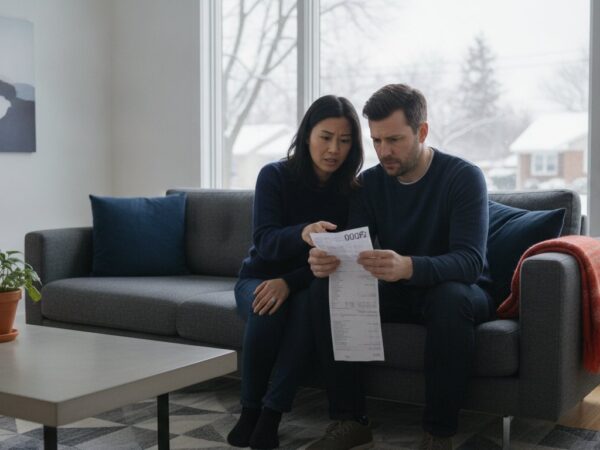
Opening your PSEG or NJNG statement shouldn’t feel like a localized crisis, yet many New Jersey families are facing record-breaking costs this season. If you are asking, “why is my energy bill so high in winter NJ,” you aren’t alone. While natural gas rates have seen some modest reductions, the price for electricity capacity in our region has surged to $329.17 per MW-day for the 2026/2027 delivery year. This shift often results in sticker shock that leaves homeowners feeling vulnerable and frustrated.
We know how stressful it is to deal with cold spots in the living room while your thermostat works overtime. You deserve a home that’s both warm and cost-effective. This 2026 guide will help you discover the external utility factors and internal HVAC inefficiencies driving up your New Jersey energy costs. We will preview the latest rate forecasts, explain how to verify your heating system’s performance, and show you how to leverage state rebates to lower your monthly expenses for good. Let’s take the guesswork out of your utility bills and secure your home’s comfort.
Key Takeaways
- Learn how regional grid shifts and specific 2026 utility rate cycles impact your monthly statement.
- Determine why is my energy bill so high in winter NJ by identifying how unmaintained furnaces and aging steam boilers work significantly harder than necessary.
- Decipher the difference between delivery and supply charges on your bill to determine if your high costs are a rate issue or a consumption problem.
- Perform a DIY home energy audit and check for hidden water leaks that force your system to waste energy heating lost water.
- Schedule a professional seasonal tune-up to leverage advanced diagnostic technology that finds invisible efficiency leaks and secures your home comfort.
Understanding the NJ Energy Landscape: Why Rates are Rising
New Jersey homeowners are currently navigating a “perfect storm” of utility shifts. If you are asking, “why is my energy bill so high in winter NJ,” the answer starts far away from your thermostat. While individual consumption matters, the baseline cost of keeping the lights on and the furnace running is dictated by regional grid pressures and state-level policy shifts. As New Jersey pushes toward its goal of 50% renewable energy by 2030, the infrastructure upgrades required for this transition are showing up on monthly statements across the state.
The PJM Factor: How the Grid Affects Old Bridge
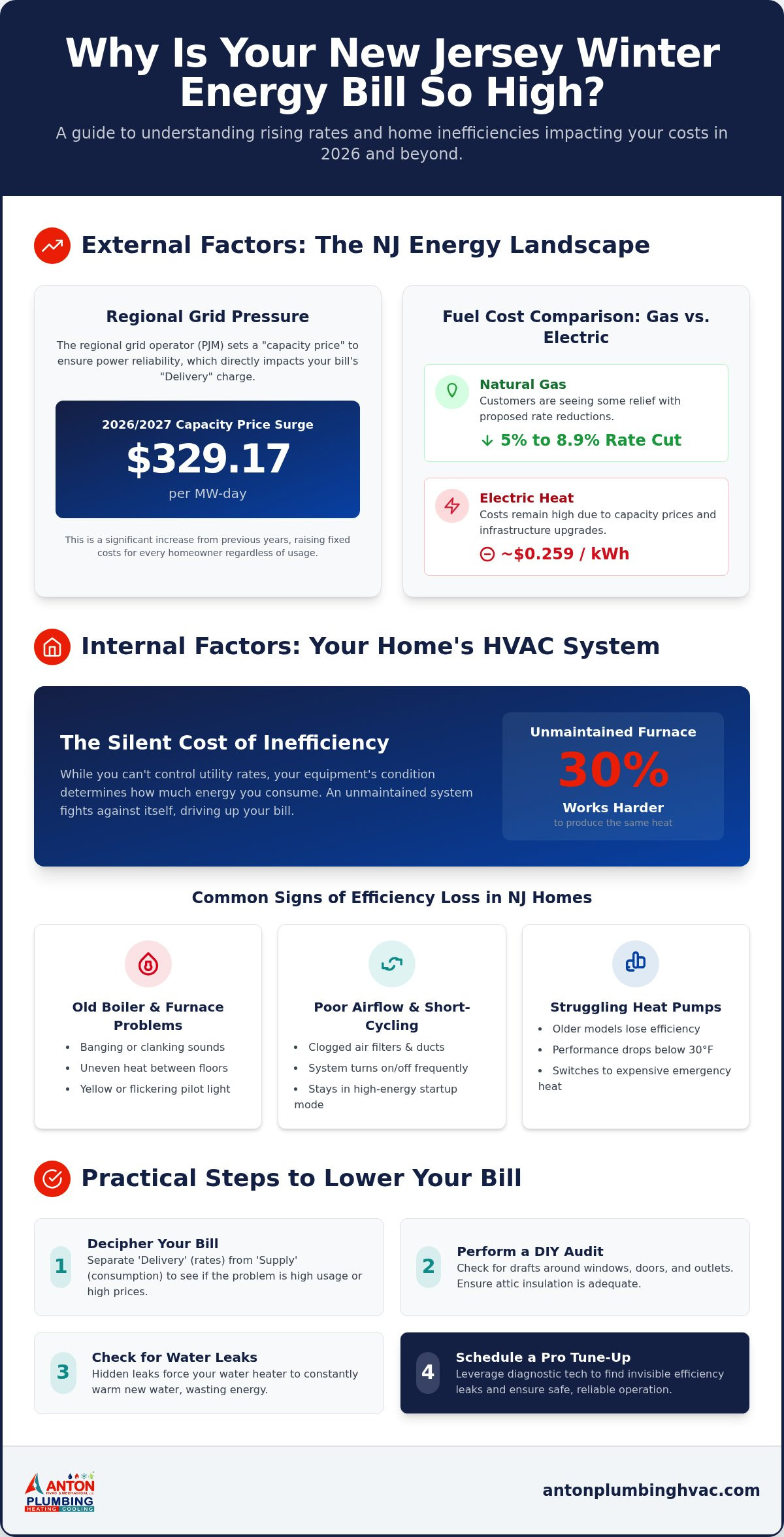
The electricity powering your home is managed by PJM Interconnection, the regional grid operator. PJM ensures that power is available even during the coldest winter nights, but this reliability comes with a “capacity price.” For the 2026/2027 delivery year, PJM capacity prices have surged to $329.17 per MW-day. This is a massive increase from previous years. These auction results determine the “Delivery” portion of your bill, which stays high regardless of how much electricity you actually use. PJM decisions regarding grid reliability and aging power plant retirements directly increased 2026 delivery charges for every residential customer in our service area.
Natural Gas vs. Electric Heat in New Jersey
The type of fuel you use plays a massive role in your winter expenses. Understanding how central heating systems work helps clarify why some neighbors are paying more than others. Currently, natural gas customers are seeing some relief; NJNG has filed for an 8.9% rate reduction, while PSE&G has proposed a 5% cut for gas heating. In contrast, electric heating costs remain high, with PSE&G winter rates hovering around $0.259/kWh.
Global supply chains and local demand spikes create unique pricing volatility in the Northeast. Because of this, many families in Middlesex County are moving toward dual-fuel systems. These setups use an electric heat pump for moderate days and switch to a gas furnace when temperatures drop below freezing. This strategy allows you to pivot between fuel sources based on which rate is currently lower. By diversifying how you heat your home, you gain a layer of protection against the unpredictable utility hikes that define the current NJ energy landscape.
HVAC Inefficiencies: The Silent Drivers of High Winter Bills
If you’ve checked the latest utility rates and they don’t fully explain your costs, the culprit is likely hiding inside your ductwork or basement. While external rates set the price per unit, your equipment determines how many units you consume. If you are asking, “why is my energy bill so high in winter NJ,” it’s often because your heating system is fighting against itself. An unmaintained furnace can work up to 30% harder to reach the same temperature as a clean, calibrated unit. This extra effort translates directly into higher fuel or electricity consumption.
Efficiency loss usually happens gradually. Clogged air filters and dirty ducts create airflow resistance, forcing your blower motor to pull more power to move heat through the house. Another major red flag is “short-cycling.” If your system turns on and off every few minutes, it never reaches a steady, efficient state. Instead, it stays in the high-energy startup phase, which is the most expensive part of the heating process. To save on energy bills this winter, you must address these mechanical drains before the temperatures drop further.
Boiler and Furnace Health in NJ Winters
Older homes in Jersey City and East Brunswick often rely on steam boiler systems. While these units are durable, they are prone to burner sediment and mineral buildup. This “sludge” acts as an insulating layer, meaning your burner has to run longer to heat the water inside. We’ve seen 28-year-old systems perform like new after a proper flush, but without it, they become massive energy sinks. Look for these signs of efficiency loss:
- Banging or clanking sounds in your pipes.
- Uneven heat between different floors of the house.
- A yellow or flickering pilot light instead of a steady blue flame.
If you notice these symptoms, it’s time to consult an expert in HVAC repair East Brunswick to restore your system’s efficiency.
The Heat Pump Myth: Performance in Sub-Zero Weather
Many New Jersey residents use heat pumps, but older models often struggle when temperatures dip below 30°F. When the air outside is too cold to extract heat effectively, the system switches to “emergency heat” or auxiliary electric strips. This mode is essentially a giant toaster element that consumes massive amounts of electricity. To avoid these spikes, we recommend high-efficiency heat pump upgrades specifically designed for the Northeast climate. Modern cold-climate units maintain their efficiency even in sub-zero weather, preventing the system from relying on expensive backup heat. A quick professional HVAC assessment can help you decide if your current unit is a candidate for a tune-up or if an upgrade is the more ethical, cost-saving choice for your family.
External Rates vs. Internal Efficiency: A Cost Comparison
Deciphering a utility statement often feels like learning a second language, but it’s the only way to answer why is my energy bill so high in winter NJ. Your bill is divided into two primary categories: Supply and Delivery. Supply is the market price of the energy you consume. Delivery is the cost PSE&G or NJNG charges to maintain the infrastructure that brings that energy to your door. In 2026, with electricity costs averaging 23¢/kWh in New Jersey, understanding this split is vital. If your usage in Therms or kWh has stayed the same but the total cost rose, you are likely feeling the weight of PJM capacity hikes. However, if your usage is climbing while your lifestyle remains unchanged, your home is likely leaking energy.
To judge your home’s performance fairly, look for the “Heating Degree Days” chart on your bill. This metric tracks how much colder the current month was compared to the previous year. If the weather was 10% colder but your bill jumped by 40%, your heating system is struggling. Investing in a high-efficiency HVAC system can bridge this gap. While an older furnace might only convert 70% of its fuel into heat, a modern 2026 model can reach 95% efficiency or higher. This shift stops the cycle of paying for energy that literally vanishes up your chimney.
Reading Your PSEG or NJNG Bill Like a Pro
Locate the usage history section on your statement to see your month-over-month consumption. You should also find the “Price to Compare,” which is the rate your utility charges for the energy supply itself. Use this number to see if third-party suppliers can offer a better deal. To detect a meter reading error, check if your bill says “Estimated” instead of “Actual.” If the utility hasn’t accessed your meter recently, they may be overcharging you based on a guess rather than your real usage.
System Age vs. Monthly Operating Costs
A 15-year-old furnace is a financial drain compared to a high-efficiency HVAC system. Older units often suffer from cracked heat exchangers or failing blowers that pull excessive electricity. For families facing a total system failure in the middle of a freeze, we offer same day HVAC replacement to restore safety immediately. Don’t forget that your heating bill isn’t just about air temperature. Heating water is a major winter expense, so consider a water heater replacement to a high-efficiency model to further insulate your budget from rising NJ utility rates.
Practical Steps to Lower Your NJ Winter Energy Bill
You don’t always need a professional to begin reclaiming your home’s efficiency. A DIY home energy audit is your first line of defense against rising costs. If you are asking, “why is my energy bill so high in winter NJ,” start by inspecting the architectural weak points common in our area. In classic New Jersey colonials, the attic hatch is often a major source of heat loss. In split-level homes, the “knee walls” in upper bedrooms frequently lack proper insulation, allowing cold air to seep in behind the drywall. Use a damp hand or a stick of incense to find drafts around window frames and door sills. Sealing these gaps with weatherstripping provides immediate relief for a few dollars.
Managing your thermostat is another high-impact move. Set your temperature to 68°F while you’re awake and lower it by seven to ten degrees while you sleep or work. A programmable thermostat is a set-it-and-forget-it tool that can save families significantly over a full season. It ensures you aren’t paying to heat an empty house while you’re commuting or running errands in town.
Plumbing Leaks and Your Energy Bill
Heating water is one of the most energy-intensive tasks in your home. If you have a leaking hot water pipe in your basement, your water heater must run constantly to replace that lost thermal energy. This is a silent budget killer that many homeowners overlook. For homes built on concrete slabs, “Under ground water leak detection” is vital because you won’t see a puddle forming on the floor. Perform a simple check by watching your water meter when no faucets are running. If the dial is still moving, you’re losing money. Check for dripping faucets and running toilets, as these small drips add up to hundreds of gallons of wasted, heated water during the long Jersey winter. If you suspect a hidden leak is driving up your costs, contact our team for a professional diagnostic check to secure your home.
Quick HVAC Wins for Homeowners
Small maintenance habits prevent large utility spikes. Follow the 30-day filter rule during the peak of winter. A clogged filter restricts airflow, which forces your blower motor to pull more electricity to move heat through the house. If your home uses a hot water system, learn how to bleed your radiators. Trapped air pockets prevent hot water from filling the unit, leaving the radiator cold even when the boiler is firing. Use a radiator key to release this air until a steady stream of water appears. Be cautious about closing vents in unused rooms. This can increase pressure within your ductwork, leading to leaks or even damaging your furnace’s blower motor. Keep at least 80% of your registers open to maintain a healthy, efficient system balance.
When to Call Anton: Professional Solutions for NJ Homeowners
While a DIY audit provides a starting point, professional intervention is the only way to solve deep-seated mechanical waste. If you’re still asking why is my energy bill so high in winter NJ after checking for drafts, the answer likely lies within the complex components of your heating system. We use advanced diagnostic technology to identify efficiency leaks that are invisible to the naked eye. From thermal imaging of your ductwork to combustion analysis of your burner, we find the exact source of your financial drain. A professional seasonal tune-up ensures your boiler or furnace operates at its peak rated efficiency, preventing the 30% performance drop common in unmaintained units.
The Anton 28-Year Legacy of Service
Anton Plumbing Heating & Cooling has served as a protective expert for New Jersey families for over 28 years. As a family-operated business, we understand that a high utility bill is a threat to your household’s financial security. Our licensed NJ Plumbing and HVACR professionals specialize in steam boilers and high-efficiency HVAC systems across Old Bridge, East Brunswick, and Jersey City. We maintain a high standard of ethical service, ensuring you receive transparent advice and clear financial expectations. Because utility failures don’t wait for convenient hours, we provide 24/7 emergency availability to keep your home safe. If you face a sudden heating loss or a burst pipe, contact an emergency plumber Old Bridge NJ for immediate, professional relief.
Investing in High-Efficiency HVAC
Investing in a high-efficiency HVAC system is the most effective long-term hedge against rising NJ utility rates. While older units struggle to convert fuel into heat, modern 2026 models are designed for maximum output with minimal consumption. We help you navigate the landscape of state incentives to maximize your savings. For instance, PSE&G offers rebates between $300 and $600 for qualifying heat pumps, while NJNG provides up to $1,000 for specialized cold climate heat pumps. Our team also offers a rebate program with zero interest to make these vital upgrades accessible for your budget. Don’t let another winter of high bills drain your household resources. Secure your comfort and your wallet by scheduling a comprehensive winter system audit today.
Secure Your Home and Your Budget This Winter
Identifying why is my energy bill so high in winter NJ is the first step toward reclaiming your household security. Whether it’s the surge in PJM capacity prices or a 15-year-old furnace working 30% harder than it should, you now have the tools to diagnose the drain. You don’t have to accept sticker shock as a seasonal reality. By addressing hidden plumbing leaks and optimizing your HVAC settings, you can insulate your family from the volatile 2026 utility landscape.
Anton Plumbing Heating & Cooling brings 28+ years of experience to every home we serve in Old Bridge and surrounding communities. As licensed NJ HVACR and Plumbing experts, we provide the technical confidence required to lower your monthly costs. We stand ready with 24/7 emergency service to ensure your domestic well-being never falters. Stop overpaying for winter heat; schedule your high-efficiency HVAC audit with Anton today! You deserve a warm home that doesn’t compromise your financial peace of mind.
Frequently Asked Questions
Why did my NJ energy bill double this month even though I didn’t change my habits?
Utility rate hikes and colder temperatures are the primary external drivers. Even if your habits stayed the same, your furnace ran more often to combat lower outdoor temperatures. Additionally, PJM capacity prices for the 2026/2027 delivery year rose to $329.17 per MW-day. This increase hits the “Delivery” portion of your bill regardless of personal usage. Mechanical wear in an unmaintained system also forces higher consumption to maintain the same comfort level.
How much should a typical winter heating bill be in New Jersey?
Typical costs vary by home size and fuel type, but the average NJ resident spends roughly $267 per month on electricity as of August 2026. Winter bills often spike higher due to heating demand. If your bill is significantly above the state average of 23¢/kWh for electricity, you should investigate your system’s efficiency. Factors like home insulation and the age of your boiler or furnace will dictate whether your costs are normal for the region.
Does a dirty furnace filter really increase my energy bill?
Yes, a dirty filter increases your energy consumption by forcing the blower motor to work harder. This restriction in airflow creates resistance that requires more electricity to overcome. We recommend changing your filter every 30 days during the peak of winter. This simple habit prevents the motor from pulling excess power and helps avoid the question of why is my energy bill so high in winter NJ. It also extends the lifespan of your equipment.
Are NJ utility rates going up again in 2026?
Electricity rates are rising, while natural gas rates are seeing some planned reductions. PSE&G electricity rates for winter 2026 are approximately $0.259/kWh following the June 1, 2026 Basic Generation Service reset. Meanwhile, NJNG has filed for an 8.9% reduction in customer bills effective October 1, 2026. These conflicting trends mean homeowners with electric heat or heat pumps may face higher spikes than those using natural gas furnaces or boilers.
Can a plumbing leak cause my gas or electric bill to rise?
A hot water leak is a major hidden driver of high energy bills. Your water heater must run constantly to replace the thermal energy lost through leaking pipes in the basement or under the slab. This constant cycling consumes significant amounts of gas or electricity. We use specialized water leak detection to find these silent drains. Fixing a single dripping faucet or a running toilet can save hundreds of gallons of heated water over a single winter.
What is the most efficient thermostat setting for a NJ winter?
The U.S. Department of Energy recommends setting your thermostat to 68°F while you are awake. Lowering the temperature by seven to ten degrees for eight hours a day can save you up to 10% on your annual heating costs. Using a programmable thermostat ensures these adjustments happen automatically. This prevents you from paying to heat an empty house while you are at work or running errands in Old Bridge or East Brunswick.
Is it cheaper to leave the heat on all day or turn it up and down?
It is significantly cheaper to turn the heat down when you aren’t home. Some people believe the system works harder to recover the temperature, but this is a common myth. A house loses heat slower when the interior temperature is lower. By reducing the thermostat setting while you’re away, you reduce the total energy transfer. This practice is one of the most effective ways to lower a high winter energy bill in New Jersey.
How do I know if my boiler is losing efficiency?
Common signs include uneven heating, strange noises like banging, and a yellow pilot light flame. If your boiler cycles on and off frequently, it’s likely short-cycling, which wastes fuel during the startup phase. Accumulation of burner sediment or mineral scale acts as insulation, forcing the burner to run longer. Our licensed experts use advanced diagnostic technology to measure your system’s actual output and identify exactly where energy is being wasted.


