
What if the recurring clogs you’re snaking every few months are actually the warning signs of a total system collapse hidden beneath your front lawn? It is a stressful reality for many homeowners in our community, especially as aging infrastructure finally reaches its breaking point. You deserve to feel confident in your home’s plumbing rather than living in fear of the next high-cost emergency. We understand that the thought of replacing cast iron sewer pipe in Old Bridge feels overwhelming, particularly when you worry about heavy machinery tearing up your carefully maintained landscaping.
This 2026 guide provides the clarity you need to move from temporary patches to a permanent, worry-free solution. You will learn why these vintage pipes are failing and how modern, trenchless technologies now accepted by the Old Bridge Municipal Utilities Authority can save your yard. We’ll also walk through the specific 2026 permit requirements and soil considerations unique to our corner of New Jersey. By the end of this article, you will have a clear roadmap to protecting your property with a fix that is designed to last a lifetime.
Key Takeaways
- Understand why homes built in the 1960s and 70s are currently hitting a critical failure zone for their original cast iron plumbing.
- Identify the specific signs of pipe channeling and internal corrosion that lead to recurring clogs and eventual system collapse.
- Compare trenchless “no-dig” methods with traditional excavation to determine the best approach for replacing cast iron sewer pipe in Old Bridge.
- Navigate the 2026 local permit process and utility mark-out requirements to ensure your project meets all New Jersey safety codes.
- Learn how advanced camera diagnostics and professional expertise can transform a plumbing crisis into a permanent infrastructure upgrade.
Why Old Bridge Homeowners are Replacing Cast Iron Sewer Pipes Now
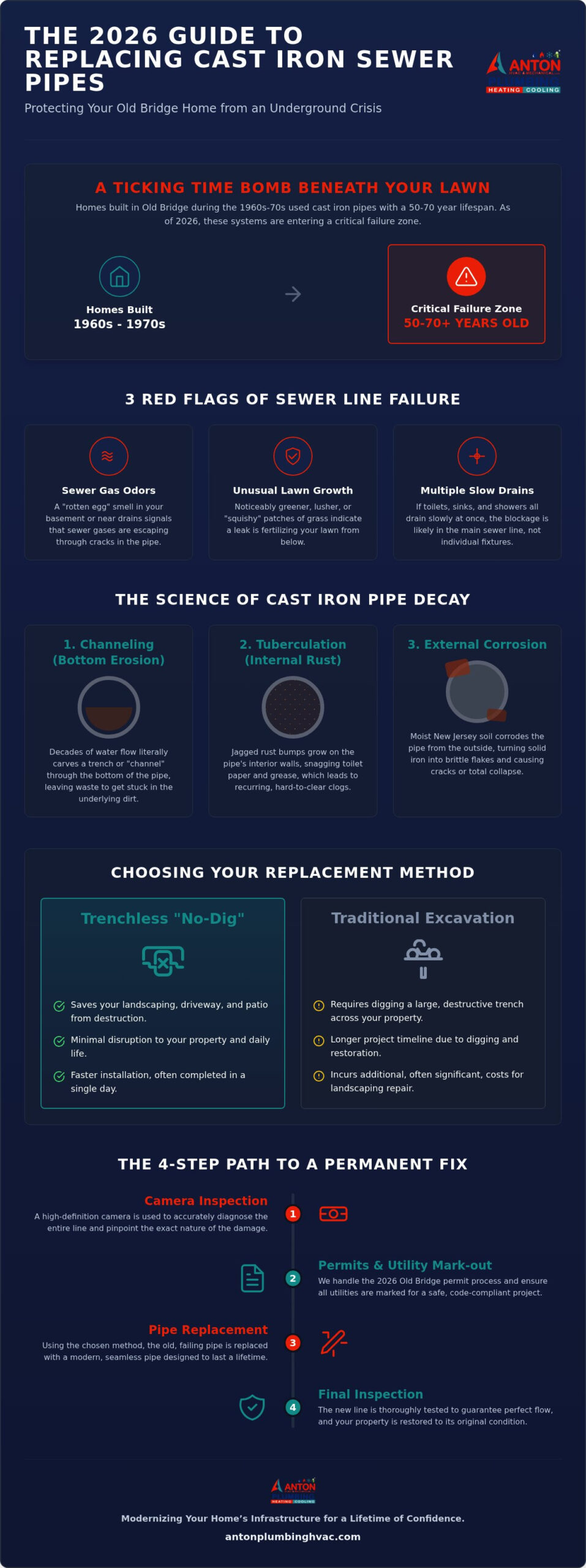
Old Bridge saw a massive housing surge during the suburban boom of the 1960s and 70s. During this era, cast iron was the industry standard for residential sewer lines. Fast forward to 2026, and these systems are reaching the end of their predictable lifespan. Most cast iron pipes last between 50 and 70 years before the metal thins significantly. This means thousands of local properties are now entering a “failure zone” where the risk of a total collapse increases every day. Replacing cast iron sewer pipe in Old Bridge isn’t just a repair; it’s a necessary infrastructure update to keep your household running safely.
Local environmental factors play a huge role in this decay. Middlesex County’s soil often holds significant moisture, which creates a corrosive environment for buried metal. Understanding The Science of Cast Iron Pipe Corrosion helps explain why these pipes fail from the outside in as much as the inside out. When the exterior of the pipe sits in damp NJ soil for decades, it undergoes a chemical breakdown that turns solid iron into brittle flakes. Eventually, the pipe loses its structural integrity entirely, leading to cracks that allow tree roots to enter and block the flow.
Many homeowners try to manage these issues with frequent drain cleanings or snaking. While this offers temporary relief, it often does more harm than good on thinned pipe walls. A heavy-duty drain snake can easily puncture a pipe that has been weakened by decades of use. Moving from reactive maintenance to a permanent replacement protects your property from sudden, messy backups that can ruin a finished basement. In the current NJ real estate market, a certified sewer replacement is also a high-value asset. Buyers are increasingly savvy about aging infrastructure and seeing a modern PVC or lined sewer pipe can be a major selling point.
Common Signs of Sewer Line Failure in NJ Homes
You don’t always need a camera to know something is wrong. Keep an eye out for these red flags:
- Sewer Gas Odors: If you smell “rotten eggs” in your basement or near floor drains, it’s a sign that sewer gases are escaping through cracks in the line.
- Unusual Lawn Growth: Look for “squishy” patches or areas where the grass is much greener and thicker than the rest of the yard. This often indicates a leak acting as a fertilizer.
- Multiple Slow Drains: If your toilets, tubs, and sinks are all draining slowly at the same time, the blockage is likely in the main line rather than a single fixture.
The Hidden Danger of ‘Patchwork’ Repairs
It’s tempting to fix only the small section of pipe that is currently leaking. However, this “spot repair” approach often leads to a cycle of frustration. When you replace a small segment of brittle cast iron with modern materials, the surrounding old pipe remains vulnerable. The pressure of the repair process can even trigger a new break in the next weak spot. We recommend a full high-definition camera inspection to see the entire line. This diagnostic tool reveals whether the whole pipe is thinned out or if the problem is truly isolated, saving you from the high costs of repeated emergency service calls.
The Science of Failure: Why Cast Iron Pipes Corrode and Scale
Understanding how your sewer line breaks down helps you make an informed decision about replacing cast iron sewer pipe in Old Bridge. One of the most common failure modes is “channeling.” Over decades, the constant flow of water along the bottom of the pipe carves a literal river through the iron. Eventually, the bottom of the metal disappears entirely, leaving only a dirt trench. This causes waste to get stuck in the mud, leading to backups that no amount of snaking can ever truly fix.
Inside the pipe, a process called “tuberculation” occurs. These are jagged rust bumps that grow on the interior walls. The Science of Why Cast Iron Pipes Fail explains that these nodules don’t just reduce flow; they create a rough surface that catches toilet paper and grease. While hydro jetting can scrub some of this away, it cannot restore the metal that has been lost to corrosion. These bumps continue to grow back, making clogs an inevitable recurring nightmare.
Modern habits also contribute to the decline of vintage iron. Harsh liquid drain cleaners are particularly destructive to older systems. These chemicals generate heat and caustic reactions that eat away at the already thinned metal. When you combine internal chemical damage with the acidic soil conditions found across Middlesex County, the pipe is under attack from both sides. For a truly accurate look at your system’s health, you can schedule a high-definition sewer camera inspection to see the extent of the damage before a total collapse occurs.
What is Pipe Scaling?
Pipe scaling is the build-up of oxidized iron and minerals that snag waste. As these minerals calcify, they narrow the pipe’s diameter, sometimes reducing a four-inch line to just two inches. While hydro jetting is a powerful tool for cleaning, it is often a temporary fix for heavily scaled pipes. If the scaling is severe, the process of removing it can actually expose holes in the thinned iron, making a full replacement the only reliable option for long-term security.
Biological Root Intrusion
Old Bridge is known for its beautiful, mature suburban trees, but their root systems are a primary threat to your sewer line. Roots are naturally attracted to the moisture and nutrients found inside your pipes. They enter through tiny cracks or failing joints as hair-like fibers. Once inside, they expand, creating a “wedge effect” that can split heavy iron pipes wide open. Because these roots grow back quickly after being cut, replacing cast iron sewer pipe in Old Bridge with modern, seamless materials is often the only way to stop the cycle of clogs for good.
Trenchless vs. Traditional Replacement: Which is Right for Your NJ Property?
The choice between trenchless technology and traditional excavation isn’t just about price; it’s about protecting your property’s future. Replacing cast iron sewer pipe in Old Bridge has evolved significantly in 2026. While older methods required a massive trench from the house to the street, modern solutions allow us to work through small access points. The Old Bridge Municipal Utilities Authority (OBMUA) has already signaled its support for these advanced methods, making it easier than ever for homeowners to choose “no-dig” options that preserve their curb appeal.
Trenchless methods like CIPP or pipe bursting typically take only 1 to 2 days to complete. In contrast, traditional excavation can stretch into a 3 to 5-day project. While the specialized equipment for trenchless tech may have a higher upfront service cost, the total project expense is often lower once you look at the big picture. Traditional digging can cost between $10,000 and $30,000, but you must also factor in the $7,500 to $10,000 typically required for professional landscape restoration. Trenchless avoids these secondary costs by leaving your yard, porch, and driveway intact.
CIPP (Cured-In-Place Pipe) Explained
CIPP is essentially a “pipe within a pipe” solution. We insert an epoxy-saturated liner into your existing cast iron line. Once the resin cures, it creates a seamless, jointless pipe that is completely resistant to the root intrusion mentioned earlier. This modern material is rated for a 50-year lifespan, matching or exceeding the durability of original iron. It’s the ideal choice for Old Bridge homes where the sewer line runs directly under a paved driveway or a mature oak tree that you don’t want to lose.
When Traditional Digging is Necessary
Trenchless technology is powerful, but it isn’t magic. If your pipe has completely collapsed, there is no path for a liner to follow. We also encounter “bellied” lines, where the ground has settled and created a low spot that traps waste. Because a liner follows the existing path, it won’t fix a slope issue. In these cases, traditional excavation is the only way to regrade the line and ensure proper gravity flow. Additionally, some municipal utility connections or deep repairs near the street may require direct access to meet local NJ plumbing codes and inspection requirements.
The Step-by-Step Process of Sewer Line Replacement in Old Bridge
Every successful project begins with a high-definition camera inspection. This diagnostic tool allows us to map the exact depth, location, and severity of the damage within your line. Once we have a clear picture, we handle the logistical heavy lifting. Replacing cast iron sewer pipe in Old Bridge requires navigating specific municipal codes. As of 2026, the township requires a $200 nonrefundable deposit for major plumbing renovations, and the minimum plumbing subcode fee is $75. We secure these permits on your behalf and coordinate with 811 for utility mark-outs to ensure all gas, water, and electric lines are clearly identified before work begins.
After the paperwork is in order, we move to the execution phase. If you’ve chosen a trenchless solution, we prepare small access points rather than a full-length trench. We then insert either a new HDPE pipe using pipe bursting or an epoxy-saturated resin liner. Once the new material is in place, we conduct pressure testing to ensure the system is airtight and fully functional. The process concludes with a final municipal inspection to certify that your new sewer line meets the 2021 National Standard Plumbing Code requirements currently enforced in New Jersey.
Preparing for Replacement Day
You’ll need to plan for a temporary water shutdown, typically lasting between 4 and 8 hours. During this window, you cannot flush toilets, run the dishwasher, or use the shower. Before our team arrives, please clear a path to your main sewer cleanout, which is usually located in your basement or utility room. Anton Plumbing Heating & Cooling takes great care to protect your home’s interior and manage the exterior work zone to minimize noise and disruption for your neighbors. If you’re ready to secure your home’s infrastructure, schedule your high-definition camera inspection with our experts now.
Post-Replacement Restoration
Once the new line is certified, we focus on restoring your property. If any digging was required, we backfill and compact the soil to prevent future settling or “dips” in your lawn. We perform a final camera run-through to provide you with “proof of work,” showing the smooth, unobstructed interior of your new pipe. To protect this investment, we recommend regular maintenance like Expert Drain Cleaning in Old Bridge. This proactive approach ensures your modernized system remains clear of debris and continues to serve your family for the next 50 years.
Modernizing Your Home’s Infrastructure with Anton Plumbing Heating & Cooling
Experience is the most valuable tool we bring to any job site. With 28 plus years of industry tenure, our team has seen every possible complication that can arise when replacing cast iron sewer pipe in Old Bridge. We don’t just see ourselves as mechanical service providers; we act as the guardians of your household’s well-being. Large-scale sewer projects require a level of technical precision and local knowledge that only comes from decades of hands-on work in New Jersey. Anton Plumbing Heating & Cooling has built a reputation on being the steady, professional partner you can rely on when your home’s infrastructure reaches its limit.
Our approach is built on the Protective Expert model. This means we prioritize transparent diagnostics and no-nonsense communication over quick fixes. We leverage advanced technology, including high-definition sewer cameras and specialized hydro jetting equipment, to ensure we understand the exact state of your pipes before any work begins. This commitment to accuracy distinguishes Anton Plumbing Heating & Cooling from competitors who might rely on guesswork. By providing clear financial expectations and accessible options, we remove the stress from what is often a high-stakes emergency repair.
As a family-owned and operated business, our heritage is deeply rooted in the communities we serve. When we enter your property, we treat your home with the same care and respect as if it were our own. We understand the emotional toll a utility failure takes on a family. That’s why we focus on efficient, brisk communication and reliable results that stand the test of time. Anton Plumbing Heating & Cooling isn’t just looking for a one-time repair; we want to be your long-term maintenance partner.
Our Commitment to Integrity and Quality
In the state of New Jersey, sewer line replacement is a major undertaking that requires a licensed NJ Master Plumber. This isn’t a suggestion; it’s a non-negotiable standard for your safety and legal protection. Our professional credentials, including NJ State Plumbing License #12867, ensure that every project we touch meets or exceeds current safety codes. We also recognize that sewer failures don’t follow a 9-to-5 schedule. If your system collapses in the middle of the night, you can rely on our Emergency Plumber Old Bridge NJ services for a rapid, 24/7 response. We are always active and ready to provide immediate relief for stressed homeowners.
Contact Anton Plumbing Heating & Cooling for a Sewer Evaluation
Taking the first step toward replacing cast iron sewer pipe in Old Bridge is as simple as scheduling a non-invasive camera inspection. This diagnostic process allows us to provide you with a clear, written estimate and a comprehensive plan for modernization. Don’t wait for a total system failure to address your aging infrastructure. Anton Plumbing Heating & Cooling provides the technical excellence and ethical standards you need to secure your property for the future. Schedule your sewer line inspection with Anton Plumbing Heating & Cooling today and let us help you turn a plumbing liability into a lifelong asset.
Secure Your Home’s Future with a Modern Sewer Solution
Your home is likely your most significant investment. Protecting it starts with the infrastructure you cannot see. By replacing cast iron sewer pipe in Old Bridge, you move from the stress of recurring clogs to the security of a system built to last another half-century. You now understand how modern trenchless technology can preserve your landscaping while providing a seamless, root-proof solution that traditional snaking simply cannot match. It is time to turn a hidden liability into a permanent asset.
Anton Plumbing Heating & Cooling brings 28 plus years of local experience and the technical precision of a Licensed NJ Master Plumber (#12867) to every project. We understand the high stakes of sewer failures. This is why we maintain a 24/7 emergency response team ready to protect your property at a moment’s notice. Don’t wait for a messy basement backup to address your aging pipes. Clear diagnostics and honest, transparent planning are just a click away.
Schedule Your Professional Sewer Camera Inspection with Anton Plumbing Heating & Cooling and gain the peace of mind that comes with a permanent fix. We are ready to act as your knowledgeable guide through this essential home modernization project. Your family’s comfort and security are our top priorities.
Frequently Asked Questions
How long does a cast iron sewer pipe typically last in New Jersey?
Cast iron pipes in New Jersey typically last between 50 and 70 years. Local soil moisture and high humidity levels in Middlesex County often accelerate external corrosion compared to drier regions. If your home was built during the suburban developments of the 1960s or 70s, your system is likely entering a critical failure zone where the metal has thinned significantly.
Is trenchless sewer repair cheaper than traditional digging in Old Bridge?
Trenchless repair is frequently more cost-effective when you calculate the total project expense. While the specialized equipment involves a higher upfront service cost, you avoid the massive secondary expenses of rebuilding driveways and restoring professional landscaping. Traditional excavation often leaves homeowners with heavy restoration bills that far exceed the savings of the initial plumbing work.
What are the first signs that my cast iron sewer pipe is failing?
The earliest signs of failure include persistent sewer gas odors in your basement and slow-draining fixtures throughout the house. You might also notice unusually green, lush patches of grass directly over the sewer line or “squishy” spots in your yard. These indicators suggest that sewage is leaking through cracks and acting as a fertilizer for your lawn.
Can I just use hydro jetting to clean my old cast iron pipes?
Hydro jetting is a powerful cleaning tool, but it is not a permanent solution for pipes that are thinned or channeled. It can clear clogs and scale temporarily to restore flow. However, if the pipe walls are significantly weakened by age, the high-pressure water can actually worsen existing cracks or puncture holes in the brittle iron.
Do I need a permit from the town of Old Bridge to replace my sewer line?
Yes, you must obtain a plumbing permit from the Old Bridge Township Construction Department for any sewer line replacement. As of 2026, the township requires a nonrefundable $200 deposit with permit applications for major renovations. There is also a minimum plumbing subcode fee of $75 that applies to this type of infrastructure work.
Will replacing my sewer pipe ruin my landscaping and driveway?
Choosing a trenchless method for replacing cast iron sewer pipe in Old Bridge protects your landscaping and driveway from major damage. These “no-dig” solutions use small access points rather than a full-length trench to install the new line. Traditional excavation will require digging up the yard, but our team manages the work zone to minimize the footprint on your property.
What is the difference between pipe lining and pipe bursting?
Pipe lining creates a new resin-based “pipe within a pipe” inside your existing cast iron line. Pipe bursting involves pulling a brand-new, high-density polyethylene pipe through the old one, physically breaking the old iron apart as the new line is installed. Both methods provide a seamless, root-proof result that modernizes your home’s infrastructure.
Does insurance cover the cost of replacing a cast iron sewer pipe?
Standard homeowners insurance policies typically do not cover the replacement of pipes that fail due to age or gradual corrosion. However, many New Jersey providers offer a “service line endorsement” that can be added to your policy for a small fee. We recommend checking your specific coverage details to see if you have protection against underground utility failures.


