
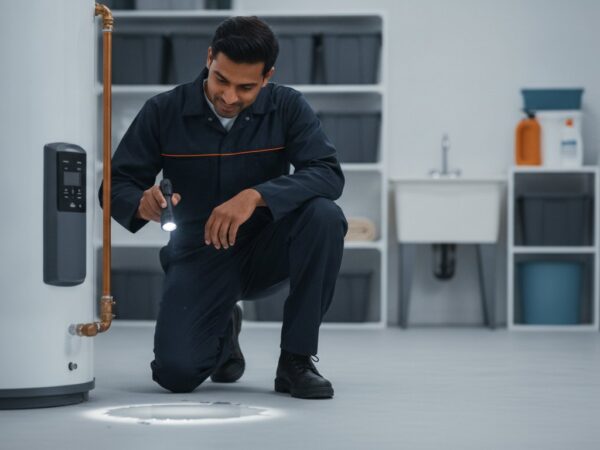
Imagine walking into your basement and feeling that cold, damp sensation underfoot because your water heater is pooling water at its base. It’s a stressful sight that immediately triggers fears of expensive floor damage and high replacement costs. If you’ve discovered your water heater leaking from the bottom in Old Bridge, you need to know exactly what you’re dealing with before the situation escalates. We understand that your home’s safety is your top priority, and a leaking tank feels like a direct threat to your domestic peace of mind.
You’re likely hoping for a simple fix while bracing for the worst; it’s a common dilemma for many of our neighbors. You aren’t alone in this. We promise to help you diagnose the source of the moisture and explain when a repair is possible versus when a new installation is the only safe path forward. This guide provides a clear look at the 2026 local permit requirements, New Jersey’s 72-hour emergency replacement laws, and the latest energy-efficiency rebates available to help you make an informed, confident decision for your household.
Key Takeaways
- Learn the immediate steps to shut off your water and power supply to prevent a minor leak from becoming a major basement flood.
- Identify whether a water heater leaking from bottom Old Bridge is a simple fix like a faulty drain valve or a sign of a terminal tank failure.
- Determine if your unit is salvageable by applying the “50% Rule” and evaluating the age of your heater against the standard 8 to 12 year lifespan.
- Understand how the specific water hardness levels in Middlesex County impact your system’s internal components and lead to premature corrosion.
- Navigate the 2026 New Jersey emergency permit rules and discover how to qualify for high-efficiency rebates when a replacement is necessary.
Immediate Steps for a Water Heater Leaking from the Bottom
Discovering a water heater leaking from bottom Old Bridge is a high-stakes moment for any homeowner. You’re likely staring at a growing puddle and wondering how much time you have before your basement floor or utility room is ruined. Don’t let anxiety take over. Your priority is to stabilize the situation and protect your domestic security. By following a specific sequence of actions, you can stop the active flooding and prevent a mechanical failure from turning into a structural disaster.
Safety First: Electricity and Gas
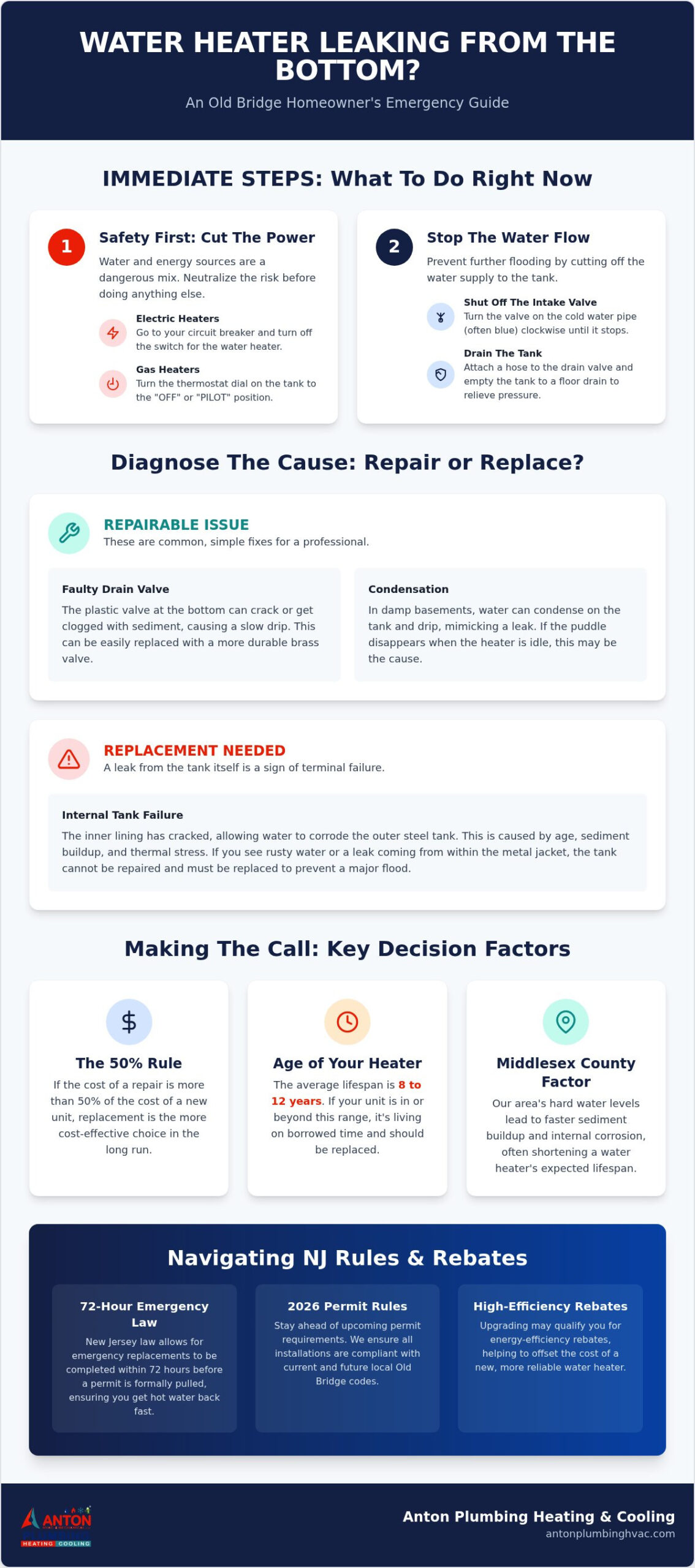
Before you touch the plumbing, you must address the energy source. If you have an electric water heater, water pooling at the base creates a severe risk of electrical shock. Head to your circuit breaker panel immediately and flip the switch labeled for the water heater. Never step into standing water to reach the unit if the power is still on. For those with gas units, locate the thermostat dial on the front of the tank and turn it to the “Off” or “Pilot” position. This prevents the burner from cycling while the tank is compromised, which could otherwise lead to the tank overheating and cracking. Taking these steps ensures you’re acting as a guardian of your household’s safety.
Stopping the Water Flow
Once the power is neutralized, you must stop more water from entering the system. Look at the top of your unit for the cold water intake pipe. You’ll usually find a lever or a gate valve, often color-coded with a blue handle. Turn this valve clockwise until it stops. If you’ve identified your water heater leaking from bottom Old Bridge, shutting off the intake is the most effective way to stop the spread. If the valve is stuck or starts to drip when you move it, don’t panic. You can shut off the main water line to your entire home to achieve the same result.
To truly mitigate the damage, you should also relieve the internal pressure. Understanding how storage water heaters work helps you realize that conventional tanks keep a large volume of water under constant pressure. Even with the intake off, that pressure will continue to push water out of the leak until the tank is empty. Attach a standard garden hose to the drain valve at the base of the tank. Run the hose to a floor drain or outside, then open the valve to empty the tank. This simple step can save you thousands in restoration costs by keeping the water contained within your plumbing rather than on your floor.
Identifying the Cause: Why is Water Pooling at the Base?
When you spot a puddle under your unit, it’s natural to assume the worst. However, not every pool of water signals the end of your equipment. You must distinguish between a failing external component and a structural breach. A water heater leaking from bottom Old Bridge usually stems from one of two places: a replaceable valve or a compromised inner shell. Understanding the difference can save you from an unnecessary replacement or, conversely, prevent a catastrophic flood.
The Drain Valve: A Common Culprit
In many older Old Bridge homes, water heaters are equipped with plastic drain valves that become brittle over time. These components are designed for maintenance, but they’re often the first part to fail. You might notice a slow drip from the threaded opening or moisture where the valve meets the tank body. This often happens after a homeowner attempts to flush the tank; sediment can get lodged in the valve seat, preventing a watertight seal. If the leak is confined to the valve itself, a professional can usually swap it for a high-quality brass version without replacing the entire system.
Sometimes, what looks like a leak is actually physics at work. In high-efficiency units or heaters located in damp basements, condensation can accumulate on the outside of the cold tank and drip to the floor. If the puddle only appears during periods of heavy use and disappears when the unit is idle, you might be dealing with a ventilation or humidity issue rather than a mechanical failure.
Internal Tank Failure: The “Death Knell”
Internal tank failure is the result of a breached glass lining that allows pressurized water to make direct contact with the steel outer shell.
Over time, sediment builds up at the base of the tank and creates an insulating layer of sludge. In gas-fired units, this forces the burner to run longer and hotter to reach the water through that debris, which leads to localized overheating. This thermal stress eventually causes the tank’s floor to crack or the protective lining to flake away. If you see rusty water or notice the leak is coming from inside the outer insulation jacket, the inner shell has likely succumbed to corrosion. This is a terminal condition for the appliance; once the tank’s integrity is gone, it cannot be safely repaired.
If you’re unsure whether that puddle is a minor nuisance or a major threat, having a professional perform water leak detection can provide the clarity you need to protect your home and your budget.
The Repair vs. Replace Dilemma for Old Bridge Homeowners
Deciding whether to sink money into a repair or invest in a new unit is the most common source of anxiety for our neighbors. You want to be a responsible steward of your home’s budget, but you also need to ensure your family’s daily comfort isn’t interrupted by a sudden cold shower. To simplify this choice, we recommend applying the “50% Rule.” If a professional repair estimate exceeds half the cost of a new installation, replacing the unit is almost always the more ethical and financially sound path. This is especially true when you’re dealing with a water heater leaking from bottom Old Bridge, as these specific leaks often signal that the tank’s structural life is over.
When a Repair Makes Sense
If your water heater is under six years old, it’s likely still under a manufacturer’s parts warranty. In these cases, repairing localized issues is usually a smart move. For example, replacing a faulty Temperature and Pressure (T&P) relief valve or a burnt-out electric heating element is a straightforward task that restores your system for a fraction of the cost of a full replacement. Sometimes, what looks like a serious failure is just a loose pipe connection at the top of the unit that has allowed water to run down the side and pool at the base. We prioritize these simple fixes whenever possible to keep your home running smoothly without unnecessary expense.
Why Replacement is Often Necessary for Bottom Leaks
While valves and elements are replaceable, the steel tank itself is not. If your unit has reached the 8 to 12 year benchmark, its internal protective components have likely reached the end of their effectiveness. A leak originating from the bottom of the tank often indicates that the inner lining has been breached by corrosion. Ignoring this warning can lead to a catastrophic tank burst, which can dump dozens of gallons of water into your home in minutes. The risk to your domestic security simply isn’t worth the gamble of a temporary patch.
Choosing to replace an aging unit also allows you to take advantage of the massive efficiency gains found in 2026 models. Modern systems, particularly heat pump water heaters, use significantly less energy than the standard tanks installed a decade ago. For more details on current technology and local requirements, check our water heater replacement guide for 2026 models. Investing in a new, warrantied system provides immediate relief from the fear of future leaks while lowering your monthly utility bills. We believe in providing clear financial expectations so you can choose the solution that best protects your household for the long term.
Why Water Heater Leaks are Common in Central New Jersey
Living in Central Jersey presents a unique set of challenges for your home’s infrastructure. It isn’t just bad luck when you find your water heater leaking from bottom Old Bridge; it’s often a direct result of our local environment. From the mineral content in our water to the specific way our plumbing systems are engineered, several factors work together to stress your tank. Understanding these regional issues helps you act as a protective guardian for your household, catching small problems before they lead to significant property damage.
Hard Water and Sediment Buildup
Middlesex County is known for having moderately hard water. As this water is heated, minerals like calcium and magnesium settle at the base of your tank, forming a thick layer of sediment. This buildup acts as an insulator between the burner and the water. If you hear a distinct “popping” or “rumbling” sound coming from your basement, it’s a sign that steam bubbles are being trapped under that sediment crust. This localized overheating eventually scorches the protective glass lining, leading to the cracks that cause a water heater leaking from bottom Old Bridge. We recommend annual flushing to clear this debris and preserve your tank’s integrity.
Our NJ climate also plays a role. During the freezing winter months, the water entering your home is significantly colder than in the summer. Your heater must work much harder and run for longer cycles to reach your desired temperature. This increased thermal stress, combined with the sediment at the bottom, accelerates the wear and tear on the steel shell.
Thermal Expansion in NJ Plumbing Systems
Many homes in older Old Bridge neighborhoods have been updated with “closed-loop” plumbing systems, which include backflow preventers. While these protect the municipal water supply, they create a new problem: thermal expansion. When water heats up, it expands in volume. In a closed system, that extra volume has nowhere to go, so it exerts immense pressure on the internal walls of your tank. This constant “breathing” of the tank as it expands and contracts eventually leads to metal fatigue and structural failure.
To combat this, New Jersey state plumbing codes require the installation of thermal expansion tanks and, in many cases, safety pans with drains. If your expansion tank has a failed internal bladder, your main water heater tank is absorbing all that pressure alone. Verifying that these safety components are functional is a critical part of our diagnostic process. If you suspect your system is under too much pressure, our team provides expert Plumbing Repair and Installation to bring your home back into code compliance and stop the leaks for good.
Professional Water Heater Solutions: The Anton Advantage
Facing a water heater leaking from bottom Old Bridge requires more than just a quick fix; it demands a partner who understands the local landscape and the high stakes of home infrastructure failure. Anton Plumbing Heating & Cooling has served as a guardian of the household for over 28 years. As a family-operated business, we don’t just provide mechanical services. We offer immediate relief for stressed homeowners. Our licensed NJ Plumbing and HVACR professionals use advanced diagnostic technology to identify the exact source of your leak. We believe in transparency, which is why we show you the failure point before discussing your options.
Emergency Response in Old Bridge
When water is pooling on your floor, every minute counts toward preventing structural damage. We maintain 24/7 emergency availability for our neighbors to ensure that a midnight leak doesn’t become a morning disaster. If you’re in a crisis, you should contact an emergency plumber in Old Bridge NJ for immediate assistance. During a same-day visit, we stabilize the unit, assess the damage, and provide clear financial expectations.
New Jersey law understands the urgency of these situations. Under the 72-hour emergency replacement rule, we can replace a failed water heater immediately to restore your hot water and home safety. While a $75 permit is required by the Township of Old Bridge, the application can be submitted within three days of the completed work. This allows us to prioritize your family’s well-being without waiting for administrative delays. We handle the technical complexities and code compliance so you can focus on getting your routine back to normal.
Modern Upgrades and High-Efficiency Options
If your tank is beyond repair, we guide you through the transition to modern, high-efficiency technology. The landscape of water heating has changed significantly for 2026. We specialize in the installation of heat pump water heaters and tankless systems that offer superior longevity and lower utility costs. These aren’t just upgrades; they’re investments in your home’s long-term security.
We also help you maximize your savings through active rebate programs. For qualifying ENERGY STAR heat pump water heaters, homeowners can access a $500 base rebate from the NJ Clean Energy Program. PSE&G customers may be eligible for an additional $200, bringing the total potential savings to $700. Our team ensures your new system is installed to the highest ethical standards, guaranteeing that your manufacturer’s warranty remains valid and your home stays protected for years to come.
Restore Your Home’s Safety and Comfort
You don’t have to face the stress of a failing appliance alone. We’ve explored how to stabilize your unit, identify the difference between a simple valve fix and a terminal tank breach, and navigate the specific hard water challenges of Middlesex County. Whether you’re dealing with a minor drip or a major water heater leaking from bottom Old Bridge, acting quickly is the best way to prevent property damage and restore your domestic security. Taking the right steps now ensures your basement stays dry and your utility bills stay manageable.
As a family-owned business with over 28 years of local experience, we prioritize the safety of your household above all else. Our team of licensed NJ Master Plumbers provides the transparent diagnostics and ethical service you deserve. We offer 24/7 emergency availability to ensure that a utility failure never compromises your family’s comfort for long. Stop the Leak Now: Call Anton Plumbing for Emergency Water Heater Repair. Your home is your sanctuary; let’s keep it dry and functional together.
Frequently Asked Questions
Is a water heater leaking from the bottom an emergency?
Yes, a water heater leaking from bottom Old Bridge is considered a plumbing emergency because it involves a pressurized vessel. If the leak is ignored, the structural integrity of the tank can fail completely, leading to a full burst that dumps dozens of gallons of water into your home. You should shut off the water supply and power immediately to prevent extensive property damage.
Can a leaking water heater explode?
A leak itself doesn’t cause an explosion, but it’s often a warning sign that the tank’s internal pressure or temperature is poorly regulated. If the Temperature and Pressure (T&P) relief valve is also failing or blocked, the tank can become dangerously over-pressurized. We treat every leak as a serious safety concern to ensure your home’s pressure-relief systems are functioning correctly.
How much does it cost to fix a water heater leak in Old Bridge?
The cost to resolve a leak varies based on whether you need a simple component repair or a full system replacement. Replacing a faulty drain valve or a heating element is a relatively minor expense compared to installing a new tank. Final costs are influenced by the type of heater you own, current local permit fees, and any necessary upgrades to meet 2026 building codes.
Can I still use hot water if my heater is leaking from the bottom?
You shouldn’t continue using the unit if you’ve discovered a leak at the base. Using hot water triggers a cycle where the tank refills with cold water and then heats it, causing the water to expand and maintain high internal pressure. This constant stress can cause a small crack to widen rapidly, turning a manageable drip into a catastrophic flood in minutes.
How long do water heaters typically last in New Jersey?
In New Jersey, conventional water heaters typically have a reliable lifespan of 8 to 12 years. The moderately hard water found in Middlesex County can often shorten this window by accelerating sediment buildup and internal corrosion. If your tank has passed the decade mark and shows signs of moisture, it’s likely nearing the end of its functional life.
Will my homeowners insurance cover a water heater leak?
Most standard homeowners insurance policies cover the damage caused by a sudden water leak, such as ruined drywall or flooring, but they usually don’t cover the unit’s replacement. If the heater failed due to old age or a lack of maintenance, the cost of the new appliance is typically the homeowner’s responsibility. Check your specific policy details to confirm your coverage limits.
What is the white gunk around the bottom of my water heater?
That white, crusty buildup is a collection of mineral deposits, primarily calcium and magnesium, left behind as leaking water evaporates. This “scale” is common in Old Bridge due to our local water profile. Its presence at the base of your tank is a definitive sign that a slow leak has been active for a significant amount of time.
Can a leaking drain valve be replaced without buying a new tank?
You can replace a leaking drain valve as a standalone repair if the rest of the tank shell is structurally sound. If our diagnostic process confirms the moisture is limited to the valve’s threads or the internal seal, a professional can swap the part for a new brass version. This is a cost-effective way to extend the life of an otherwise healthy water heater.


