
Imagine the rain is lashing against your windows during a midnight Nor’easter when the familiar hum of your basement pump suddenly cuts out. For many New Jersey homeowners, that silence is the sound of an impending disaster. With rainfall intensity increasing by an average of 12 percent in our region, your home’s defense against rising groundwater has never been more critical. If you find yourself in this high-stakes situation, our team provides fast emergency sump pump repair NJ residents can rely on to stop the water before it compromises your foundation or leads to costly mold growth.
We understand the anxiety that comes with every heavy storm forecast, especially as new state regulations like the REAL rules expand flood hazard areas across the Garden State. You deserve the peace of mind that comes from a consistently dry basement and a system that won’t quit when the power goes out. You’ll learn how to safeguard your basement with professional sump pump services tailored for New Jersey’s unique climate and high water tables. We will explore the differences between submersible and pedestal models, the importance of 24/7 response times, and why a reliable backup system is your best defense against property damage.
Key Takeaways
- Identify why New Jersey’s high water tables and seasonal rainfall patterns make a reliable sump pump your home’s most essential defense against flooding.
- Compare the benefits of submersible and pedestal models to determine which pump provides the quietest and most efficient protection for your specific basement layout.
- Recognize critical failure signs like grinding noises or frequent cycling so you can secure emergency sump pump repair NJ before the next storm hits.
- Understand the professional installation process, from pinpointing the optimal pit location to ensuring a stable, gravel-lined base that prevents system shifting.
- Learn how 28 years of local expertise in communities like Old Bridge and Jersey City provides the technical precision needed to keep your foundation secure.
Understanding Sump Pumps: Your NJ Home’s First Line of Defense
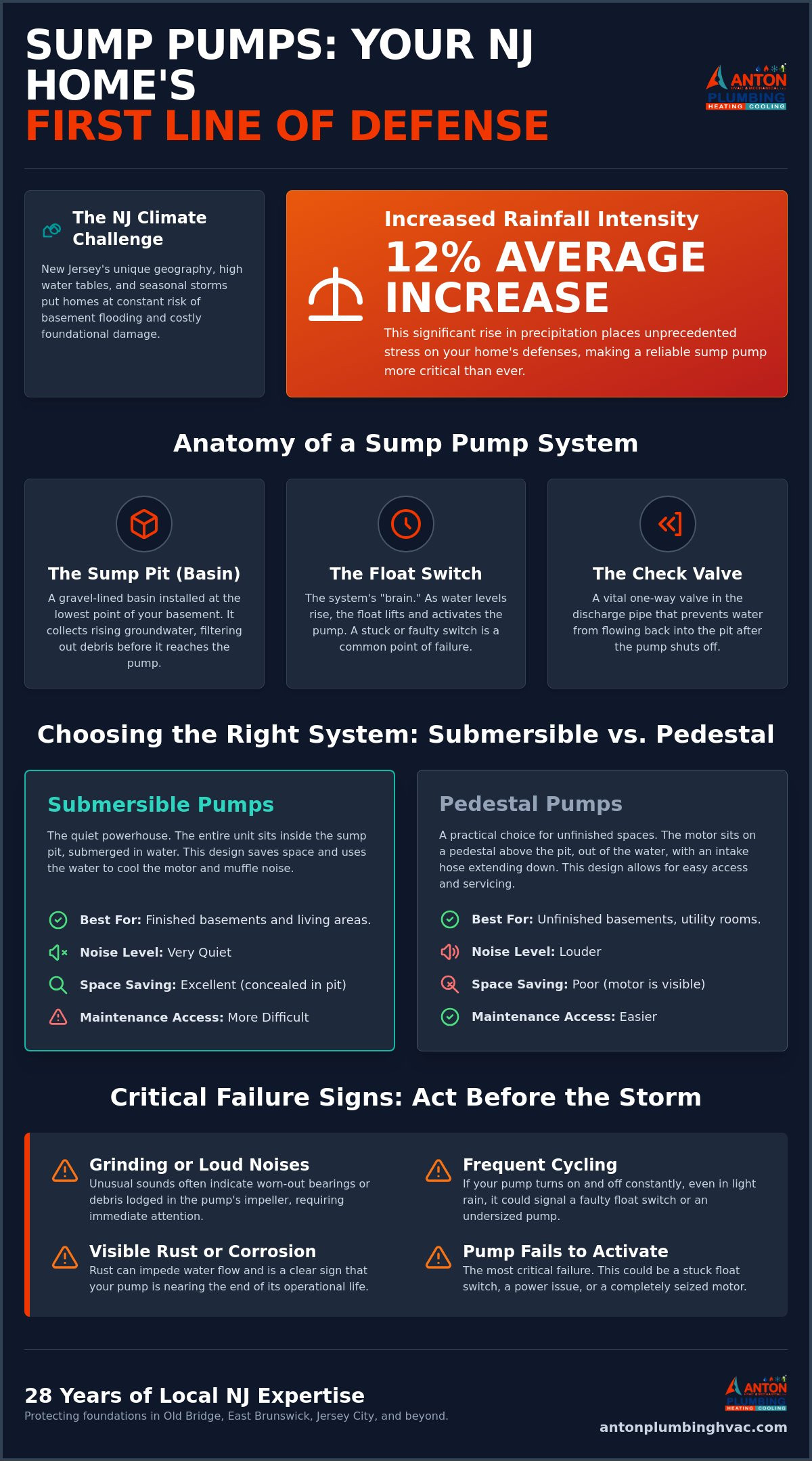
New Jersey’s geography presents a unique challenge for homeowners. Between the high water tables in Middlesex County and the low-lying coastal plains of Hudson County, groundwater is a persistent threat to your basement’s structural integrity. A sump pump acts as your home’s primary defense system against this moisture. It’s a specialized mechanical device installed in a carved-out basin, known as a sump pit, designed to collect and redirect water before it can breach your floor or walls. By actively managing the water level beneath your home, this system ensures that your living space remains dry even during the most intense storms.
Gaining a clear perspective on What is a Sump Pump? helps you appreciate why a failure during a heavy storm is a true crisis. When the system works correctly, it moves water through a discharge pipe to a designated zone far from your foundation. If this cycle breaks, you need immediate emergency sump pump repair NJ professionals can provide to stop water from rising. Without this active drainage, the water table beneath your house rises until it finds the path of least resistance. Usually, that path leads directly through your basement floor or the seams where the walls meet the foundation.
How Sump Pumps Protect NJ Foundations
Groundwater doesn’t just sit still; it exerts massive force called hydrostatic pressure against your basement walls. This pressure can cause concrete to bow, crack, or shift over time, leading to permanent structural damage. A functional pump relieves this pressure by giving the water a controlled exit. Beyond structural safety, keeping your basement dry prevents the rapid growth of mold and mildew during our humid New Jersey summers. For expert guidance on managing moisture levels, Subfloor Ventilation Sydney provides specialized solutions to eliminate dampness and protect property health. It also shields expensive mechanical assets like your furnace, boiler, and water heater from corrosive water damage. Protecting these systems is vital for your family’s comfort and your home’s long-term value.
The Anatomy of a Sump Pump System
A reliable system consists of several critical components that must work in perfect harmony to keep your home safe. Understanding these parts helps you spot trouble before it becomes a disaster:
- The Sump Pit (Basin): This is a gravel-lined hole where water naturally gravitates. The gravel liner acts as a filter to prevent silt and debris from clogging the pump’s intake.
- The Float Switch: This acts as the system’s brain. As water levels rise in the pit, the float lifts, mechanically triggering the pump to activate. If this switch sticks, the pump won’t turn on.
- The Check Valve: This one-way valve is a small but vital part of the discharge line. It ensures that once water is pumped out, it cannot flow back down into the pit when the motor stops.
If any of these components fail during a Nor’easter, the result is a rapid rise in water levels. Our team brings over 28 years of experience to every emergency sump pump repair NJ call, ensuring your home remains a dry, safe sanctuary for your family. We don’t just fix the machine; we restore your home’s first line of defense.
Choosing the Right System: Submersible vs. Pedestal Pumps
Selecting a sump pump isn’t just a matter of picking a model off a shelf; it’s about matching mechanical specs to your home’s specific layout. In New Jersey, where groundwater levels vary wildly between the dense urban foundations of Jersey City and the suburban yards of Old Bridge, the wrong choice can lead to a flooded basement. If your current system is undersized or poorly suited for your space, you may find yourself calling for emergency sump pump repair NJ when the next heavy rain hits. Our goal is to ensure you have the right hardware in place to prevent that emergency before it starts.
Submersible Pumps: The Quiet Powerhouse
Submersible pumps are high-horsepower units designed to sit entirely underwater within the sump pit. Because the water surrounds the motor, it helps keep the unit cool and significantly muffles the sound of operation. These are the gold standard for homes in East Brunswick with finished basement living areas or basement bedrooms where noise would be a major disruption. While they handle small debris better than other models, their submerged position means they’re more difficult to access for minor maintenance. Their space-saving design and quiet performance make them the preferred choice for modern renovations.
Pedestal Pumps: Accessibility and Longevity
A pedestal pump features a motor that sits on a vertical column well above the sump pit. Since the motor stays dry, it generally has a longer lifespan and remains easily accessible for routine checkups. The tradeoff is that these units take up more floor space and produce a loud, audible hum when running. They’re best for utility rooms or unfinished crawl spaces where noise isn’t a concern. If you’re unsure which model fits your home’s footprint, you can schedule a professional consultation to evaluate your basement’s specific needs.
Beyond the pump type, material quality is a non-negotiable factor. We always recommend cast iron housings over plastic alternatives. Cast iron dissipates heat more effectively during high-demand periods, which prevents the motor from burning out during a multi-day storm. This durability is essential for handling the flow rates required in low-lying areas of Jersey City where the pump might run continuously for hours.
For those interested in the industrial-grade standards that inform reliable water management, visit Water Services, Inc. to explore specialized hardware designed for high-capacity systems.
The Critical Role of Battery Backups
New Jersey Nor’easters often bring heavy rain and high winds that knock out local power grids. A battery backup is the only thing standing between a dry home and a flood when the grid goes down. While primary pumps run on standard AC power, a battery-powered backup system kicks in automatically during an outage or if the primary pump fails. For 2026 homes, we recommend advanced battery systems that offer longer run times and smartphone alerts, ensuring you’re never left in the dark about your home’s safety. Integrating this second layer of protection is the hallmark of a truly secure household.
Sump Pump Repair: Signs Your System is Failing
A failing sump pump often gives subtle warnings before it quits entirely. Ignoring these signs in a state like New Jersey, where groundwater levels can shift rapidly, is a gamble with your home’s foundation. If you notice your system behaving strangely, you likely need a professional diagnostic to avoid the chaos of a midnight flood. Catching a mechanical issue early can be the difference between a simple part replacement and needing a full-scale emergency sump pump repair NJ response during a heavy storm.
Listen to the sounds coming from your sump pit. A healthy pump should produce a steady hum. If you hear grinding, rattling, or loud thumping, these are red flags. Grinding usually points to a damaged impeller, the internal component that moves the water. Rattling suggests a failing motor or loose hardware. Thumping sounds often indicate a faulty check valve, which allows water to crash back down into the pit when the pump shuts off. This backflow forces your pump to work twice as hard, significantly shortening its lifespan.
Watch the frequency of operation. If your pump turns on and off every few minutes, it’s “short cycling.” This is often caused by a misaligned float switch or a check valve that isn’t sealing properly. Conversely, if the motor is running but the water level in the pit isn’t dropping, you have a serious problem. This usually indicates a clogged discharge line or a motor that has lost its priming capability. Finally, look for visible rust or corrosion on the housing. In the damp environment of a New Jersey basement, these signs suggest the metal is degrading, making a total failure inevitable.
Troubleshooting Common Pump Issues
Before you panic, perform a few basic checks. Ensure the GFCI outlet hasn’t tripped, as these sensitive breakers can sometimes pop during electrical surges. Next, reach into the pit and manually lift the float switch to see if the pump engages. Sometimes the float gets pinned against the side of the basin, preventing it from rising with the water level. In autumn, check the exterior discharge pipe for leaf debris. During freezing New Jersey winters, ensure the outlet isn’t blocked by ice, which can cause water to back up and burn out your motor. These simple steps can often resolve minor issues without a service call.
When to Repair vs. Replace Your Sump Pump
Most high-quality pumps have a reliable lifespan of about 10 years. If your unit is approaching a decade of service, it’s a liability, especially in high-risk Jersey City flooding zones where the water table is notoriously high. We generally follow a simple cost-benefit rule: if the repair cost exceeds 50 percent of the price of a new, high-efficiency unit, replacement is the smarter investment. Newer models offer better energy efficiency and integrated smart alerts that older units lack. For urgent failures that require an immediate solution, contact our emergency plumbing services in NJ. We provide the honest diagnostics you need to decide if your current system is still a reliable guardian for your household.
Professional Sump Pump Installation: What to Expect
A professional installation is the foundation of a dry home. While many homeowners focus on the pump itself, the physical setup of the basin and discharge lines determines how well that hardware performs during a crisis. A poorly installed system is often the root cause of late-night calls for emergency sump pump repair NJ residents face during heavy storms. Our team approaches every installation with the precision of a protective expert, ensuring your home’s defense is robust from day one.
We start with a comprehensive site assessment. This involves identifying the lowest point of your basement floor, where groundwater naturally migrates. In areas like Jersey City with older foundations, this step is critical for effective drainage. Once we pinpoint the location, we begin the excavation process. We don’t just dig a hole; we create a stable, gravel-lined base for the basin. This gravel prevents the pit from shifting over time and acts as a natural filter, keeping heavy silt from entering your pump’s intake and causing premature motor failure.
The Installation Process: From Pit to Discharge
Correctly sizing the sump pit is essential for system longevity. If the basin is too small, your pump will cycle too frequently, burning out the motor. If it’s too large, water may sit too long, leading to humidity issues. We use high-quality PVC piping and secure, heavy-duty check valves to ensure every gallon of water moves efficiently. We route the discharge line far from your foundation to prevent water from simply recycling back into your basement. Finally, we seal the pit with a gas-tight lid. This is a safety requirement that also helps prevent radon gas from entering your living space.
Local NJ Regulations and Drainage Standards
New Jersey has strict standards regarding where you can send your groundwater. In towns like Old Bridge and East Brunswick, it’s illegal to discharge sump water into the sanitary sewer system. Doing so can overwhelm local treatment plants and lead to heavy fines. We ensure your system meets all municipal codes, which is also a vital requirement for maintaining your homeowners insurance coverage. Using a licensed professional protects you from both flooding and legal complications. If you’re ready to upgrade your home’s protection, contact us for a professional sump pump installation today.
The final step is rigorous testing. We don’t just plug the unit in and leave. We run multiple “live water” cycles to calibrate the float switch and ensure the pump activates exactly when it should. This testing phase guarantees that when a real emergency strikes, your system is ready to respond without hesitation. By investing in a professional setup now, you significantly reduce the likelihood of needing an emergency sump pump repair NJ call during the next major Nor’easter.
Reliable Sump Pump Services in Old Bridge, East Brunswick, and Jersey City
Anton Plumbing Heating & Cooling has spent over 28 years serving as a guardian for homes in Old Bridge, East Brunswick, and Jersey City. We know that when a storm hits, you don’t need a corporate call center; you need a neighbor who understands exactly how Jersey soil holds water. Our commitment to integrity means we provide honest diagnostics. We don’t recommend a full replacement if a simple float switch repair will suffice. Every service comes with transparent pricing so you aren’t left with financial surprises in the wake of a flood.
Disasters don’t wait for business hours. That’s why we provide 24/7 availability for emergency sump pump repair NJ homeowners can depend on during the height of a Nor’easter. When the rain is relentless and your pit is overflowing, our licensed professionals respond with the specialized equipment needed to restore your home’s safety. Whether you require emergency sump pump repair NJ services at 3 AM or a scheduled maintenance visit, our team arrives ready to work. We handle everything from routine annual checkups to complex new system installations for high-risk coastal properties.
Why Old Bridge Trusts Anton Plumbing Heating & Cooling
As a family-owned and operated business, we treat your household’s well-being as our own. Our technical standards meet the highest industry requirements, but our approach remains neighborly and community-focused. Because we are licensed NJ professionals, we ensure every installation and repair complies with local plumbing codes and environmental regulations. Beyond pump services, we help keep your home safe with professional drain cleaning to prevent backup issues throughout your entire plumbing system.
Schedule Your Sump Pump Inspection Today
Preventative maintenance is significantly cheaper than the staggering cost of emergency flood cleanup and property restoration. A quick inspection can reveal failing check valves or corroded impellers that would otherwise go unnoticed until the next heavy rainfall. We make the process simple by providing fast, reliable estimates for both repairs and new high-efficiency installations. Don’t wait for the silence of a failed pump to signal a crisis. Contact Anton Plumbing for Sump Pump Services today and ensure your basement stays dry through every season.
Secure Your Peace of Mind Before the Next Storm Hits
A reliable sump pump is the only barrier between your family’s sanctuary and the rising groundwater common throughout New Jersey. You’ve seen how choosing the right submersible or pedestal model and ensuring a professional, code-compliant installation can prevent catastrophic foundation damage. Don’t let the anxiety of a failing system haunt you during the next Nor’easter. While we are always ready to provide the emergency sump pump repair NJ homeowners need during a crisis, proactive maintenance is your most effective tool for long-term security.
With over 28 years of experience, our family-operated team stands as a protective expert for households in Old Bridge and beyond. We combine technical precision with a neighborly commitment to your domestic well-being. Whether you need a routine inspection or a complete system overhaul, our fully licensed and insured professionals are available with a 24/7 emergency response to keep your basement dry and your family safe. Secure Your Basement Today with Anton Plumbing’s Sump Pump Services. Your home is your greatest investment; let’s work together to protect it.
Frequently Asked Questions
How often should I test my sump pump in NJ?
Test your system at least every three to four months. In New Jersey, it’s vital to perform a test before the spring thaw and the late summer hurricane season. Pour enough water into the pit to trigger the float switch and ensure the motor engages and discharges water immediately. Regular testing helps you identify mechanical issues before they escalate into a crisis.
Does a sump pump need a dedicated circuit?
Yes, your sump pump should always have its own dedicated circuit. These units draw a significant amount of power when the motor first kicks on. If the pump shares a circuit with other appliances, it can easily trip a breaker. This leaves your home completely unprotected during a heavy storm when you need the system to be most reliable.
What is the average lifespan of a submersible sump pump?
The average lifespan of a submersible model is approximately 10 years. While high-quality cast iron units might last longer with annual maintenance, a decade is the standard benchmark for reliability. If your pump is approaching this age, it becomes a liability. Replacing an aging unit is a smart investment that prevents the sudden need for emergency sump pump repair NJ homeowners face during floods.
Why is my sump pump making a loud humming noise but not pumping?
A loud humming noise usually indicates that the motor is receiving power but the internal impeller is jammed or the motor has seized. This often happens when debris enters the pit or if the unit is failing due to age. Turn off the power to the unit immediately to prevent the motor from burning out or causing an electrical fire, and contact a professional for a diagnostic.
Can I install a sump pump myself or do I need a plumber?
You should always hire a licensed plumber for sump pump installation. Proper pit placement, stable gravel lining, and correct discharge routing are technically demanding tasks. DIY mistakes can lead to foundation erosion or legal trouble. Most New Jersey municipalities have strict codes that forbid draining groundwater into the sanitary sewer system, which a professional will ensure you follow.
Will a sump pump work if the power goes out during a storm?
A standard AC-powered pump will not operate during a power outage. To keep your basement dry when the grid goes down, you must have a battery backup system installed. This secondary unit runs on DC power and activates automatically the moment it detects a loss of primary electricity, providing a critical safety net during severe Nor’easters.
Is it normal for a sump pump to run constantly during heavy rain?
It’s normal for a pump to cycle frequently during a heavy storm, but it shouldn’t run non-stop without any breaks. Constant operation suggests the pump might be undersized for the volume of water entering your pit. It could also mean the check valve has failed, which allows water to flow back into the basin and forces the pump to work on the same water repeatedly.
Does insurance cover basement flooding if my sump pump fails?
Standard homeowners insurance policies typically don’t cover damage from a failed sump pump unless you’ve added a specific water backup rider. Without this additional coverage, you could be responsible for all restoration costs. Maintaining your system with professional emergency sump pump repair NJ services is the best way to prevent a disaster that your insurance might not cover.


