What if that frustrating trickle in your shower isn’t just a bad fixture, but a warning sign from your entire plumbing system? You shouldn’t have to wait an hour for your dishwasher to fill or struggle to rinse soap off in the morning. It’s exhausting to deal with weak flow that disrupts your home’s domestic well-being. When you notice the water pressure low in whole house Old Bridge, the anxiety of a potential underground leak or a major pipe failure can feel overwhelming.
We understand that your home is your sanctuary, and we’re here to provide the technical clarity you need. This guide will help you identify the root cause of your weak water flow and explain when it’s time to call a licensed Old Bridge professional. We’ll walk through a diagnostic process to determine if the problem is inside your walls or a result of local infrastructure issues, like the recent water main breaks reported on Route 34 or Route 516. You’ll learn how to distinguish between municipal failures and private plumbing repairs so you can restore a strong, steady flow to every faucet in your house.
Key Takeaways
- Learn to distinguish between a single clogged fixture and a systemic plumbing failure that impacts every tap in your home.
- Identify the common culprits for water pressure low in whole house Old Bridge, including corroded pipes and failing pressure reducing valves.
- Discover how to perform a water meter test to detect silent leaks before they cause significant structural damage to your foundation.
- Follow a professional diagnostic checklist to rule out water heater malfunctions and verify your main shut-off valve is fully operational.
- Explore how advanced diagnostic technology can locate underground main line breaks with precision, avoiding the need for disruptive digging.
Why is Water Pressure Low in My Whole House? Old Bridge Context
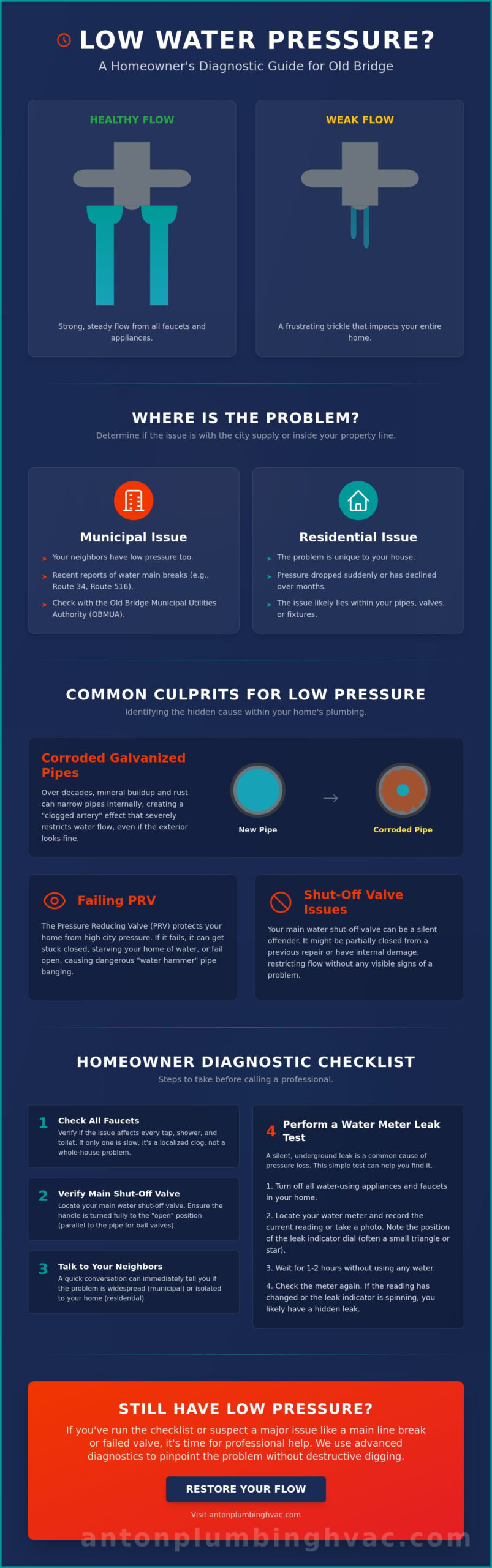
When you discover the water pressure low in whole house Old Bridge, it’s rarely a coincidence. Whole-house low pressure is defined as a consistent, noticeable drop in flow across every faucet, showerhead, and appliance in your home. Unlike a localized clog, where only one sink might be slow, a systemic failure indicates a problem with your main water line, your pressure regulator, or the municipal supply itself. It’s a frustrating experience that turns simple chores into time-consuming burdens.
In many Old Bridge neighborhoods, aging infrastructure is a common reality. Whether you live near Route 516 or closer to the Sayreville border, older homes often rely on pipes that have served families for decades. As a protective expert for your home, we know that ignoring these symptoms can lead to more than just a weak shower. It can be the first sign of a pipe nearing its breaking point. Understanding how water gets to your home through the municipal grid is the first step in diagnosing why that flow has suddenly vanished.
Municipal vs. Residential Issues in Middlesex County
Before you assume your plumbing has failed, determine if the problem stops at your property line. The Old Bridge Municipal Utilities Authority (OBMUA) manages a vast network, but main breaks occur more often than most homeowners realize. For instance, major breaks on Route 34 in early 2026 caused significant pressure fluctuations for local residents. Check with your neighbors; if everyone on the block is struggling, the issue likely lies with the city or a neighborhood-wide break. If the problem is unique to your address, the culprit might be your curb stop valve. This is the shut-off point where the city’s pipe meets yours. A partially closed or damaged curb stop will throttle your entire home’s supply without warning.
Sudden Pressure Drop vs. Gradual Decline
The speed of the pressure loss tells a story. A sudden, dramatic drop often points to a mechanical failure or a major breach. This could be a failed Pressure Reducing Valve (PRV), which is the bell-shaped device designed to regulate incoming pressure. If this component fails, it can restrict flow entirely to protect your pipes from high-pressure bursts. On the other hand, a gradual decline over months or years usually indicates internal pipe corrosion or mineral buildup. In Old Bridge, where groundwater from local wells is mixed with surface water, minerals can slowly narrow the diameter of older galvanized steel pipes. Homeowners should monitor these flow changes seasonally to catch issues before they become emergencies.
Common Culprits: Why Your Old Bridge Home Lost Its Flow
When you experience water pressure low in whole house Old Bridge, the cause is usually hidden deep within your infrastructure. It is rarely a single broken tap. Instead, it is a systemic failure that requires a professional diagnostic eye. Identifying the specific culprit is the first step toward restoring your home’s domestic well-being and security. Whether the issue is a mechanical failure or a slow chemical reaction, understanding these common culprits will help you make an informed decision for your family’s safety.
The Crisis of Corroded Galvanized Pipes
Many homes in Old Bridge, particularly those built several decades ago, still rely on galvanized steel lines. These pipes were once the industry standard, but they have a finite lifespan. Over time, the internal zinc coating reacts with the minerals found in Middlesex County water. This reaction causes internal rust to bloom, creating a “clogged artery” effect. While the exterior of the pipe may look solid, the interior diameter can narrow to the size of a drinking straw. This restriction is a primary reason for water pressure low in whole house Old Bridge. Cleaning these lines is rarely effective because the corrosion is part of the pipe’s structure. In these cases, we believe the most ethical solution is a targeted replacement with modern materials to ensure your home remains leak-free for the next generation.
Pressure Regulators and Shut-off Valves
Your Pressure Reducing Valve (PRV) is a critical guardian of your plumbing system. Usually located near your main shut-off, this bell-shaped device is designed to throttle high-pressure municipal water down to a safe level for your appliances. If the internal spring or diaphragm fails, it can either lock in a closed position, starving your home of water, or fail “high.” A high-pressure failure is dangerous because it leads to “water hammer,” where pipes bang violently, potentially causing joints to burst.
Additionally, your main shut-off valve can be a silent offender. If your home uses an older gate valve, characterized by a round, wheel-like handle, the internal gate can detach from the stem. This means the valve might stay partially closed even if you have turned the handle all the way to the “open” position. Modern ball valves, which use a simple lever, are far more dependable and provide a clear visual indicator of their status. If you find your valves are stuck or leaking, our team can provide expert plumbing repair and installation to secure your main supply line and restore consistent pressure.
Hidden underground leaks also play a significant role in pressure loss. If a break occurs in the service line between the street and your meter, the escaping water siphons off the flow intended for your home. This type of leak is particularly hazardous because it can wash away soil, leading to foundation instability over time. Monitoring your yard for unusually lush green patches or soft, soggy spots is essential for early detection.
Sudden Low Pressure: Is it an Emergency Plumbing Situation?
A sudden, dramatic drop in flow is a high-stakes event that differs from the gradual decline of aging pipes. When you find the water pressure low in whole house Old Bridge without any warning, it often signals a catastrophic failure rather than a simple maintenance issue. This situation requires immediate action to protect your home’s foundation and your family’s domestic well-being. Treating a sudden pressure loss as a minor nuisance is a mistake; instead, view it as a critical symptom that demands a professional diagnostic approach.
Start by identifying the ‘Silent Leak.’ You can do this by checking your water meter, which is usually located in your basement or a utility closet. Ensure every faucet, shower, and appliance is turned off, then observe the meter’s leak indicator. If the small dial or triangle is spinning while your home is silent, water is escaping at a high volume. This often indicates a breach in your main service line. Because water undermines the soil it flows through, a hidden leak can quickly lead to foundation instability or sinkholes on your property. Reaching a qualified Emergency Plumber Old Bridge NJ is the most effective way to mitigate these risks before they escalate into structural damage.
The ‘Neighbor Test’ and Municipal Alerts
Before assuming the crisis is yours alone, perform a quick ‘neighbor test.’ If your neighbors are also experiencing a sudden loss of flow, the issue likely rests with the municipal grid. Old Bridge residents are served by different entities depending on their exact location, including the Old Bridge Municipal Utilities Authority (OBMUA) and NJ American Water. Check their official websites or social media feeds for alerts regarding recent water main breaks. If your neighbors have full pressure but you don’t, the problem is isolated to your property line. This confirms that the failure exists between the municipal curb stop and your home’s internal plumbing.
Signs of a Main Line Break
Main line failures often leave physical clues in your yard or basement. Walk your property and look for unusually lush, green patches of grass or soggy, soft spots, even if it hasn’t rained recently. These are clear indicators that your main water line is leaking underground. Inside the home, listen for hissing, whistling, or bubbling sounds near the point where the water line enters your basement. If the sudden drop in flow is accompanied by sediment, sand, or brown discoloration in your water, the pipe has likely breached, allowing New Jersey soil to enter your drinking supply. These signs confirm that you are dealing with a water pressure low in whole house Old Bridge emergency that requires specialized equipment to resolve.
Homeowner Checklist: Steps to Take Before Calling Anton
Before you commit to a professional service call, performing a few simple diagnostic steps can save time and provide clarity. While we’ve already discussed how systemic failures like main line breaks or corroded pipes can leave the water pressure low in whole house Old Bridge, some issues are simpler to identify. By following this structured checklist, you can gather the technical data our team needs to resolve your problem efficiently. These actions protect your home’s domestic well-being and ensure you aren’t overlooking a minor adjustment.
- Test temperature flow: Run the cold water for a minute, then switch entirely to hot. If the pressure only drops when the water is hot, your pipes aren’t the problem.
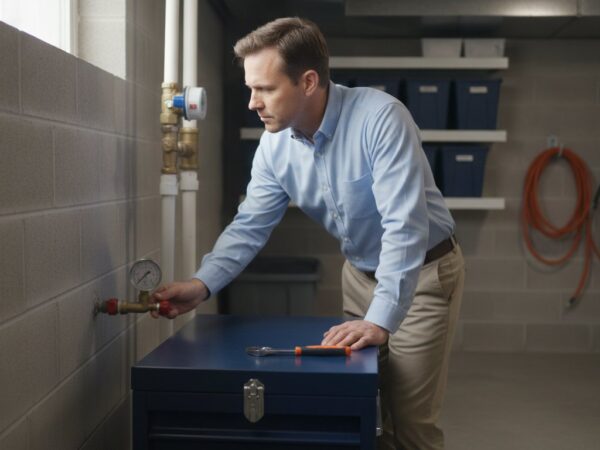
- Inspect the main shut-off valve: Locate your primary valve, usually found in the basement or utility closet near the water meter. Ensure the lever is fully parallel to the pipe or the wheel is turned completely counter-clockwise.
- Check the Pressure Reducing Valve (PRV): Look for signs of “weeping” or moisture around the bell-shaped regulator. A damp PRV often indicates an internal diaphragm failure.
- Perform a fixture audit: Unscrew the aerators from three different faucets. If the pressure returns to normal with the screens removed, you are dealing with localized sediment rather than a main line issue.
If these steps don’t reveal a simple fix, you likely have a deeper systemic issue. In such cases, it is best to schedule a professional plumbing inspection to prevent further infrastructure damage.
Hot vs. Cold Pressure Discrepancies
If your diagnostic test reveals that only hot water is weak, the culprit is likely your water heater. Over time, the minerals in Central Jersey water settle at the bottom of the tank, creating a thick layer of sediment. This buildup acts like a literal bottleneck, restricting the volume of water that can exit the tank and reach your taps. If your unit is more than a decade old, this internal restriction often signals that the tank is nearing the end of its functional life. You can learn more about choosing a high-efficiency replacement in our Water Heater Replacement in Old Bridge guide.
The Aerator and Fixture Audit
Old Bridge homeowners frequently deal with “hard water” that carries a high mineral content. These minerals can break loose from the municipal grid and get trapped in the fine mesh screens of your faucet aerators. If you find the water pressure low in whole house Old Bridge only at specific sinks, cleaning these screens is your first line of defense. Soak the aerators in white vinegar for thirty minutes to dissolve the calcium deposits. However, if you remove the aerators and the flow remains weak at every single fixture, the restriction exists in your main supply line or the PRV we discussed earlier. At that point, the problem is systemic and requires advanced diagnostic tools to resolve safely.
Restoring Flow: Professional Main Water Line Solutions in Old Bridge
When DIY checks fail to pinpoint the cause, professional intervention becomes necessary to protect your home’s infrastructure. Restoring a weak supply requires more than just a quick fix; it demands specialized equipment and deep local knowledge. If you are still dealing with the water pressure low in whole house Old Bridge, we utilize advanced underground water leak detection to find the exact point of failure. This high-tech approach allows us to locate breaks beneath your lawn or driveway without the need for destructive digging. We also employ hydro jetting to remove stubborn mineral obstructions that traditional snaking simply cannot reach, ensuring your pipes are as clear as the day they were installed.
Trenchless and Traditional Pipe Repair
We evaluate every situation to determine if a main line needs a full replacement or a targeted repair. Trenchless technology often allows us to restore your service with minimal impact on your landscaping. However, if your pipes are severely corroded galvanized steel, a traditional main water line repair and installation ensures your system meets current Old Bridge plumbing codes. We prioritize these main line failures because we know that a total loss of water is a domestic emergency. To prevent future catastrophes, we recommend installing a smart water monitor shutoff. This device detects minute pressure changes and automatically closes your valve if a leak is detected, providing immediate relief and long-term security for your household.
The Anton Advantage: Licensed and Family-Owned
Choosing a licensed and family-owned partner makes a difference in the quality of your home’s maintenance. With over 28 years of experience specifically in Old Bridge soil, we understand the unique challenges of the local water supply grid. Holding a New Jersey state Plumbing license and a New Jersey state HVACR license isn’t just about compliance; it’s about providing the high-trust expertise your family deserves. We value clarity in all our communications, offering no-fluff explanations and transparent financial expectations. Our goal is to act as a guardian for your home, ensuring your utility systems are safe and efficient. To make major repairs accessible, we offer the following benefits:
- Rebate programs: We help you identify available local and state rebates to offset the cost of high-efficiency upgrades.
- Zero interest financing: We provide flexible payment options to ensure your home’s safety isn’t delayed by budget constraints.
- 28+ years of expertise: Our long-term presence in the community means we’ve seen and solved every local plumbing complication.
- Ethical standards: We only recommend the repairs you actually need to restore the water pressure low in whole house Old Bridge.
Don’t let a weak trickle disrupt your life any longer. By combining technical excellence with a neighborly approach, we provide the straightforward, professional answers you need to get your home back to normal. Your domestic well-being is our top priority, and we’re ready to respond at a moment’s notice to secure your water supply.
Secure Your Home’s Water Supply and Domestic Well-being
You now have the tools to distinguish between a simple fixture clog and a major systemic failure. Whether the culprit is a failing pressure regulator, sediment buildup in your water heater, or aging galvanized pipes, resolving these issues quickly is essential for your home’s security. Dealing with water pressure low in whole house Old Bridge doesn’t have to be a source of constant anxiety for your family. By following the diagnostic steps we’ve shared, you can determine if the problem is a local municipal issue or a private plumbing failure that requires expert intervention.
Our team brings 28+ years of local NJ experience to every diagnostic call we perform. As licensed NJ State Plumbing and HVACR professionals, we use advanced technology to restore your flow with precision and integrity. We maintain 24/7 emergency availability in Old Bridge to ensure you’re never left without a functional water supply during a crisis. Restore your water pressure today—Contact Anton Plumbing for a Professional Diagnostic! Your home deserves a strong, steady flow, and we are ready to help you achieve it.
Frequently Asked Questions
Is low water pressure in the whole house always a plumbing emergency?
Low water pressure isn’t always an emergency, but you should treat a sudden drop with high-stakes urgency. If your flow vanishes instantly, it often signals a major underground leak or a catastrophic main line failure that could threaten your foundation. A gradual decline over several months is typically a maintenance issue, such as pipe corrosion, that we can resolve through a scheduled professional diagnostic visit.
Can a failing water heater cause low water pressure throughout the house?
A failing water heater usually only impacts the pressure of your hot water supply. If you notice the water pressure low in whole house Old Bridge specifically when the hot tap is running, sediment buildup in your tank is likely the culprit. This mineral layer restricts the volume of water leaving the unit. If your cold water pressure is also weak, the problem is systemic and located in your main supply line or regulator.
How do I know if my Pressure Reducing Valve (PRV) is bad?
You can identify a bad PRV by listening for vibrating pipes or “water hammer” noises when you turn off a faucet. The PRV is a bell-shaped regulator that manages incoming municipal pressure. If the internal diaphragm fails, it can lock in a closed position and starve your home of water. If you see moisture or “weeping” around the valve body, the mechanical components have reached the end of their lifespan.
Does Old Bridge municipal water have known pressure issues?
Yes, Old Bridge experiences occasional pressure drops due to aging infrastructure and localized water main breaks. Significant events occurred on Route 34 in February 2026 and Route 516 in August 2025, which impacted flow for hundreds of residents. If your neighbors are also struggling with weak flow, the issue likely rests with the Old Bridge Municipal Utilities Authority (OBMUA) rather than your private plumbing system.
Will cleaning my pipes fix whole-house low pressure?
Cleaning pipes is rarely a permanent solution for whole-house issues caused by internal corrosion. If your home has older galvanized steel lines, the rust is part of the pipe’s structure and creates a permanent restriction. While hydro jetting is highly effective for clearing sediment or mineral obstructions in some cases, replacing the affected sections is often the most ethical and reliable way to restore a steady flow.
What is the cost range for main water line repair in NJ?
Costs for main water line repairs vary based on the depth of the pipe, the materials required, and whether we can use trenchless technology. We provide clear financial expectations after a professional diagnostic inspection of your property. Factors such as the distance from the street to your home and the specific condition of the Old Bridge soil will influence the scope of the restoration work needed.
Can a clogged drain cause low water pressure?
No, a clogged drain cannot cause low water pressure. Your drains are part of a separate system designed to remove wastewater using gravity, while your supply lines deliver pressurized water to your fixtures. If you are experiencing both slow drains and weak flow, you are likely facing two distinct plumbing complications. These would require separate professional solutions, such as drain cleaning and main line repair.
How long does it take to restore water pressure professionally?
Most professional pressure restorations are completed within a single business day. Simple repairs, such as replacing a failed Pressure Reducing Valve or cleaning internal aerators, typically take only an hour or two. More complex projects, like a main water line installation, require several hours but are usually finished by the evening. Our goal is to minimize friction and restore your home’s domestic well-being as quickly as possible.


