
That pooling puddle near your air handler isn’t just a mess; it’s a plumbing failure hiding inside your cooling system. You’re likely worried that your entire unit is broken or that the heavy New Jersey humidity has finally won the battle against your drywall and subfloors. It’s a stressful situation for any homeowner, especially when you’re just trying to keep your family comfortable and safe during a summer heatwave.
We understand the urgency of an AC leaking water inside house NJ, and we’re here to provide the steady, professional guidance you need. With over 28 years of experience as licensed plumbing and HVACR experts, we’ve seen how a small drip can quickly turn into a major repair if it’s left unchecked. This article will help you discover the exact reasons behind the moisture and teach you the immediate steps to prevent costly water damage to your home’s infrastructure.
You’ll learn how to identify common culprits like clogged condensate lines or dirty filters. We’ll also explain how the 2026 refrigerant regulations might impact your repair options. By the end of this guide, you’ll know whether you’re facing a simple maintenance task or if it’s time to bring in a protective expert to restore your home’s security and cooling.
Key Takeaways
- Shut off your system at the thermostat immediately to stop moisture production and prevent damage to your subfloors or drywall.
- Identify if your AC leaking water inside house NJ is caused by a common condensate drain line clog or a more serious mechanical failure.
- Distinguish between harmless condensation and hazardous refrigerant leaks by checking for oily residues or specific hissing sounds.
- Trust dual-licensed experts with 28 years of experience to provide high-tech diagnostic accuracy for both plumbing and cooling repairs.
- Utilize 24/7 emergency response services in Old Bridge and East Brunswick to restore your home’s comfort and security without delay.
Why is My AC Leaking Water Inside the House?
Finding a puddle near your air handler is a stressful experience for any homeowner. In New Jersey, where summer humidity levels often skyrocket, your air conditioner does double duty as a cooling system and a high-capacity dehumidifier. It doesn’t just lower the temperature; it actively strips moisture from your living space to keep you comfortable. This process creates a significant amount of liquid as a byproduct. Understanding How Air Conditioners Remove Humidity helps you see why a small mechanical failure can quickly lead to an AC leaking water inside house NJ.
In 2026, we are seeing more intense humidity spikes across Middlesex and Hudson Counties. This means your system is pulling more gallons of water from the air than in previous years. When the humidity is this high, any minor blockage in the drainage path becomes an immediate emergency. As licensed HVACR professionals, we treat these calls with high priority because the volume of water produced can damage your subfloors and drywall in a matter of hours.
The Role of the Evaporator Coil
The evaporator coil is the primary heat exchange component of your HVAC system. As warm, humid air from your home blows over these cold coils, the moisture in the air condenses into liquid water. A clean coil is essential for this process. If the metal fins are covered in dust or pet hair, the water can’t drip cleanly into the collection pan. Instead, the moisture hitches a ride on the debris and bypasses the drainage system entirely. This causes water to blow off the coil and spray into your ductwork or pool at the base of the unit.
How Your Drainage System Should Work
Your air conditioner is designed with a specific, gravity-fed path to handle this liquid. The water should drip off the coils into a primary drain pan. From there, it travels through a condensate drain line, which is usually a PVC pipe that carries the water outside your home or into a floor drain. If your unit is located in an attic, you likely have a secondary drain pan underneath the entire system to catch overflows before they ruin your ceiling. For homes in Old Bridge or Jersey City with basement units, the pipe’s slope is critical. Without a proper downward angle, the water sits still, allowing slime and algae to grow until the line is completely blocked. This is where our expertise in drain cleaning services becomes invaluable for a permanent fix.
The Top 5 Causes of Indoor AC Water Leaks in NJ
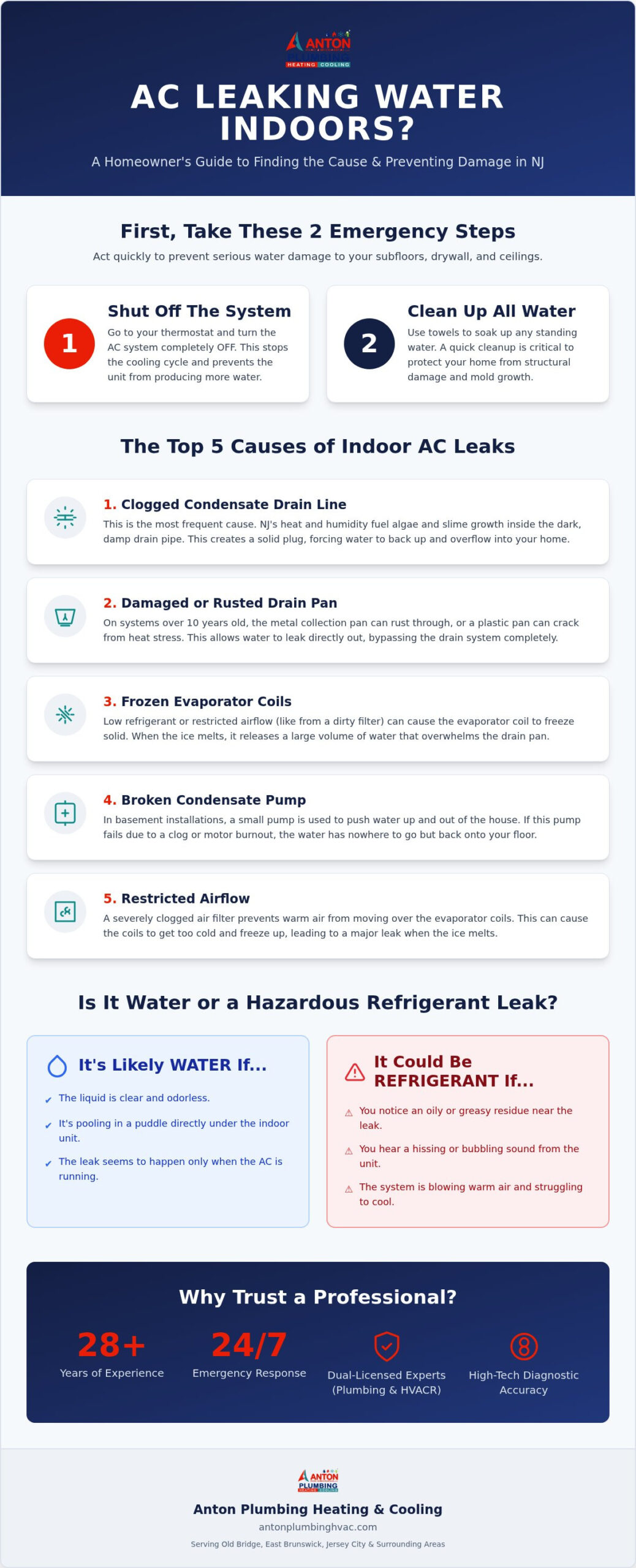
Identifying the source of a puddle is the first step toward protecting your home’s domestic well-being. While your system is complex, most cases of an AC leaking water inside house NJ boil down to five specific mechanical or maintenance failures. Our team treats these issues with the high-stakes urgency they deserve, ensuring your subfloors and drywall remain dry and secure.
The Algae Problem in NJ Drain Lines
NJ summers provide the exact heat and moisture that biological “slime” needs to thrive. Inside your dark, damp PVC drain line, algae can grow into a thick plug that completely blocks the flow of water. When this happens, the condensate has nowhere to go but back into your furnace cabinet. This is the most frequent cause of system shutdowns we see in Old Bridge and East Brunswick. For deep clogs that homeowners can’t reach, our expert drain cleaning services use high-tech accuracy to clear the line and restore proper flow.
Damaged or Rusted Drain Pans: If your air conditioner is older than 10 years, the primary drain pan may be reaching the end of its life. Older units often use metal pans that eventually rust through, while newer plastic versions can crack due to heat stress. Once a hole forms, water bypasses the drain line and leaks directly onto your floor.
Frozen Coils and Thawing Issues
If you notice ice forming on the copper refrigerant lines, your evaporator coil is likely frozen. This often happens because of low refrigerant levels or restricted airflow. When the ice eventually melts, it produces a volume of water that easily overwhelms the drain pan. Because EPA refrigerant leak regulations require specialized handling, you should turn the system off immediately to start the thawing process safely before a technician arrives.
Broken Condensate Pumps: Many Jersey City homes feature HVAC systems installed in basements. These setups rely on a small condensate pump to push water up and out of the house. If the pump’s motor fails or the float switch becomes stuck, the reservoir will overflow and flood the surrounding area.
Dirty Air Filters: A simple clogged filter is a surprisingly common culprit. When airflow is restricted, the evaporator coil gets too cold and freezes. Maintaining a clean filter is a vital part of being a guardian of your home’s infrastructure. If you’re unsure why your system is failing, a professional AC repair diagnostic can provide the immediate relief and clarity you need.
Is it Water or Refrigerant? How to Tell the Difference
Identifying the substance pooling on your floor is the first step toward restoring your home’s security. While an AC leaking water inside house NJ is often a drainage problem, it can sometimes be a sign of a refrigerant leak. These two issues require very different responses. Water is clear, odorless, and typically drips steadily. Refrigerant, however, exists as a gas at room temperature. You won’t see a puddle of refrigerant, but you might notice an oily residue on the copper lines or the evaporator coil where the gas escaped.
Listen for a distinct hissing or bubbling sound near your indoor unit. This indicates high-pressure gas escaping from the sealed system. You should also check the air coming from your vents. If the air is lukewarm despite the system running constantly, you’re likely facing a refrigerant issue. If you notice a faint, sweet chemical odor or see thick ice building up on the copper pipes, shut the system down at the thermostat immediately to prevent further compressor damage.
Why Refrigerant Leaks are an HVAC Emergency
Refrigerant leaks are a serious HVAC emergency that impacts both your family’s health and the environment. Under EPA Section 608 regulations, any refrigerant must be recovered by a certified technician before repairs begin. As of January 1, 2026, the production of new systems using R-410A is banned, making the maintenance of existing units even more critical as the cost of older coolants rises. You can’t simply top off a leaking system; the leak must be found and sealed. Our team holds a New Jersey state HVACR license, ensuring every repair meets the high-tech accuracy and ethical standards required for modern refrigerant handling.
Water Leaks: A Plumbing Priority
A water leak is a plumbing priority that can quickly compromise your home’s infrastructure. Standing water in a Jersey City basement or an Old Bridge attic promotes rapid mold growth and can warp expensive subfloors within hours. Your AC’s drainage system is often integrated with your home’s main waste line, meaning a backup could be a symptom of a larger plumbing failure. If the water is spreading fast, contacting a dual-licensed emergency plumber in Old Bridge NJ provides the immediate relief you need to save your home from structural damage. We treat these calls with the urgency of a guardian, protecting your property from the long-term effects of moisture infiltration.
Emergency Steps: What to Do Before the Technician Arrives
Discovering an AC leaking water inside house NJ requires immediate action to protect your home’s structural integrity. While you wait for a professional to arrive, you can take several steps to minimize damage and potentially identify the cause. We treat every water-related call with high-stakes urgency, but your initial response is the first line of defense for your subfloors and ceilings.
- Step 1: Turn off the AC at the thermostat immediately. This is the most critical move. Cooling the air creates condensation; by shutting the system down, you stop the production of new water and prevent electrical shorts.
- Step 2: Clear away standing water. Use towels or a mop to dry the area around the indoor unit. In New Jersey’s high humidity, moisture trapped against wood can lead to floor warping or mold growth in less than 48 hours.
- Step 3: Check the air filter. Pull the filter and inspect it. If it looks like a thick “dust blanket,” it’s likely restricting airflow and causing the evaporator coil to freeze. Replace it with a fresh one immediately.
- Step 4: Inspect the visible PVC drain line. Look for obvious cracks or loose fittings where the pipe connects to the unit. Sometimes a leak is simply a disconnected joint that needs a professional seal.
Safe DIY Troubleshooting
If you own a wet/dry shop vac, you can often clear a minor clog yourself. Locate the condensate drain exit on the exterior of your home and use the vacuum to pull any algae or “slime” through the pipe. This is a common fix for NJ homes during the peak of summer. If your system is in a basement, check the condensate pump. Sometimes the float switch gets stuck in the “up” position, causing the reservoir to overflow. Simply tapping the pump or clearing debris from the float can provide immediate relief. Never pour bleach down a modern high-efficiency drain without professional guidance, as the chemicals can damage sensitive internal components and heat exchangers.
When DIY is Not Enough
There are moments when a homeowner’s toolkit isn’t sufficient to solve the problem. If you see a rusted-through internal drain pan, no amount of vacuuming will stop the leak. This is especially dangerous for attic units where water can quickly seep through the floor and destroy the ceiling below. These complex mechanical failures require the high-tech accuracy of a protective expert. For residents in Middlesex County, securing professional HVAC repair in East Brunswick is the most reliable way to ensure your system is restored to peak efficiency. If you’re facing a flood you can’t control, contact us for 24/7 emergency support to safeguard your household well-being.
Expert AC Repair in Old Bridge, East Brunswick & Jersey City
When your home infrastructure fails, you need more than a quick fix; you need a guardian who understands the complex interplay between your cooling system and your plumbing. An AC leaking water inside house NJ is rarely a standalone mechanical issue. It’s often a failure of the drainage path that requires a specialized eye to resolve. Anton Plumbing Heating & Cooling has served as a reliable partner for New Jersey families since 1996, bringing over 28 years of seasoned experience to every service call in Middlesex and Hudson Counties.
Our protective expert approach ensures that we don’t just stop the immediate drip. We investigate the root cause to prevent future water damage to your subfloors and ceilings. During the 2026 summer season, we’ve maintained 24/7 availability to respond to these emergencies with the speed and professional steadiness that local homeowners deserve. Whether you’re in a historic Jersey City brownstone or a modern East Brunswick suburban home, we arrive ready to restore your domestic well-being.
The Anton Difference: Dual Licensing
Holding both a New Jersey state Plumbing license and an HVACR license is what distinguishes our team from traditional contractors. Most water leaks in an AC system are actually plumbing failures within the HVAC cabinet. By sending a technician who is an expert in both fields, we provide a level of high-tech accuracy that ensures your condensate lines are cleared and your refrigerant levels are safe. We utilize advanced leak detection technology to find hidden cracks in internal pans or secondary lines that others might miss. You can expect transparent communication and ethical service standards from the moment we enter your home, with no hidden fees or unnecessary upsells.
Schedule Your NJ AC Inspection Today
The best way to handle a leak is to prevent it before the first heatwave hits. We recommend seasonal tune-ups that include comprehensive drain line flushes and coil cleanings to keep your system running at peak efficiency. These proactive steps are essential for avoiding the stress of a mid-summer flood. We are proud to serve Old Bridge, East Brunswick, Jersey City, and the surrounding communities with rapid, neighborly response times. Don’t let a small puddle turn into a major structural repair. Contact Anton Plumbing Heating & Cooling for 24/7 AC Repair and let our family-operated team protect your home and your comfort.
Protect Your Home From Water Damage Today
Addressing an AC leaking water inside house NJ requires a combination of quick thinking and professional precision. By shutting down your system immediately and clearing standing water, you’ve already taken the most important steps to safeguard your subfloors and drywall. Whether the issue is a simple algae clog in your condensate line or a more complex failure of the internal drain pan, getting your cooling back to normal shouldn’t be a source of stress.
Our team at Anton Plumbing Heating & Cooling brings the high-tech accuracy of a Licensed NJ Master Plumber and HVACR Tech to every home. With 28+ years serving NJ families, we understand the specific challenges that local humidity poses to your infrastructure. We provide 24/7 emergency response in Old Bridge and East Brunswick to ensure you never have to face a utility failure alone. Trust a seasoned veteran to restore your domestic well-being with transparent, ethical service.
Stop the leak now; Schedule 24/7 Emergency AC Repair with Anton. We are ready to act as the guardian of your household and keep your family comfortable and safe all summer long.
Frequently Asked Questions
Can I still run my AC if it is leaking water inside?
No, you should shut it off at the thermostat immediately. Running the system continues the condensation process, which only adds more water to the existing leak. This can lead to dangerous electrical shorts or permanent structural damage to your home’s subfloors. It is much safer to stay warm for a few hours than to face the high cost of replacing warped wood or repairing a flooded furnace cabinet.
How much does it typically cost to fix an AC water leak in NJ?
The total cost depends entirely on the root cause of the failure and the parts required. A simple drain line flush is a routine maintenance task, while replacing a cracked internal drain pan or a failed condensate pump involves more labor and materials. Diagnostic fees are standard to identify the exact source of the moisture. We recommend a professional assessment to get a clear and honest quote for your specific system.
Is an AC water leak a plumbing job or an HVAC job?
It is actually a combination of both, which is why our dual licensing is so beneficial for homeowners. While the moisture is produced by the air conditioner, the failure usually happens within the drainage plumbing. A technician who holds both NJ State Plumbing and HVACR licenses can handle the mechanical cooling repair and the professional drain cleaning services needed to fix the leak permanently. This approach ensures your entire system is restored safely.
How do I unclog my AC condensate drain line myself?
You can attempt to clear a minor blockage by using a wet/dry shop vac on the exterior exit of the PVC drain line. Create a tight seal between the vacuum hose and the pipe to pull out accumulated algae and slime. If the clog is deep inside the unit, you will likely need specialized tools or high-pressure clearing. Avoid pouring bleach down modern high-efficiency drains, as the chemicals can corrode sensitive internal components and heat exchangers.
Why is my AC leaking water even when it is turned off?
This usually happens because the evaporator coil was frozen while the system was running. Once the unit is turned off, the ice begins to melt and turn back into liquid. The resulting volume of water often overwhelms the drain pan, leading to a puddle on your floor. It can also indicate a backup in the main drain line that is slowly seeping back into the unit through gravity even when the system is idle.
What happens if I ignore a small AC leak in my basement?
Ignoring a leak can lead to rapid mold growth and structural rot in your home’s foundation or walls. In New Jersey, high humidity levels make moisture problems escalate quickly. A small drip can ruin your furnace’s electrical components or keep your basement floor damp, which often attracts pests. Addressing an AC leaking water inside house NJ early prevents these high-stakes secondary damages and protects your family’s domestic well-being and security.
Can a dirty air filter really cause a water leak?
Yes, a dirty filter restricts the airflow necessary to keep the system functioning properly. When air cannot move freely, the evaporator coil gets too cold and eventually freezes over with ice. When that ice thaws, it produces far more water than the drain pan was designed to handle. Keeping your filters clean is one of the simplest ways to act as a guardian for your home’s infrastructure and prevent unnecessary service calls.
How often should I have my AC drain line cleaned in New Jersey?
We recommend a professional cleaning at least once per year as part of your spring maintenance routine. New Jersey’s humid climate creates a perfect environment for biological slime and algae to grow inside your PVC pipes. Annual flushes ensure your drainage system stays clear before the heat of the summer arrives. Taking this proactive step is the most effective way to prevent an AC leaking water inside house NJ from disrupting your comfort.


