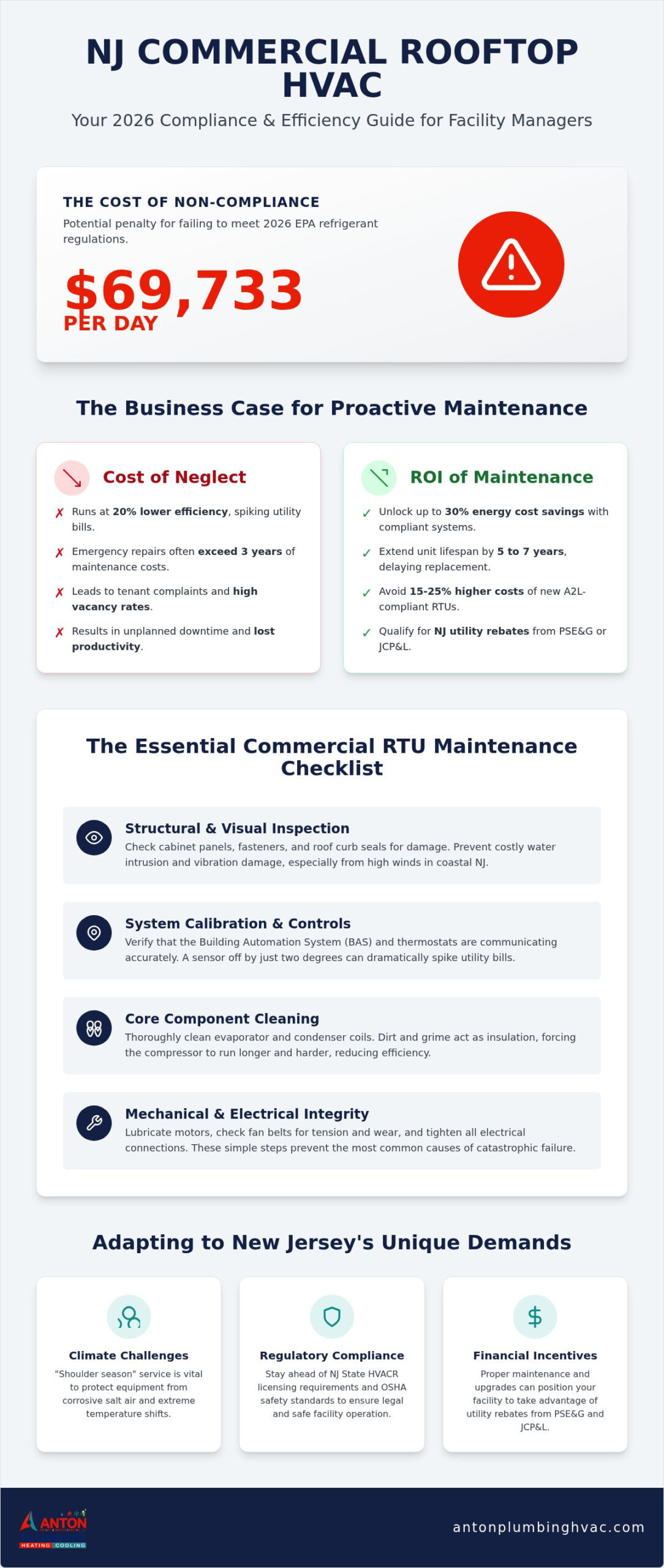
Did you know that non-compliance with the 2026 EPA refrigerant regulations can result in penalties as high as $69,733 per day? For a New Jersey facility manager, your rooftop unit acts as the guardian of your building’s infrastructure, yet it’s often the primary source of budget-breaking repair costs and tenant complaints. It’s stressful to manage aging equipment while navigating the shift to A2L refrigerants and new efficiency standards. We understand the high stakes of maintaining a professional environment, and we believe you deserve a clear path to compliance. That’s why we’ve developed this comprehensive commercial rooftop hvac maintenance checklist specifically for the NJ market.
This guide will help you protect your commercial investment and avoid costly downtime with a framework built for 2026 regulations. By following this NJ-specific approach, you can lower energy bills and position your facility to take advantage of utility rebates from PSE&G or JCP&L. We’ll provide a printable checklist for your internal teams and a deep dive into the latest state HVACR standards to ensure your building stays efficient and legal. Let’s look at how to turn your HVAC system from a liability into a reliable asset.
Key Takeaways
- Safeguard your commercial assets and prevent budget-draining emergency repairs by identifying early warning signs of rooftop unit failure.
- Utilize a comprehensive commercial rooftop hvac maintenance checklist that covers everything from visual panel inspections to advanced building automation system verification.
- Learn why New Jersey’s specific climate demands specialized “shoulder season” service to protect sensitive equipment from salt air and extreme temperature shifts.
- Stay ahead of NJ State HVACR licensing requirements and OSHA safety standards to ensure your facility operates legally and safely.
- Explore the advantages of professional service agreements that offer priority emergency response and keep your building’s infrastructure running at peak efficiency.
The Business Case for Commercial Rooftop HVAC Maintenance in New Jersey
Rooftop units (RTUs) are the hardest working assets in your New Jersey facility. Unlike indoor equipment, these systems endure 24/7 exposure to the Garden State’s volatile weather. From the salt air of Jersey City to the freezing winds of Old Bridge, your unit’s cabinet, coils, and fans are under constant environmental stress. When these systems fail, they don’t just stop moving air; they stop your business. Utilizing a comprehensive commercial rooftop hvac maintenance checklist is the most effective way to ensure these vulnerable assets don’t become a liability during a July heatwave or a January freeze.
The cost of neglect is far higher than the price of a service agreement. In 2026, industry data shows that upgrading to compliant, energy-efficient systems can lead to energy cost savings of up to 30%. Conversely, a neglected unit often runs at 20% lower efficiency, quietly draining your annual budget through spiked utility bills. Complex HVAC systems require precise care to maintain these margins. Beyond energy, the emergency repair fees for a catastrophic failure often exceed the cost of three years of preventative care. For retail and office spaces, this neglect translates directly to tenant complaints. A building that is too hot or too cold is a building with high vacancy rates.
Protecting Your Bottom Line: Avoiding Costly Downtime
For NJ manufacturing and food processing businesses, HVAC failure is more than an inconvenience; it’s a production halt. If your cooling fails, temperature-sensitive inventory can be lost in hours. Even in standard office environments, the “invisible” costs of employee productivity loss are staggering. Studies consistently show that worker output drops significantly when indoor temperatures deviate from the comfort zone. Preventative maintenance is a capital expenditure protection strategy designed to maximize the return on investment of building infrastructure while minimizing the total cost of ownership.
Extending the Life of Your NJ Commercial RTU
Routine service can add 5 to 7 years to your unit’s operational lifespan. This is critical in 2026, as the cost of new, compliant HVAC systems has risen 15-25% due to the transition to A2L refrigerants. By focusing on the roles of lubrication and calibration, you reduce the mechanical friction that leads to motor burnout. Just as you wouldn’t ignore Commercial Plumbing Maintenance in Old Bridge, NJ, you shouldn’t ignore the mechanical health of your roof. Proper maintenance ensures your commercial rooftop hvac maintenance checklist includes the diagnostic checks needed to catch small issues before they require a full system replacement.
The Essential Commercial Rooftop HVAC Maintenance Checklist
A reliable commercial rooftop hvac maintenance checklist serves as the first line of defense for your facility. It transforms a reactive “fix it when it breaks” mindset into a strategic asset management plan. Begin with a thorough visual inspection of the unit cabinet and panels. High winds in coastal New Jersey can loosen fasteners, leading to vibration damage or water intrusion. Inspect the roof seals around the unit’s base; a failed curb seal can lead to structural rot that costs far more than a simple gasket replacement.
Precision calibration is the next priority. Verify your building automation system (BAS) and thermostats are communicating accurately with the RTU. If your sensors are off by even two degrees, your system works harder than necessary, which spikes your utility bills. Moving to the core components, clean the evaporator and condenser coils using professional-grade solutions. Dirt and grime act as thermal insulation, forcing the compressor to run longer cycles. This is particularly vital given the 2026 transition to A2L refrigerants. Systems now require exact charge levels and advanced leak detection to maintain safety and efficiency. You can find more technical details in this Commercial Rooftop Unit Maintenance Checklist provided by industry experts.
Electrical and Mechanical Component Inspection
Electrical failures often stem from New Jersey’s high summer humidity, which accelerates corrosion on terminals. Tighten all electrical connections and test contactors, relays, and capacitors for signs of pitting or swelling. Mechanical reliability depends on the blower motor and belt tension. A loose belt slips and reduces airflow, while an overly tight belt causes premature bearing failure. For units providing heat, inspecting the heat exchanger for cracks is a non-negotiable safety step. Even a hairline fracture can allow carbon monoxide to enter the building’s airstream during the cold NJ winters.
Air Quality and Filtration Standards for NJ Offices
In 2026, New Jersey commercial buildings are increasingly adopting higher MERV rating requirements to ensure superior indoor air quality. Check your filters every 90 days at a minimum. Inspect the outdoor air intake and dampers for urban debris, such as leaves or nesting birds, which can block essential ventilation. Finally, sanitize the condensate drain pans. Standing water in a rooftop unit is a breeding ground for bacteria and mold, which quickly leads to tenant complaints about “dirty sock” odors. If you aren’t sure if your system meets current standards, consult with a licensed professional to review your equipment’s health.
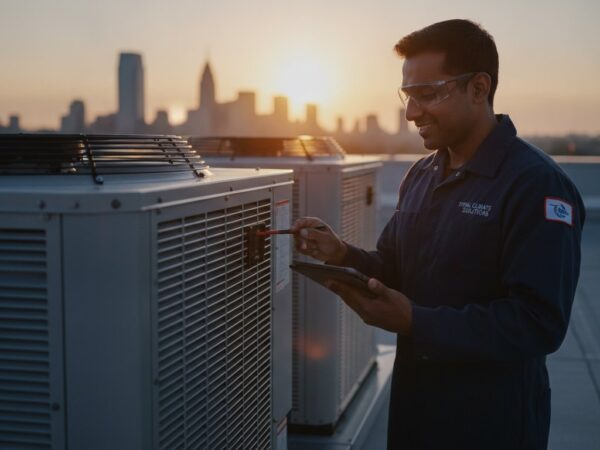
Seasonal RTU Maintenance: Adapting to New Jersey’s Climate
New Jersey facility managers know that the “shoulder seasons” of spring and autumn offer more than just a break from high utility bills. They provide a critical window for proactive care. During these months, your commercial rooftop hvac maintenance checklist should focus on the transition between heating and cooling demands. In Jersey City, the salt air is a constant threat. It eats away at aluminum fins and copper tubing through galvanic corrosion. Without protective coatings or regular rinsing, your coils can degrade significantly faster than units located further inland. We treat these coastal units with specific care to prevent premature metal fatigue.
Moving inland to East Brunswick and Middlesex County, the challenge shifts to high-pollen springs. This biological debris clogs filters and coats condenser coils, which forces motors to work harder and increases the risk of a mid-season breakdown. Integrating a professional preventive HVAC maintenance schedule during these transitions ensures your building remains a sanctuary of clean air, regardless of the allergens outside. Proper timing allows our technicians to identify wear and tear before the extreme temperatures of summer or winter push your equipment to the breaking point.
Spring and Summer: High Humidity and Cooling Demands
Before the first 90°F day hits, your system needs a pre-cooling season tune-up. New Jersey summers are notoriously humid, which puts immense pressure on your unit’s ability to dehumidify indoor spaces. We pay special attention to condensate pumps and drainage lines during these months. Since these systems can pull gallons of water from the air daily, a single blockage can lead to roof leaks or internal water damage. If you’ve noticed poor performance or rising humidity levels, it may be time for professional HVAC Repair in East Brunswick, NJ. Ensuring these pumps are clear protects your building’s structural integrity and your tenants’ comfort.
Fall and Winter: Preparing for Freezing NJ Temperatures
When the temperature drops, the focus of your commercial rooftop hvac maintenance checklist shifts to reliable heating and structural protection. Inspect burners and ignition assemblies before the first frost to prevent “no-heat” emergencies that disrupt your operations. Fall is also the perfect time to verify economizer operation. These components allow for “free cooling” by using crisp NJ autumn air instead of running the compressor, which slashes energy costs significantly. Finally, check that your roof curbs are watertight. Heavy NJ snow and ice can put hundreds of pounds of pressure on your unit’s base. A secure, watertight curb prevents melting ice from seeping into your facility’s ceiling during the spring thaw.
Safety Protocols and Regulatory Compliance for NJ Businesses
Managing a rooftop unit involves navigating a complex web of legal and safety requirements that go far beyond basic mechanical repairs. It isn’t just about keeping the building cool; it’s about protecting your organization from massive legal liabilities. As of January 1, 2026, the transition to A2L refrigerants like R-32 and R-454B is mandatory for all new installations. This shift requires technicians to follow strict new safety protocols to manage these mildly flammable substances. Failure to comply with EPA Section 608 regulations regarding refrigerant handling can lead to staggering penalties as high as $69,733 per day. Ensuring your commercial rooftop hvac maintenance checklist includes verified refrigerant tracking is no longer optional; it’s a financial necessity.
Beyond federal rules, you must also prioritize OSHA compliance for rooftop access. This includes maintaining clear paths to the unit, ensuring proper guardrail heights, and verifying that technicians are trained in fall protection. Accurate record-keeping is the backbone of a professional operation. Your documentation should include every service date, the name of the licensed professional who performed the work, and a log of all refrigerant added or recovered. These records are vital during municipal inspections and are often required by insurance providers to validate claims in the event of a system failure or building fire.
Meeting New Jersey HVACR Licensing and Safety Standards
Hiring unlicensed contractors is a risk that New Jersey facility managers simply cannot afford to take. Only a professional holding a valid New Jersey State HVACR license has the legal authority to service complex commercial equipment. Using uncertified labor can void your equipment warranties and leave your business fully liable for any damages or injuries that occur on-site. Furthermore, annual safety inspections are a core component of NJ fire code compliance. For 2026, New Jersey has implemented updated requirements for carbon monoxide monitoring in commercial spaces, mandating that detection systems be integrated with the building’s air handling units to provide automated shut-off capabilities if a leak is detected. If you’re concerned about your facility’s compliance, schedule a comprehensive safety audit with our licensed team to ensure every unit meets current state standards.
Managing Condensate Drainage and Rooftop Leaks
There is a critical intersection between HVAC maintenance and commercial plumbing health that many managers overlook. During humid New Jersey summers, a single RTU can produce gallons of condensate daily. If your drain lines are neglected, they will eventually clog with algae and debris, leading to “ponding” on your roof. This standing water is a primary cause of roof membrane failure and structural rot. To prevent these issues, your commercial rooftop hvac maintenance checklist must include a thorough cleaning of all condensate traps and lines. For severe blockages that threaten your roof’s integrity, our team provides Expert Drain Cleaning Services in Old Bridge, NJ to clear clogs fast and restore proper drainage. Keeping these lines clear is the simplest way to act as a guardian for your building’s infrastructure.
Implementing a Professional Maintenance Plan with Anton
Managing a commercial facility is a high-stakes responsibility. You need more than just a commercial rooftop hvac maintenance checklist; you need a partner who understands the unique infrastructure of New Jersey. At Anton, we provide structured commercial service agreements that take the guesswork out of facility management. Our partners in Old Bridge and Jersey City receive priority emergency response, ensuring that utility failures don’t lead to prolonged business interruptions. We believe in transparent pricing and provide detailed performance reporting after every visit. You’ll always know exactly what work was performed and the current health of your investment.
Our team leverages 28+ years of NJ infrastructure knowledge to protect your bottom line. We don’t just check boxes; we analyze the data to provide a clear picture of your equipment’s efficiency. This steady professionalism offers immediate relief for facility managers facing the complexities of 2026 regulatory changes. By choosing a structured plan, you shift from a state of constant crisis management to a position of controlled, strategic oversight. We act as the guardian of your building, allowing you to focus on your core business operations while we handle the technical complexities of your rooftop infrastructure.
Custom Maintenance Contracts for Middlesex and Hudson County
Every building has its own personality and mechanical needs. Whether you manage a single-site retail shop in Middlesex County or a multi-location portfolio across Hudson County, we offer scalable solutions tailored to your specific goals. Our philosophy centers on predictive maintenance rather than reactive repairs. By identifying a failing capacitor or a worn belt before it snaps, we save you from the stress of a midnight emergency. However, we also know that plumbing and HVAC issues often go hand-in-hand. If a condensate line failure leads to an indoor flood, our team is ready to act as your Emergency Plumber Old Bridge NJ to mitigate damage immediately.
Why Anton’s 28+ Years of Experience Matters for Your Business
Our extensive industry tenure has taught us that Jersey City’s urban rooftops present challenges that suburban contractors often overlook. High wind loads, tight clearances, and the relentless salt air require a specific technical approach. We act as the “Protective Expert” for your building. This means we treat your rooftop unit with the same ethical standards and attention to detail we would apply to our own property. We use advanced diagnostic technology to ensure high-tech accuracy, distinguishing our service from traditional methods. Don’t wait for a system failure to reveal the gaps in your current plan. Schedule your commercial rooftop HVAC inspection today and secure the future of your facility.
Secure the Future of Your NJ Facility
Protecting your building’s infrastructure requires a proactive approach that balances mechanical precision with local climate expertise. By following a structured commercial rooftop hvac maintenance checklist, you ensure your facility stays compliant with 2026 refrigerant standards and avoids the staggering daily penalties associated with neglect. We’ve explored how seasonal transitions and coastal salt air can degrade units; however, a professional maintenance plan provides the security your business needs to thrive. This strategic oversight turns a vulnerable rooftop asset into a reliable component of your building’s long-term success.
You don’t have to manage these complexities alone. As Licensed NJ State HVACR Professionals with 28+ years of commercial experience, the team at Anton is your dedicated partner in infrastructure health. We offer 24/7 emergency service for NJ businesses to ensure you’re never left in a crisis. Protect Your NJ Commercial Property—Book a Rooftop HVAC Tune-Up today and gain the peace of mind that comes with a high-performance rooftop unit. We’re ready to help your facility run at its best and keep your tenants comfortable year-round.
Frequently Asked Questions
How often should a commercial rooftop HVAC unit be serviced in New Jersey?
Schedule professional service for your rooftop unit at least twice per year, specifically during the spring and fall. Quarterly inspections are better for high-traffic facilities or those in harsh coastal environments. These visits prepare your system for the extreme temperature shifts common in the Garden State. Regular check-ups ensure your commercial rooftop hvac maintenance checklist stays current and helps prevent mid-season failures.
What are the signs that my RTU needs immediate professional repair?
Look for sudden spikes in utility bills, uneven cooling across zones, or persistent odors. Strange grinding or squealing noises from the roof often indicate mechanical friction or a failing blower motor. If your building’s humidity levels remain high despite the system running, it’s a clear sign of a cooling cycle failure. Addressing these issues immediately prevents a small repair from becoming a total system replacement.
Can my internal maintenance team handle the rooftop HVAC checklist?
Internal teams can manage basic tasks like monthly filter changes or visual inspections for roof debris. However, complex mechanical tasks and refrigerant handling require a professional with a New Jersey State HVACR license. Attempting advanced repairs without the proper training puts your building’s safety and your company’s liability at risk. Professional technicians use advanced diagnostic technology to ensure accuracy that internal teams often cannot match.
Does New Jersey require specific licenses for commercial HVAC maintenance?
Yes, technicians performing work on commercial systems must hold a New Jersey State HVACR license. Additionally, anyone handling refrigerants must be certified under EPA Section 608. These requirements ensure that the person working on your unit understands the specific safety standards and environmental regulations active in 2026. Hiring licensed professionals protects your equipment warranties and ensures compliance with municipal fire and safety codes.
How much can I save on energy bills with regular HVAC maintenance?
Upgrading to a high-efficiency system and maintaining it properly can lead to energy cost savings of up to 30%. Regular calibration and coil cleaning ensure your system doesn’t have to work overtime to meet building demands. Even small adjustments to belt tension and thermostat accuracy contribute to lower monthly overhead. Consistent use of a commercial rooftop hvac maintenance checklist keeps your system running at peak performance, which translates directly to lower utility costs.
What happens if I neglect my commercial rooftop unit’s condensate drain?
Neglecting the condensate drain leads to ponding on your roof, which can cause structural rot and membrane failure. Standing water in the drain pan also becomes a breeding ground for bacteria and mold, resulting in poor indoor air quality and tenant complaints. If the blockage is severe, water will eventually back up into the unit cabinet and leak through your facility’s ceiling. Regular cleaning prevents these expensive structural repairs and keeps your building’s drainage healthy.
Are there NJ state rebates for upgrading to high-efficiency rooftop units in 2026?
Significant incentives are available through major utility providers in 2026. PSE&G offers increased incentives of 50% or more on eligible high-efficiency equipment through September 30, 2026. JCP&L’s “Energy Solutions for Business” program can cover up to 80% of project costs for qualifying HVAC upgrades. They also provide 0% financing options for up to five years, making it easier for facility managers to invest in modern, compliant infrastructure.
Why is salt-air corrosion a concern for commercial HVAC in Jersey City?
Salt-air corrosion is a major threat in Jersey City because airborne salt accelerates the degradation of aluminum fins and copper tubing. This process, known as galvanic corrosion, creates tiny pits in the coils that lead to refrigerant leaks and reduced heat transfer. Without specialized coatings and regular rinsing, coastal units can fail years earlier than those located further inland. We prioritize protective measures for these units to safeguard your long-term investment.


