
What if that faint, rotten-egg smell in your laundry room isn’t just a minor nuisance, but a critical warning that your family’s safety is at risk? When you suspect a leak, the initial panic is overwhelming. You worry about the potential for an explosion, the silent threat of carbon monoxide, and the confusing reality that your utility provider will shut off your gas but won’t actually fix the pipes inside your walls. It’s a high-stakes situation that requires immediate, expert intervention.
We understand the anxiety that comes with utility failures, especially when nearly a quarter of New Jersey’s gas infrastructure is aging and prone to issues. This guide provides the clarity you need during a crisis. You’ll learn the exact safety protocols to follow and how professional emergency gas leak repair NJ ensures your system meets strict state codes. We will walk you through the professional detection process, the necessity of pressure testing, and the steps required to restore your service with total peace of mind.
Key Takeaways
- Identify critical warning signs like the “rotten egg” odor and hissing sounds so you can evacuate your family safely and immediately.
- Understand the professional detection methods, such as electronic sniffers and pressure testing, used to find leaks that utility companies often miss.
- Learn why emergency gas leak repair NJ must be performed by a licensed Master Plumber to comply with strict state safety codes and local building permits.
- Explore the differences between Black Iron and CSST piping and how experts select the right materials to ensure a permanent, leak-free solution for your home.
- Gain peace of mind by knowing when to call the utility company versus when to contact a 24/7 protective expert for internal gas line restoration.
Suspecting a Gas Leak: Immediate Safety Steps & Identification
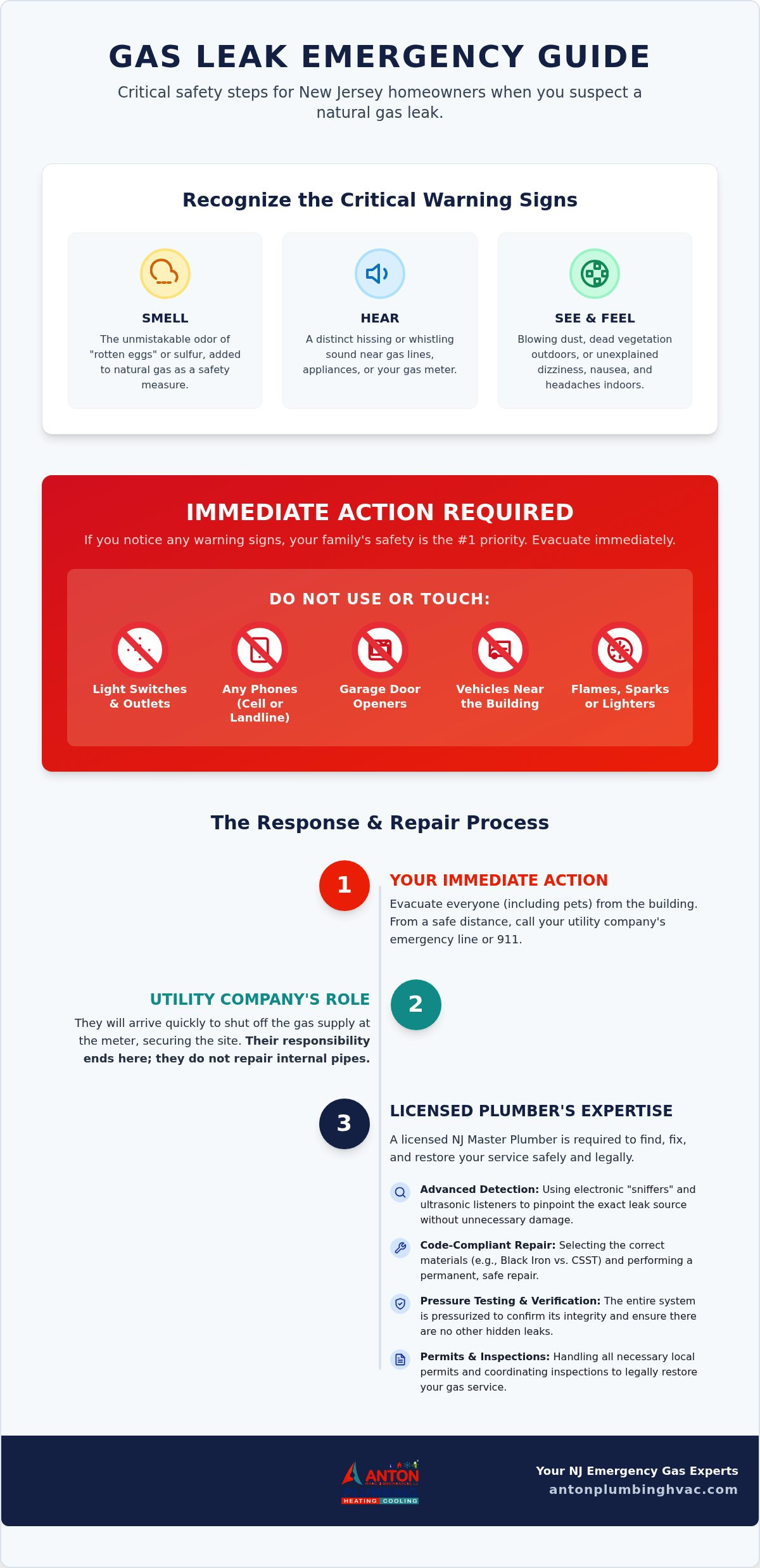
Natural gas is naturally odorless and colorless. To protect your household, utility companies add a chemical called mercaptan, which creates that unmistakable sulfur or rotten egg smell. If you catch a whiff of this scent, you are likely facing a gas leak that requires immediate action. Your first priority isn’t to find the source or attempt a DIY fix; it’s to ensure every resident and pet gets out of the building safely and quickly.
Before you leave, follow this strict “No-Go” list to prevent an accidental spark that could ignite the gas:
- Don’t flip any light switches or use electrical outlets.
- Don’t use your landline or cell phone inside the house.
- Don’t open or close your garage door with an automatic opener.
- Don’t start your car if it’s parked in a garage or near the structure.
- Don’t smoke, strike matches, or use a lighter.
Recognizing the Signs of a Gas Leak
Beyond the sulfur smell, your other senses can provide vital clues. Listen for a persistent hissing or whistling sound near your stove, boiler, or gas meter. Look for physical indicators like dust blowing from a hole in the ground or patches of dead vegetation in an otherwise green lawn. Indoors, you might notice pilot lights blowing out frequently or unusual condensation on windows near gas appliances. Physical symptoms are also common. If you or your family feel sudden dizziness, nausea, or persistent headaches, evacuate immediately. These are signs of potential oxygen displacement or carbon monoxide buildup that demand professional attention.
Utility Responsibility vs. Homeowner Responsibility
In New Jersey, there’s a clear “demarcation point” for gas infrastructure. Your utility provider, such as PSE&G or NJNG, is responsible for the main distribution lines and the gas meter itself. If you report an emergency, they’ll arrive quickly to shut off the gas and secure the site. However, their responsibility ends at the meter. They won’t repair the pipes running through your basement, walls, or those connected to your appliances.
Once the utility company has secured the area but “red-tagged” your system, you must contact a licensed NJ state plumber to perform the actual fix. Securing a professional for emergency gas leak repair NJ ensures that an expert can pressure test your internal lines and replace damaged sections. This transition from utility safety to private repair is where many homeowners feel overwhelmed, but a qualified expert handles the permits and inspections required to get your gas service restored legally and safely.
Professional Gas Leak Detection: How NJ Experts Find the Source
Once the area is clear and the utility provider has secured the meter, the focus shifts to technical precision. Finding a leak within the complex infrastructure of a New Jersey home requires more than just a keen sense of smell. Professional technicians use a systematic approach to isolate the problem without causing unnecessary damage to your property. This process is the backbone of reliable emergency gas leak repair NJ, ensuring that the root cause is addressed, not just the symptoms.
Electronic sensors, often called “sniffers,” are the first line of defense. These handheld devices detect minute concentrations of natural gas that a human might miss. They are essential because natural gas is lighter than air and can migrate through wall cavities or floors, making the source hard to pin down by scent alone. According to federal guidelines on Natural Gas Fuel Safety, these odorants are vital, but technology provides the accuracy needed for a permanent fix. For visible joints and connections, experts often use the “bubble test.” By applying a specialized non-corrosive solution to the pipes, technicians look for expanding bubbles that indicate escaping gas. While simple, this method is incredibly effective for pinpointing leaks at threaded fittings.
For leaks hidden behind drywall or under flooring, ultrasonic leak detection becomes necessary. This technology listens for the specific high-frequency sound of gas escaping under pressure, allowing us to find the breach without destructive exploration. Finally, pressure testing isolates the entire gas system. By capping all lines and monitoring a pressure gauge, we can confirm the integrity of every pipe in the house, ensuring no secondary leaks remain.
Advanced Diagnostic Technology
Modern detection has evolved significantly beyond soap and water. We utilize specialized sensors that provide digital readouts of gas levels, allowing us to map the concentration of the leak accurately. This data-driven approach is a hallmark of our service, distinguishing us from contractors who rely on guesswork. We also employ infrared technology to identify thermal irregularities in gas lines, which can signal stress points or thinning pipe walls before they become full-blown emergencies. If you suspect a hidden issue, our team of protective experts is ready to provide a thorough diagnostic.
Underground Leak Detection in NJ
Many New Jersey homes feature outdoor gas-powered amenities like pool heaters, fire pits, or high-end grills. These lines are buried and subject to soil shifts or corrosion. Detecting a leak in these areas requires specialized equipment to avoid digging up your entire yard. The process of underground water and gas leak detection involves acoustic sensors and tracer gases to find the exact location of the failure. This precision protects your landscape and ensures your outdoor living space remains safe for your family throughout the year.
The Emergency Gas Repair Process: Restoring Safety and Service
Once the immediate danger has passed and the area is secured, the technical work of restoration begins. Unlike the utility company, which focuses on safety through disconnection, a licensed professional focuses on safety through precision engineering. Every step of emergency gas leak repair NJ is governed by the New Jersey Fuel Gas Code. This ensures that once your gas is turned back on, it stays inside the pipes where it belongs. We take this responsibility seriously because a permanent fix is the only way to protect your household long-term.
The process starts by shutting down the main gas valve and isolating the specific section of damaged piping. We then remove any corroded or compromised materials. This is a critical stage because gas lines are often hidden in damp basements or crawlspaces where oxidation can weaken metal over decades. Following industry-standard Natural Gas Safety tips, we ensure the work area is properly ventilated and free of any potential ignition sources before we begin threading and fitting new sections of pipe.
Common Gas Line Repair Materials
We use materials specifically rated for high-pressure fuel delivery. For most residential basements in New Jersey, Black Iron pipe remains the gold standard because of its extreme durability and resistance to impact. However, if we’re running lines through tight spaces or modern additions, we may utilize Corrugated Stainless Steel Tubing (CSST). CSST is flexible and requires fewer joints, which can reduce the number of potential leak points. You should never attempt to use “gas tape,” putty, or hardware-store sealants for a permanent repair. These materials are illegal under NJ code and are prone to failure under pressure, creating a dangerous situation for your family.
The Critical Pressure Test
No repair is complete without a rigorous pressure test. We use a highly sensitive manometer or digital pressure gauge to monitor the system’s integrity. During a “drop test,” we pressurize the lines and observe the gauge over a specific duration required by local NJ inspection standards. If the needle moves even a fraction, the system isn’t airtight, and we continue our search until it’s perfect. We document these results meticulously. This documentation is often required by your local municipality or homeowner’s insurance provider to prove the system is safe for occupancy. After the test passes, we coordinate with your utility provider to verify the repair, allowing them to safely restore your service and relight your appliances.
NJ Regulations & Permits for Gas Line Repairs
Securing your home after a leak involves more than just mechanical skill. In New Jersey, gas line work is a tightly controlled sector of the construction trades. State law requires a licensed Master Plumber to contract for and supervise any emergency gas leak repair NJ. This isn’t just about professional standards; it’s about legal compliance. Unlicensed individuals are not permitted to perform this work because the risks of an improper repair are too high. A professional fix ensures your home meets the New Jersey Fuel Gas Code, which is essential for passing the mandatory inspections that follow any significant line work.
Local building departments in municipalities like Old Bridge, East Brunswick, and Jersey City play a vital role in this process. While a utility company like PSE&G might secure the site, they don’t issue the permits required to rebuild your system. A construction permit is required for almost all gas line work, including alterations to existing pipes. There is no homeowner exemption for gas piping in New Jersey. This means you must have a licensed professional file the paperwork to ensure the work is recorded and inspected by a local subcode official. Permit fees typically start around $65 to $150 for a single fixture, though more extensive repairs often see fees closer to a common average of $600.
Local Permit Requirements in Middlesex and Hudson Counties
Navigating the bureaucracy of local municipalities can be the most frustrating part of a utility crisis. In Jersey City, for instance, filing emergency repair permits requires specific documentation to fast-track the inspection. We handle all the paperwork and coordination with local NJ inspectors on your behalf. Performing unpermitted gas work can lead to severe consequences, including fines, issues with your homeowner’s insurance, and a significant decrease in your home’s resale value. More importantly, unpermitted work hasn’t been verified by a third-party inspector, leaving your family at unnecessary risk.
Upgrading Systems During Repair
When a section of your gas line fails, it’s often a sign that the rest of the system is reaching the end of its lifespan. Many homeowners use this disruption as an opportunity for a water heater replacement or a boiler upgrade. In 2026, New Jersey state rebate programs offer significant incentives for switching to high-efficiency gas appliances during these repairs. We also provide zero-interest financing options for major gas line overhauls, allowing you to modernize your home’s infrastructure without immediate financial strain. If you need a licensed NJ state plumber to guide you through the permit process and restore your service, contact our team today.
Why Anton Plumbing is Your NJ Emergency Gas Expert
Choosing a partner for your home’s infrastructure is a decision based on trust and tenure. With over 28 years of dedicated local experience, Anton Plumbing Heating & Cooling has built a reputation as the protective expert for New Jersey families. Facing a gas crisis is stressful, but our team brings a sense of immediate relief through technical mastery and ethical service standards. We aren’t just mechanical contractors; we act as guardians of your household’s safety. Our dual-licensed expertise in both NJ state Plumbing and HVACR ensures that we understand the entire ecosystem of your home, from the gas meter to the complex appliances that keep your family comfortable.
We maintain rapid response teams strategically stationed near Old Bridge, East Brunswick, and Jersey City. This localized approach allows us to arrive quickly when you need emergency gas leak repair NJ most. As a family-operated business, we prioritize the domestic well-being of our neighbors. We don’t just patch a pipe and leave; we provide a comprehensive solution that restores your gas service and your peace of mind. Our commitment to high-tech accuracy and modern efficiency distinguishes us as a seasoned veteran in a fast-paced industry.
The Anton Advantage: Protective Expertise
We believe clarity is the antidote to emergency-induced anxiety. Our transparent pricing models ensure you have clear financial expectations even during high-stakes utility failures. Every technician on our team is a highly trained professional who treats your home with the same respect they would their own. We offer comprehensive solutions that go beyond simple fixes. Whether you require a specialized boiler repair, a furnace installation, or a full gas line replacement, we handle the job with no-nonsense professionalism. Our use of advanced diagnostic technology ensures that every leak is found and every repair is permanent.
Contact Us for Immediate Gas Line Assistance
When you suspect a leak, every second is vital for your family’s security. Our 24/7 availability for emergency gas leak repair NJ means that expert help is always just a phone call away. We move with the speed and efficiency required by the service industry, guiding you through the complexities of permits and utility inspections with ease. If you aren’t facing an immediate crisis but want to ensure your system is up to code, we also provide non-emergency gas safety inspections. These proactive checks identify potential corrosion or stress points before they become dangerous failures. Don’t leave your family’s safety to chance. Contact Anton Plumbing Heating & Cooling today for the professional, licensed assistance you deserve.
Secure Your Home With Professional Gas Line Expertise
Navigating a gas emergency is one of the most stressful experiences a homeowner can face. By understanding the sensory warning signs and following strict evacuation protocols, you’ve already taken the most important step toward protecting your family. It’s vital to remember that while utility companies secure the meter, the responsibility for permanent, code-compliant restoration lies with a licensed professional. Only a Master Plumber can perform the rigorous pressure testing and precision fitting required to ensure your internal lines are 100% airtight and safe for daily use.
When you need emergency gas leak repair NJ, don’t settle for guesswork or unpermitted repairs. Anton Plumbing Heating & Cooling brings 28+ years of heritage and dual-licensed expertise in Plumbing and HVACR to every crisis. We handle the complex permits and coordination with local inspectors in communities like Old Bridge and Jersey City so you don’t have to. Our 24/7 rapid response teams are ready to restore your service with the transparency and technical excellence your household deserves.
Call Anton Plumbing Heating & Cooling for 24/7 Emergency Gas Leak Repair
Your safety is our priority, and we’re here to guide you through every step of the restoration process with confidence and care.
Frequently Asked Questions
What is the very first thing I should do if I smell gas?
Stop everything and evacuate the building immediately. Don’t flip light switches, use landlines, or start cars near the structure. Once you are at a safe distance, call 911 or your local utility provider like PSE&G. Your safety is the primary concern. Professional responders must secure the area and shut off the gas before any permanent repair work can begin on your internal lines.
Will the gas company charge me for reporting a leak?
No, utility companies do not charge customers for reporting a suspected gas leak. They prioritize community safety and encourage immediate reporting to prevent potential disasters. While they’ll secure the site and shut off the gas for free, they won’t perform the actual emergency gas leak repair NJ for your internal house lines. That responsibility falls to you and your licensed plumber once the immediate danger is cleared.
Can a plumber fix a gas leak, or do I need the utility company?
You need both professionals to handle different parts of the restoration. The utility company is responsible for the main lines and the meter. They’ll arrive quickly to shut off the gas and make the site safe. However, you must hire a licensed NJ Master Plumber to fix the pipes inside your home. A dual-licensed expert ensures your system is airtight and compliant with state plumbing and HVACR regulations.
How long does a typical gas line repair take in NJ?
Most technical repairs are finished within a few hours once the technician identifies the leak’s source. However, the total time to get your gas turned back on depends on the local municipal inspection schedule. In cities like Jersey City or East Brunswick, a subcode official must witness a successful pressure test. We coordinate these schedules to minimize friction, but the process usually spans one to two business days.
What does a gas leak repair cost in Old Bridge or Jersey City?
The cost of repairing a gas line depends on the complexity of the breach and the materials required for a code-compliant fix. Accessible basement pipes are generally simpler to address than underground lines or leaks hidden behind finished drywall. You must also account for municipal permit fees and the cost of a professional pressure test. We value transparency and provide clear financial expectations before starting any work to help you manage this unexpected domestic challenge.
Why does my gas smell like rotten eggs?
Natural gas is naturally odorless, so utility companies add a chemical called mercaptan to give it a distinct rotten egg scent. This additive is a vital safety feature designed to alert you to even the smallest leaks. If you smell this sulfur-like odor, it means gas is escaping into your living space. Treat this as a high-stakes warning and follow your family’s evacuation protocols immediately without delay.
Is it safe to stay in the house if the gas smell is faint?
No, it’s never safe to stay in a building where you smell gas, regardless of how faint the odor seems. Even a minor leak can lead to a dangerous accumulation of gas in wall cavities or crawlspaces. This creates a risk of explosion or carbon monoxide poisoning. Always prioritize your family’s security by evacuating first. Let a protective expert with advanced diagnostic technology confirm the home is safe before you re-enter.
Do I need a permit to repair a gas line in New Jersey?
Yes, New Jersey state law requires a construction permit for almost all gas line repairs and alterations. There is no homeowner exemption for gas piping work in our state. A licensed professional must file the paperwork and coordinate a post-repair inspection with your local building department. This step is mandatory to ensure the emergency gas leak repair NJ meets safety codes and to satisfy your utility provider’s requirements for restoring service.


