

Imagine hosting a summer gathering in Old Bridge, only for your fire pit to flicker out because the propane tank hit empty right as the s’mores came out. It’s a common frustration for homeowners who want a seamless outdoor living space but feel overwhelmed by the complexities of utility extensions. You’re right to be cautious; handling combustible fuel requires more than just a basic toolkit. It demands a deep understanding of local safety codes to prevent dangerous leaks. Securing a professional gas line installation for fire pit Old Bridge projects ensures your family stays safe while enjoying a permanent, high-performance fire feature.
We understand that navigating NJ building permits and plumbing subcode fees can feel like a headache. This 2026 guide simplifies the process by breaking down everything you need to know about installing a code-compliant natural gas line. You’ll discover the specific Old Bridge permit requirements, including the $75 minimum plumbing subcode fee, and why NFPA 54 standards are non-negotiable for your home’s security. We’ll walk you through the transition from portable tanks to a reliable, underground system that adds lasting value to your property and provides total peace of mind.
Key Takeaways
- Eliminate the frustration of empty tanks by learning how a permanent utility connection provides a reliable, high-performance fuel source for your outdoor space.
- Understand how to accurately calculate BTU requirements to ensure your fire pit operates at full strength without overwhelming your home’s gas meter.
- Navigate the specific local regulations and safety codes required for a professional gas line installation for fire pit Old Bridge residents.
- Discover the technical steps involved in safe trenching and sleeving to protect your underground infrastructure from environmental damage.
- Protect your property value and insurance validity by ensuring all outdoor gas work meets the strict standards of the New Jersey Uniform Construction Code.
Why Switch to a Permanent Natural Gas Line for Your Old Bridge Fire Pit?
Many Old Bridge homeowners start their outdoor journey with a standard 20lb propane tank. It’s accessible, but it’s also temporary. Transitioning to a fixed utility connection means your fire feature becomes a permanent part of your home’s infrastructure. This upgrade eliminates the heavy lifting and the aesthetic eyesore of a tank tucked behind a chair. A professional gas line installation for fire pit Old Bridge project turns a seasonal hobby into a year-round luxury. It’s a definitive shift from “making do” to creating a high-end retreat right in your backyard. To complement your new fire feature, you can learn more about adding wellness amenities like a cold therapy tub to your outdoor space.
We’ve all been there. You’re halfway through a backyard party when the flame starts to sputter. “Propane anxiety” is the constant worry that your fuel will run out at the worst possible moment. A direct line from your municipal supply ends this cycle forever. Beyond the convenience, natural gas is significantly more cost-efficient over the long term. While propane prices can fluctuate based on retail markups, natural gas provides a steady, lower cost per hour of operation. It’s a smart financial move for Middlesex County families looking to maximize their outdoor budget while increasing their property value with a high-ROI upgrade.
Natural Gas vs. Propane: Performance and Safety
Natural gas operates at a lower pressure than liquid propane, which inherently changes the safety profile of your backyard. When you choose a permanent line, you remove the trip hazards of loose hoses and the risk of improper tank storage. Safety is our primary concern. Understanding gas leak safety is vital because outdoor lines are subject to soil movement and shifting weather patterns. Professional installation ensures the pipe is buried at the correct depth and sleeved properly to resist corrosion. This method is also better for the environment, as it utilizes the existing municipal grid rather than relying on the carbon-heavy production and transport of refined tanks.
Versatility for Outdoor Living in Old Bridge
Technical Specs: Calculating BTUs and Gas Line Sizing for Fire Features
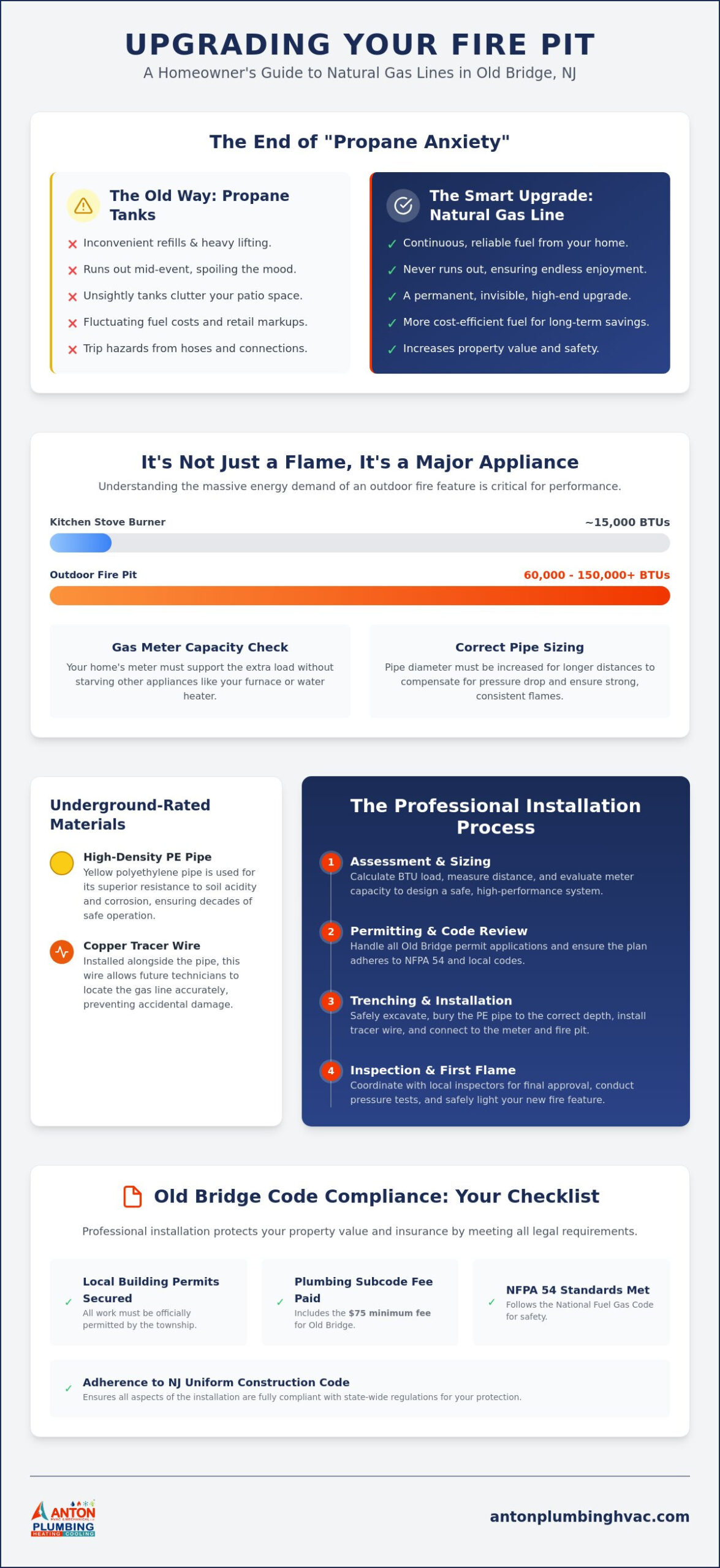
High-performance fire pits aren’t just decorative accents; they’re heavy-duty gas appliances. A standard indoor range burner typically consumes about 10,000 to 15,000 BTUs. In contrast, a mid-sized outdoor fire feature often demands 60,000 to 150,000 BTUs. This massive load means your existing gas meter must be evaluated to ensure it can support the extra volume without starving your furnace or water heater. If the meter’s capacity is exceeded, you’ll notice poor performance across all your household appliances when the fire is roaring.
The distance from the meter to the fire pit is the next critical variable. Gas pressure naturally drops as it travels through a pipe. If the run is long, we must increase the pipe diameter to compensate for this pressure drop. Failing to account for this results in “lazy flames” that lack the height and heat you expect. We adhere strictly to the National Fuel Gas Code to determine the exact pipe size needed for your specific backyard layout. This precision prevents future utility failures and keeps your flame consistent regardless of the weather.
Choosing Professional Grade Pipe Materials
For underground burial, we move away from the black iron used inside your home. Instead, we use high-density yellow polyethylene (PE) pipe. This material resists soil acidity and corrosion, ensuring a decades-long lifespan. We also install a copper tracer wire alongside the pipe. This allows technicians to locate the line accurately in the future, preventing accidental damage during landscaping projects. For the final connection to the burner, flexible Corrugated Stainless Steel Tubing (CSST) provides the necessary movement and vibration resistance to keep the system stable.
Manifold Integration and Shut-off Valves
Safety dictates that every outdoor feature has a dedicated, accessible shut-off valve. This allows you to isolate the fire pit instantly in an emergency without entering the house. We often integrate these lines into a manifold system. A manifold acts as a central distribution hub, balancing pressure between your high-demand appliances like the boiler and your new outdoor features. A professional gas line installation for fire pit Old Bridge service ensures these components work in harmony. A multi-hour pressure test is the most critical technical step because it verifies the absolute integrity of every joint and fitting before the trench is backfilled.
Navigating Old Bridge Permits and Safety Codes for Outdoor Gas Lines
Compliance with the New Jersey Uniform Construction Code (UCC) is mandatory for every gas extension project. In Old Bridge, you must secure a plumbing subcode permit before any work begins on your property. While the township fee schedule lists a $35 charge per gas piping unit, the minimum fee for a plumbing subcode permit is $75. Skipping this legal step is a major risk. Unpermitted work often voids homeowner insurance policies, leaving you liable if a utility failure occurs. It’s simply not worth the gamble with your family’s financial and physical security.
The inspection process is a critical safety net for your household. A Middlesex County inspector will visit your home during the ‘rough-in’ phase to verify that the National Fuel Gas Code standards are met. They check pipe materials, joint integrity, and burial depths before the trench is backfilled. If your fire feature demands high BTUs, we coordinate directly with PSE&G to determine if a meter upgrade is necessary. This ensures your indoor furnace and outdoor fire pit don’t compete for fuel during a cold snap. A professional gas line installation for fire pit Old Bridge project handles these bureaucratic details so you don’t have to.
Burial Depth and Clearance Regulations
New Jersey regulations typically require gas line trenches to be buried between 12 and 18 inches deep. This specific depth protects the line from frost heave and accidental damage from common yard tools or lawn aerators. We also maintain strict clearance distances from electrical lines, water pipes, and property boundaries to prevent cross-utility interference. Before we ever break ground, we handle the mandatory “811 Call Before You Dig” requirement. This proactive step identifies existing underground utilities, preventing dangerous strikes and service interruptions for your entire neighborhood.
Risk Mitigation: Why DIY Gas Lines Are Dangerous
DIY gas line installation is prohibited in Old Bridge because the stakes are too high for trial and error. Improper pipe threading or using the wrong sealant can lead to microscopic leaks that are impossible to detect without advanced diagnostic tools. These slow leaks create significant hazards, including the risk of fire or carbon monoxide buildup in partially enclosed patio areas. If you ever smell a “rotten egg” odor or hear a faint hissing sound near your fire feature, follow our guidance for suspected leaks immediately and evacuate the area. Professional installation by a dual-licensed expert is the only way to ensure your outdoor retreat remains a safe haven for your guests.
The Professional Installation Process: From Trenching to First Flame
Our process begins with a meticulous site assessment. We map the most efficient path from your gas meter to the fire pit to minimize landscape disruption while ensuring maximum pressure efficiency. This isn’t just about digging. It’s about engineering a route that avoids other underground utilities and follows the natural grade of your property. Once the path is set, we begin trenching and sleeving. We use professional-grade materials that resist the corrosive nature of New Jersey soil, creating a protective barrier that keeps your utility line safe from physical damage and chemical degradation.
Expert piping and connection follow. Our technicians use specialized threading equipment to create airtight seals at every joint. We integrate the new line into your home’s manifold with surgical precision, ensuring the fire pit receives its required BTU load without affecting your indoor appliances. Before a single molecule of gas enters the line, we perform a rigorous pressure test. We use a high-sensitivity manometer to verify the system holds air at a pressure significantly higher than its operating level. This step is non-negotiable for a safe gas line installation for fire pit Old Bridge project.
Preparing Your Yard for the Plumber
You can help ensure a smooth installation by clearing the designated path of any outdoor furniture, potted plants, or children’s toys. This allows our trenching equipment to move efficiently and reduces the risk of accidental lawn damage. Please have the manufacturer specifications for your fire pit burner ready so we can verify the fitting sizes and BTU requirements on-site. Finally, ensure our team has clear access to your main gas shut-off valve, as we will need to briefly interrupt service to tie in the new line.
Final Commissioning and Safety Walkthrough
Once the local inspector approves the rough-in, we move to the final commissioning. We bleed the air from the new line and perform the first ignition to calibrate the flame height. During the safety walkthrough, we’ll teach you how to operate the key valve and locate the emergency shut-off. Reliability doesn’t end at the first flame. We recommend scheduling a yearly gas system checkup to ensure your outdoor and indoor components remain in peak condition. If you’re ready to upgrade your backyard, contact us today to schedule your professional gas line installation for fire pit Old Bridge.
Why Old Bridge Homeowners Trust Anton Plumbing for Gas Line Projects
For nearly three decades, families have turned to Anton Plumbing Heating & Cooling as the steady hand for local utility projects. We understand that your home is more than just a building; it’s the center of your family’s life. Securing a professional gas line installation for fire pit Old Bridge projects requires a specific blend of technical mastery and ethical standards. We don’t just run pipes. We build infrastructure that’s designed to last for generations, ensuring your outdoor retreats are as safe as they are beautiful. Our team approaches every job with the mindset of a protective expert, prioritizing your security above all else.
Safety in gas work isn’t optional, and it shouldn’t be left to general contractors. We’re proud to be dual-licensed professionals, holding both New Jersey Plumbing and HVACR licenses. This dual certification is critical when extending gas lines because it ensures we understand the total mechanical load of your home’s system. We evaluate how your new fire feature interacts with your furnace, boiler, and water heater to prevent pressure drops or utility failures. By choosing a team with 28+ years of experience, you’re hiring seasoned veterans who know exactly how to navigate the complexities of local infrastructure.
We believe that high-quality safety upgrades should be accessible to every local family. That’s why Anton Plumbing Heating & Cooling provides transparent, upfront pricing with no hidden fees or surprise surcharges. To make your outdoor living dreams a reality, we offer zero-interest financing options for qualified NJ homeowners. You’ll receive a clear financial roadmap before we ever break ground. This transparency is a core part of our mission to be a dependable, no-nonsense partner for your home maintenance needs.
Our Legacy of Service in Middlesex County
Since 1996, our family-owned business has been rooted in the Old Bridge community. We’ve seen how local building trends have evolved, and we’ve kept pace by investing in advanced diagnostic technology. This equipment allows us to identify microscopic leaks or structural weaknesses that traditional methods often miss. When we perform a gas line installation for fire pit Old Bridge, we look at the big picture. We often recommend a total home gas load assessment, similar to what we provide during a water heater replacement, to ensure your entire utility system is balanced and efficient.
The Anton Guarantee: Professionalism and Integrity
Every gas line we install is fully permitted and strictly follows the New Jersey Uniform Construction Code. We handle the paperwork and coordination with township inspectors to ensure your project is 100% compliant from day one. Our work is backed by a satisfaction guarantee, and we remain available 24/7 for post-installation support or emergency concerns. We believe that uncompromising customer safety and professional integrity are the primary drivers of our business success. You can rest easy knowing that your family’s well-being is guarded by Anton Plumbing Heating & Cooling professionals who treat your home with the same care they give their own.
Ready to Upgrade Your Outdoor Living Experience?
Transitioning to a permanent natural gas connection is the final step in creating a reliable, high-performance outdoor space. By adhering to Old Bridge’s specific plumbing subcode and ensuring accurate BTU load calculations, you’re investing in a system that’s both safe and efficient. Remember that proper burial depths and pressure testing are the only ways to guarantee a secure environment for your guests. These technical standards protect your property value and ensure your fire feature is ready for every evening gathering.
At Anton Plumbing Heating & Cooling, we bring 28+ years of local experience to every project. As licensed NJ Plumbing and HVACR experts, we ensure your gas line installation for fire pit Old Bridge project is handled with the precision of a seasoned veteran. We don’t just finish the job; we provide 24/7 emergency response to give you total peace of mind long after the installation is complete. Don’t leave your home’s infrastructure to chance when professional help is just a click away.
Schedule your professional gas line installation in Old Bridge today! We’re ready to help you build a warm, inviting retreat that your family will enjoy for years to come.
Frequently Asked Questions
Do I need a permit for a fire pit gas line in Old Bridge, NJ?
Yes, you must obtain a plumbing subcode permit from the Township of Old Bridge before work begins. All gas piping extensions are governed by the New Jersey Uniform Construction Code (UCC). This process ensures that a local inspector verifies the safety of your connection before you use the feature. Failing to pull a permit can lead to township fines and complications with your home insurance coverage.
How much does gas line installation for a fire pit typically cost?
Total costs vary based on the distance from your meter and the complexity of the trenching required for your property. Factors like soil conditions, the need for a meter upgrade, and the specific BTU requirements of your burner will influence the final investment. We provide transparent, upfront pricing after a site assessment to ensure you have a clear financial roadmap without any hidden surprises during the project.
Can I run the gas line under my existing deck or patio?
Yes, it’s possible to run lines under existing structures, but it requires specific sleeving and ventilation to meet NJ safety codes. We use specialized routing techniques to minimize damage to your hardscaping while ensuring the pipe is protected from physical stress. Our team ensures that any line running beneath a deck is shielded from environmental corrosion to maintain its long term structural integrity.
Is natural gas safer than using a propane tank for a fire pit?
Natural gas is generally considered safer because it’s lighter than air and dissipates quickly if a leak occurs. Propane is heavier than air and can pool in low areas, which creates a higher risk of accidental ignition. A professional gas line installation for fire pit Old Bridge project also eliminates the physical hazards associated with transporting, storing, and connecting portable high pressure tanks in your backyard.
How deep does a gas line have to be buried in New Jersey?
Most residential gas lines in New Jersey must be buried at a minimum depth of 12 to 18 inches. This requirement protects the pipe from frost heave, which can shift the soil and stress your connections over time. We always verify the specific depth requirements for your property layout to ensure total compliance with the National Fuel Gas Code and all local Old Bridge ordinances.
What should I do if I smell gas near my outdoor fire pit?
Evacuate the area immediately and don’t attempt to turn off any electrical switches or use a phone near the suspected leak. Once you’re at a safe distance, call 911 or your local utility provider to report the emergency. We offer 24/7 emergency gas leak response to help secure your home and address utility failures with advanced diagnostic technology that identifies the exact source of the problem.
How long does the professional installation process take?
Most standard installations are completed within one to two business days, excluding the time required for township inspections. The first day typically involves site preparation, trenching, and piping, while the second day focuses on final connections and pressure testing. We coordinate with the Old Bridge building department to schedule your inspections as efficiently as possible to minimize any downtime for your project.
Will my existing gas meter be large enough for a fire pit and a grill?
It depends on the total BTU load of all your gas appliances running simultaneously. Many standard residential meters can handle a fire pit, but high output features may require a meter upgrade from PSE&G to prevent fuel starvation. We perform a comprehensive load calculation during your gas line installation for fire pit Old Bridge project to ensure your furnace and water heater continue to operate at peak performance.


