
Imagine walking into your basement in Old Bridge and feeling that cold, sinking sensation as your socks soak up a growing puddle. A water heater leaking from the bottom isn’t just an inconvenience; it’s a direct threat to your home’s foundation and your family’s comfort. When you’re troubleshooting no hot water Old Bridge homeowners often realize that what started as a small drip has quickly turned into a high-stakes emergency. It’s natural to feel anxious about potential property damage or the fear of being overcharged for a solution you don’t actually need.
You deserve a clear, honest assessment of whether your system can be saved or if it’s time for a professional upgrade. We’ve designed this guide to help you identify the root cause of the leak and determine if a repair is truly safe for your household. You’ll learn how to stop the water immediately, explore the benefits of high-efficiency replacements, and see how local NJ rebate programs can make a necessary change much more affordable. Let’s get your hot water back and your basement dry today.
Key Takeaways
- Protect your home from immediate water damage by shutting off the power supply and closing the cold water inlet valve as soon as a leak is detected.
- Identify whether the leak is coming from a replaceable valve or a breached internal tank to determine if a repair is even possible.
- Save time when troubleshooting no hot water Old Bridge families often encounter by applying the “10-Year Rule” to your replacement decision.
- Avoid the safety risks of DIY work by ensuring all repairs and installations meet current New Jersey plumbing codes and permit requirements.
- Reduce the financial burden of a new system by leveraging NJ state rebate programs and zero-interest financing options for high-efficiency upgrades.
Immediate Emergency Steps: What to Do When Your Water Heater Leaks
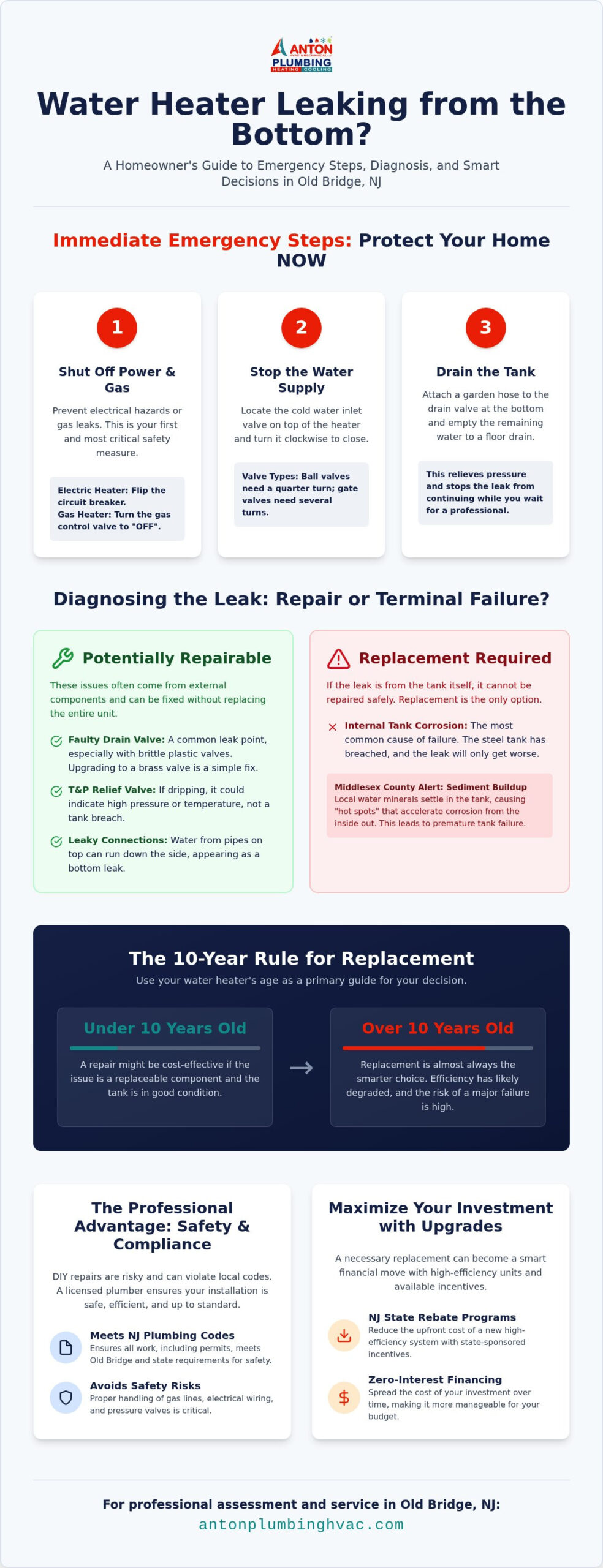
Discovering a puddle beneath your water heater is a high-stakes moment for any homeowner. Whether the leak is a slow drip or a steady stream, you must act decisively to protect your property from water damage. When you’re troubleshooting no hot water Old Bridge residents often find that a leak is the primary culprit. Speed is your best ally here. Follow these steps to stabilize the situation before the water can damage your flooring or drywall.
Safely Shutting Off Power and Gas
Your first priority is safety. If you have an electric water heater, head straight to your home’s electrical panel. Locate the circuit breaker labeled for the water heater and flip it to the “OFF” position. This prevents the heating elements from burning out once the tank starts to empty. For gas units, look for the thermostat dial on the front of the tank. Turn the gas control valve to the “OFF” position. You should also close the dedicated gas shut-off valve on the supply line. Never leave a leaking gas heater unattended; if you smell gas, exit the house immediately and call for help. Ensuring the energy source is dead is the only way to safely begin the repair process.
Managing the Cold Water Supply
Once the power is off, you need to stop more water from entering the tank. Look for the cold water pipe leading into the top of the unit. This line is usually marked with a blue handle or ring. Most New Jersey homes built before the 1990s use gate valves, which require several turns to close. Modern upgrades often feature ball valves, which only require a quarter turn to shut off the flow. If the valve is stuck or starts leaking when you touch it, don’t force it. In that case, you may need to shut off the main water valve for the entire house. Understanding how storage water heaters work helps you realize that even with the intake closed, the tank still holds dozens of gallons of pressurized water that must be managed.
After the water is shut off, attach a standard garden hose to the drain valve at the bottom of the tank. Run the other end of the hose to a floor drain or outside. Open the valve to empty the tank and relieve the internal pressure. This prevents the remaining water from continuing to seep out onto your basement floor. Once the tank is draining, it’s time to call a professional. Contact an emergency plumber in Old Bridge NJ for an immediate assessment. A licensed expert can tell you quickly if the unit is salvageable or if a replacement is the only safe path forward.
Diagnosing the Source: Why Your Water Heater is Leaking from the Bottom
Finding water pooling at the base of your unit is the first step in troubleshooting no hot water Old Bridge residents often face. However, not every puddle means the tank is finished. Sometimes, water from a leaky pipe at the top can run down the side of the insulation, making it look like a bottom leak. Wipe the unit dry and watch closely. If water reappears at the drain valve or the very base of the jacket, you’re likely dealing with an internal failure or a faulty component. Distinguishing between a simple fix and a total breach is vital for your home’s safety.
Middlesex County Water Quality and Sediment Buildup
In Middlesex County, our water contains minerals that settle at the bottom of the tank over time. This sediment acts as an insulator between the burner and the water. As the heater works harder to penetrate this layer, the sediment “cooks” and hardens. This often results in a loud knocking or popping sound, which is a clear warning sign. Eventually, these localized hot spots weaken the steel tank, leading to a microscopic breach in the internal glass lining. Old Bridge homes often see shorter tank lifespans because this buildup accelerates corrosion from the inside out. Regular flushing is the only way to prevent this silent killer.
Faulty Drain Valves vs. Tank Corrosion
Before you assume the tank is dead, check your drain valve. Many standard units come with plastic valves that become brittle and crack over time. Upgrading to a durable brass valve can often stop a bottom leak without the need for a full replacement. Also, inspect the Temperature and Pressure (T&P) relief valve discharge pipe. If it’s dripping, the tank might be overheating or over-pressurized, rather than leaking from a hole in the tank itself. Adhering to professional plumbing standards ensures that your system is installed to handle these pressure fluctuations safely. If you’re unsure if your tank is salvageable, a quick water heater inspection can save you from a flooded basement.
During the peak of a humid New Jersey summer, a cold tank filling with fresh water can produce significant condensation. This “sweating” can mimic a leak. If the puddle disappears when the humidity drops or the tank stays hot, you might not have a leak at all. However, if the water is consistent and the unit is over ten years old, you are likely dealing with a true tank failure. Recognizing these signs early allows you to plan for a replacement rather than reacting to a sudden flood in your basement.
Repair vs. Replacement: Making a Cost-Effective Choice in Old Bridge
Deciding whether to sink money into an old unit or invest in a new one is the most critical part of troubleshooting no hot water Old Bridge residents must handle. For most homeowners in Middlesex County, the age of the unit is the primary deciding factor. We call this the 10-Year Rule. If your water heater is over a decade old and starts leaking from the bottom, the internal glass lining has likely failed. In this scenario, a repair is usually a temporary band-aid on a terminal problem.
Choosing a full water heater replacement often proves more cost-effective over time. Modern units are designed with superior insulation and higher energy efficiency standards. Upgrading to a high-efficiency model can lead to noticeable reductions in your monthly utility bills. Additionally, because of the local mineral content, a new installation is the perfect time to consider a heavy-duty sacrificial anode rod. This component attracts corrosive elements in the water, protecting your new tank from the same fate as the old one.
When a Repair is Possible
Not every leak requires a trip to the dumpster. If the water is coming from a specific component rather than the tank itself, a repair is often fast and affordable. We frequently find that a leaking T&P valve or a burnt-out heating element is the true culprit. Swapping out a cheap, factory-installed plastic drain valve for a high-quality brass alternative can also solve many bottom-leak issues. Sometimes, the fix is as simple as tightening a loose plumbing connection at the cold water inlet. These repairs extend the life of a younger unit without the cost of a full replacement.
Signs of Irreversible Internal Tank Failure
Some symptoms clearly indicate that your water heater has reached the end of its life. If you see rusty water coming from your hot water taps, the internal tank is likely corroding. Visible bulging or hairline cracks in the outer steel shell are also red flags that the unit is no longer structurally sound. If you’ve already paid for multiple repairs within the last 24 months, your system is telling you it’s time to move on. Continuing to patch a failing tank only increases the risk of a catastrophic flood in your home. We prioritize your family’s safety by recommending replacement when a repair is no longer a responsible or cost-effective option.
Professional Plumbing Standards in Old Bridge, New Jersey
When you’re troubleshooting no hot water Old Bridge homeowners often feel the urge to find a quick fix. However, water heater repair and installation involve complex systems that require strict adherence to local safety codes. Attempting a DIY repair on a unit leaking from the bottom is incredibly risky. Improper handling of gas lines can lead to silent, deadly gas leaks or carbon monoxide buildup. Even electric units pose a significant risk of fire or electrocution if the wiring is not handled with professional precision. We prioritize your family’s safety by ensuring every job meets the highest technical standards.
Local expertise matters because Old Bridge has specific plumbing codes and permit requirements that must be followed. These regulations aren’t just red tape; they’re designed to prevent catastrophic failures in residential neighborhoods. Using advanced diagnostic technology, we can pinpoint the exact source of a leak without the guesswork that often leads to unnecessary costs. This modern approach distinguishes our service, providing you with a definitive answer and a reliable solution the first time.
Why a NJ Master Plumber License is Non-Negotiable
There is a massive difference between a general handyman and a licensed NJ Master Plumber. A license is a badge of professional accountability and deep technical knowledge. Perhaps most importantly, many homeowner’s insurance policies will only cover water damage claims if the work was performed by a licensed professional. If an unlicensed contractor makes a mistake that leads to a flooded basement, you could be left paying for the entire restoration out of pocket. Our family-owned business has been built on an ethical foundation since 1996. With over 28 years of experience, we bring a level of heritage and trust that protects both your home and your financial peace of mind.
The Anton Plumbing 24/7 Response Process
Hot water failures don’t wait for business hours. When you call us for an emergency water heater leak, our rapid response team is ready to act. We understand the stress of a utility failure, so we move quickly to stabilize your home and prevent further property damage. We serve our neighbors in East Brunswick and Old Bridge with a community-focused approach, treating every home as if it were our own. Because we maintain a full inventory of high-quality units, we can often provide same-day replacement options to restore your comfort immediately. If you’re facing a leak right now, contact our emergency plumbing team to get a licensed expert to your door today.
Maximizing Your Investment: NJ State Rebates and High-Efficiency Upgrades
When you’re finished troubleshooting no hot water Old Bridge families often find themselves at a crossroads. While a leak is a stressful event, it’s also a strategic opportunity to transition from an aging, inefficient tank to a modern system that pays for itself. Upgrading isn’t just about restoring your daily routine; it’s about fortifying your home against future utility failures. High-efficiency options like tankless hot water systems or heat pump models offer superior performance and a significantly longer lifespan than traditional units. Making the right choice now protects your basement and your budget for the next two decades.
While troubleshooting no hot water Old Bridge homeowners often overlook the preventative measures that could have saved their previous unit. Transitioning to a high-efficiency system reduces the strain on your home’s infrastructure. These modern units are designed to handle the specific water conditions in Middlesex County more effectively, especially when paired with a proactive maintenance plan. By choosing a water heater replacement now, you avoid the “emergency tax” of a sudden, catastrophic failure later.
Accessing Zero-Interest Financing and Utility Rebates
Navigating the financial side of a new installation is simpler when you have a partner who understands the local NJ landscape. For 2026, the New Jersey Clean Energy Program (NJCEP) remains a vital resource. You can access a $500 base rebate for qualifying ENERGY STAR heat pump water heaters. Depending on your utility provider, these savings grow. JCP&L customers are currently eligible for a $750 rebate, while PSE&G customers can receive an additional $200, bringing their total potential rebate to $700. We specialize in helping you qualify for these maximum amounts. Beyond state programs, we provide access to zero-interest financing options that remove the barrier of high upfront costs, allowing you to prioritize your home’s safety without financial anxiety.
Preventing Future Leaks with Routine Maintenance
A new system is a major investment that requires professional care to reach its full potential. The mineral-heavy water in our area makes an annual professional flush essential. This process removes the sediment that causes tank weakening and internal corrosion. You should also have your sacrificial anode rod inspected every 2 to 3 years. This component is your tank’s primary defense, and replacing it is a fraction of the cost of a new unit. For the ultimate level of protection, we recommend installing a smart water monitor shutoff. This technology detects moisture instantly and cuts off the water supply, ensuring a small drip never turns into a flooded basement. Our team stands ready to act as your long-term maintenance partner, keeping your household secure and your water hot.
Take Decisive Action to Protect Your Old Bridge Home
A leaking water heater doesn’t have to be a disaster for your household. By taking immediate steps to stabilize the unit and understanding when a repair is no longer cost-effective, you’ve already done the hard work of protecting your property. Whether you’re currently troubleshooting no hot water Old Bridge homeowners face or you’re planning a strategic upgrade to a high-efficiency system, professional guidance ensures your family stays safe and comfortable. Remember that local NJ rebate programs and zero-interest financing can turn a stressful emergency into a smart, long-term investment in your home’s infrastructure.
You don’t have to face a utility failure alone. As a family-owned business with over 28 years of experience, we act as the protective experts for our community. Our status as a Licensed NJ Master Plumber means every repair and installation meets the highest ethical and technical standards. We’re ready to help you navigate permit requirements and maximize your savings through current state incentives. Stop the leak now with Anton Plumbing’s 24/7 Emergency Service! We’ll restore your hot water and your peace of mind today.
Frequently Asked Questions
Is a water heater leaking from the bottom an emergency?
Yes, any leak from the base of the unit is a high-priority emergency. Even a slow drip indicates that the internal structure of the tank or a critical valve has been compromised. If left unaddressed, the pressure can cause the tank to burst, releasing dozens of gallons of water into your basement. Shut off the energy source and water supply immediately to prevent expensive structural damage and mold growth.
Can I still use hot water if my heater is leaking from the bottom?
No, you should stop using hot water immediately once a leak is detected. Drawing water from the tank maintains internal pressure, which can force a small crack to widen into a major breach. Additionally, if you have correctly shut off the power or gas for safety, the water won’t stay hot for long. Continuing to use a compromised system significantly increases the risk of a catastrophic flood in your home.
How much does it cost to fix a leaking water heater in Old Bridge?
The cost depends entirely on the root cause of the leak. Minor issues like a faulty drain valve or a loose connection are relatively affordable to repair. However, if the internal tank has corroded or cracked, a full replacement is the only safe option. While we don’t provide fixed quotes without a physical inspection, we offer access to zero-interest rebate programs to help make a necessary replacement more manageable for your family.
Why is my water heater leaking from the bottom but only sometimes?
Intermittent leaks are often related to thermal expansion or high humidity. As water heats up, it expands; if your system doesn’t have an expansion tank, the T&P valve may drip occasionally to relieve pressure. In New Jersey, high summer humidity can also cause condensation to form on the cold tank, mimicking a leak. Professional troubleshooting no hot water Old Bridge experts can determine if you need a simple pressure adjustment or a new tank.
Will insurance cover a water heater leak in my basement?
Most standard homeowners insurance policies cover the damage caused by a sudden leak, such as ruined flooring or drywall, but they rarely cover the cost of the heater itself. If the leak was caused by years of neglected maintenance, your claim might be denied. It’s vital to check your specific policy for “sudden and accidental” discharge clauses. We provide the professional documentation and licensed assessments often required by insurance adjusters during the claims process.
How long do water heaters typically last in Middlesex County, NJ?
Traditional tank water heaters in Middlesex County generally last between 8 and 12 years. The local water contains minerals that can lead to rapid sediment buildup, which often causes tanks to fail prematurely if they aren’t flushed annually. High-efficiency tankless models are much more durable and can provide reliable service for 15 to 20 years. Regular professional maintenance is the single most important factor in reaching the upper end of these lifespans.
What is the difference between a tank leak and a valve leak?
A valve leak is a component failure, while a tank leak is a structural failure. Valves, such as the drain valve or the temperature and pressure relief valve, can be unscrewed and replaced by a licensed plumber. A tank leak means the internal glass lining or the steel shell itself has cracked or corroded. You can usually spot a valve leak by looking for moisture specifically dripping from the valve threads or the discharge pipe.
Should I switch to a tankless water heater if my current tank is leaking?
Switching to a tankless system is an excellent way to prevent future basement floods. Because they don’t store a large volume of water, they can’t burst and release 50 gallons into your home. When troubleshooting no hot water Old Bridge residents often find that the endless hot water and compact size make tankless units a superior choice. Additionally, current NJ state rebates for high-efficiency upgrades can help offset the initial cost of the transition.