
Imagine waking up on a frigid morning in Old Bridge to a strange humming sound coming from your utility closet. You check the gauge and see the needle buried deep in the red zone. It’s a moment that triggers instant anxiety; you wonder if the system is about to leak or if you’ll be left without heat during a New Jersey freeze. If you’re currently staring at that dial and wondering about boiler pressure too high what to do, you aren’t alone. It’s one of the most common calls our team receives during the peak of the heating season.
We understand that your family’s safety and domestic well-being are your top priorities. This 2026 troubleshooting guide is designed to replace that stress with the steady confidence of a professional diagnostic. You’ll learn how to identify the specific cause of the pressure spike, how to safely reduce it to the green zone, and how to recognize when a professional repair is mandatory to prevent permanent damage. We’ll walk you through checking your filling loop and expansion tank so you can protect your home from costly repairs and keep your boiler running efficiently all winter long.
Key Takeaways
- Identify your boiler’s “green zone,” which is usually between 1.0 and 1.5 bar, and learn why minor fluctuations during use are normal.
- Check that your filling loop valves are tightly closed, as even a small gap can cause a steady and dangerous pressure rise.
- Master the radiator bleed method as the safest first step for homeowners who need to know boiler pressure too high what to do.
- Learn to spot the signs of a failing expansion vessel or a sticking pressure relief valve before they lead to water damage.
- Understand exactly when to stop DIY efforts and call a licensed professional to protect your system’s heat exchanger from permanent failure.
Understanding Boiler Pressure: What is Normal vs. Dangerous?
If you’re standing in your utility room wondering about boiler pressure too high what to do, start by looking at the dial on the front of your unit. Boiler pressure is the measurement of water tension within your closed-loop heating system, essential for circulating heat but hazardous when exceeding the manufacturer’s designated safety limits. Think of your boiler like a balanced ecosystem; it needs exactly the right amount of water and air to function. Too little water stops the heat from reaching your radiators, but too much water creates a high-stakes environment for your pipes and internal seals.
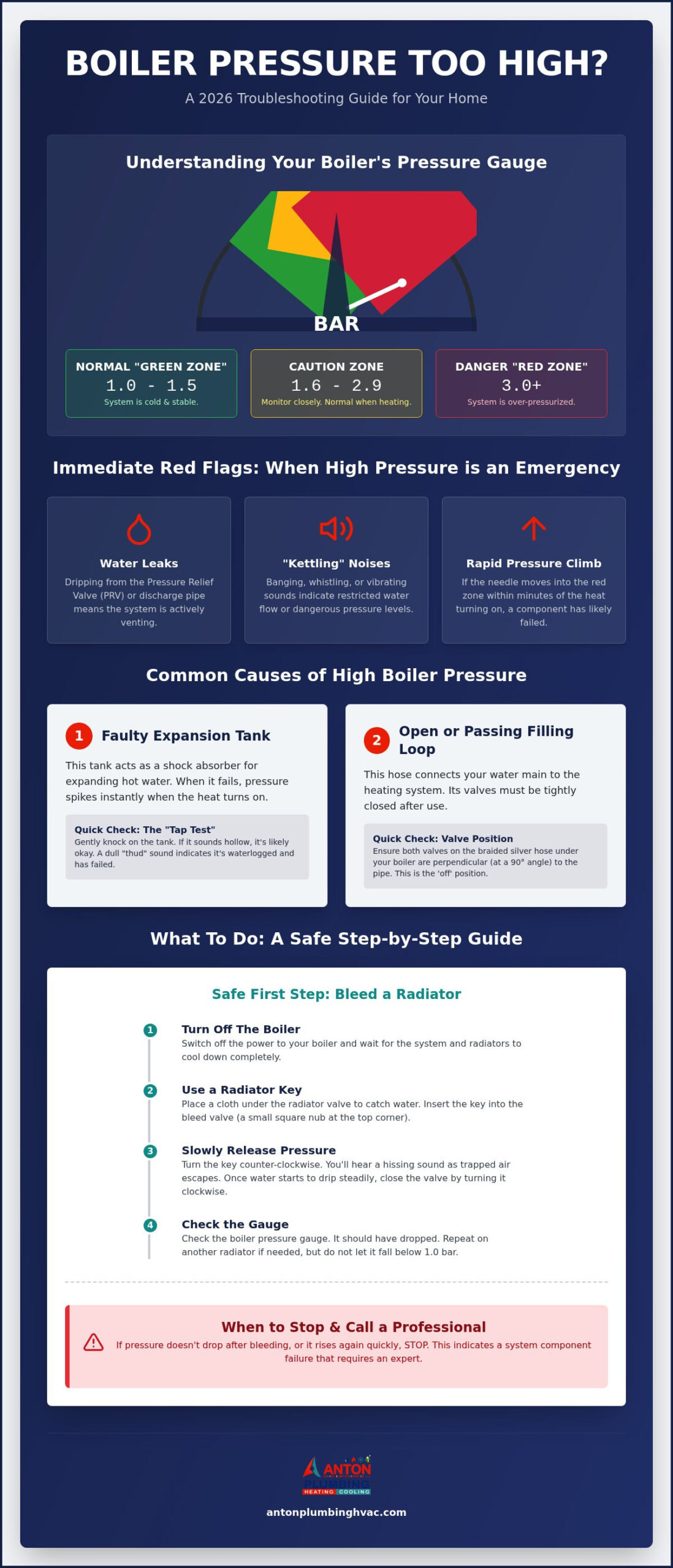
Most modern systems feature a “Green Zone” on the gauge, typically ranging from 1.0 to 1.5 bar. It’s normal for this needle to fluctuate slightly. When your heat kicks on, the water expands as it warms, causing a small, controlled rise in pressure. However, if that needle climbs into the “Red Zone” at 3.0 bar or higher, your system’s safety mechanisms are the only things preventing a major failure. In the older housing stock of Jersey City or East Brunswick, it’s also vital to distinguish between hot water and steam boilers. While hot water systems use the 1.5 bar standard, NJ steam boilers often operate at much lower pressures, typically between 0.5 and 2 PSI. Misreading these units can lead to unnecessary panic or overlooked dangers.
The Role of the Pressure Gauge
Your gauge is the primary window into your system’s health. Modern high-efficiency boilers often use digital displays that flash specific error codes when the pressure is out of spec. Older models rely on manual needle gauges. Always check your pressure when the system is cold to establish a true baseline. If the needle remains stuck in one position regardless of whether the heat is on or off, or if it moves erratically, the gauge itself may have failed. A faulty gauge is a silent risk because it hides the true state of your system’s internal tension.
When High Pressure Becomes an Emergency
High pressure can quickly transition from a minor annoyance to a household crisis. You should treat the following symptoms as immediate red flags:
- Water Leaks: If you see water dripping from the Pressure Relief Valve (PRV) or the discharge pipe, the system is actively trying to vent excess tension to prevent a rupture.
- Kettling Noises: Strange banging, whistling, or vibrating sounds indicate that the water flow is restricted or the pressure is dangerously high.
- Rapid Climbing: If the needle moves toward the red zone within minutes of turning the heat on, your expansion vessel has likely failed.
If you notice these signs, don’t wait for a total breakdown. Shut off the power and the gas supply to the unit immediately. This simple action protects your heat exchanger and prevents a costly emergency replacement during a cold NJ winter.
Common Causes of High Boiler Pressure in NJ Homes
NJ winters put incredible strain on heating systems. In Old Bridge and East Brunswick, rapid temperature drops mean your boiler runs longer and hotter than usual. This constant cycling can expose weaknesses in your system components that might have stayed hidden during milder weather. When you’re trying to figure out boiler pressure too high what to do, you’ll likely find the culprit is one of three common mechanical issues. Identifying the root cause early is the best way to protect your home from sudden utility failures.
The Expansion Tank: Your System’s Shock Absorber
The expansion vessel is a small tank, often tucked inside the boiler cabinet or mounted nearby, that contains a rubber diaphragm. One side is filled with pressurized air; the other side holds water. This “cushion of air” absorbs the extra volume created when water heats up and expands. Over time, that air can leak out or the diaphragm can perish. When this happens, there’s no room for the expanding water, so the pressure spikes instantly as soon as the heat kicks on. You can perform a “tap test” by gently knocking on the tank. It should sound hollow at the top. If it sounds like a dull thud throughout, it’s likely waterlogged and requires a professional recharge or replacement.
Filling Loop and Valve Issues
The filling loop is that silver, braided hose usually found underneath your boiler unit. It connects your main water supply directly to the heating circuit. It features two valves that must remain tightly closed during normal operation. A common mistake homeowners make is leaving one valve slightly cracked after topping up the system. This allows a slow, constant stream of water into the loop, causing the pressure to climb day after day. In some cases, the internal seal of the valve fails. This is known as a “passing valve,” which lets water through even when the handle is turned to the off position. Check the hose for any coldness or vibration, which often signals water is moving through it when it shouldn’t be.
Internal failures are rarer but more serious. A cracked heat exchanger can allow domestic hot water to leak into the heating loop. Because NJ water can be hard in certain regions, mineral buildup can accelerate this internal corrosion over decades. If your pressure continues to rise despite your best efforts to close the filling loop, it’s time to consult a licensed NJ boiler specialist to prevent a total system shutdown. Protecting your family’s comfort means addressing these small leaks before they turn into mid-winter emergencies.
How to Safely Reduce Boiler Pressure: A Step-by-Step Guide
If you’ve confirmed that the filling loop is tightly closed but the gauge needle remains stuck in the red, you need to know boiler pressure too high what to do. The most reliable way for a homeowner to lower system tension is by bleeding the radiators. This process allows you to remove small amounts of water from the heating circuit, which directly reduces the pressure. It’s a straightforward task, but it requires a methodical approach to ensure your safety and the longevity of your equipment.
Step 1: The Cooling Period
Safety is the foundation of every home repair. Switch off your boiler at the main control panel and wait at least 30 minutes before starting. Never attempt to bleed a system while the central heating pump is active. If the pump is running, it can actually pull more air into the radiators, making the problem worse. Furthermore, letting the water cool prevents thermal shock to your heat exchanger and ensures you won’t be scalded by hot spray. Grab a radiator bleed key and a thick towel to protect your floors from any discharge.
Step 2: Bleeding the Radiators
Start with the radiator located furthest from the boiler, often on the highest floor of the home. Insert the bleed key into the valve at the top corner and turn it slowly counter-clockwise. You’ll likely hear a hissing sound as trapped air escapes. Once a steady stream of water begins to trickle out, the pressure in the system is dropping. Use your towel or a small container to catch the water.
Communication is key during this step. Have someone monitor the boiler’s pressure gauge while you work. You want the needle to settle in the “sweet spot,” typically around 1.2 bar when the system is cold. If you accidentally bleed too much water and the pressure drops below 1.0 bar, your boiler may refuse to fire up. In that case, you’ll need to use the filling loop to add a tiny amount of water back in.
Step 3: Resetting the System
Once the gauge reaches the correct level, tighten the radiator valve firmly. Ensure all other radiators in the house are also closed tight. Turn the power and gas back on and observe the boiler as it starts its cycle. If the needle remains steady in the green zone, you’ve successfully resolved the issue. However, if the pressure immediately spikes back into the red once the heat starts, it’s a sign that an internal component has failed. This is the moment to schedule a professional boiler repair and installation assessment to check your expansion tank or pressure relief valve for damage.
When DIY Isn’t Enough: Identifying Major Component Failures
If you’ve bled your radiators and confirmed the filling loop is tight, yet the gauge needle still migrates toward the red zone, your system is signaling a deeper mechanical failure. While basic troubleshooting resolves many issues, certain components require specialized tools and industry expertise to fix. Continuing to ignore these signs can lead to catastrophic damage to your heat exchanger or internal seals. When you’re stuck wondering about boiler pressure too high what to do after the basics fail, it’s time to look at the more complex parts of your heating infrastructure.
Faulty Pressure Relief Valves
The Pressure Relief Valve (PRV) is your boiler’s last line of defense. It’s designed to open and discharge water if the internal tension exceeds 3.0 bar. However, once a PRV has been triggered, it often fails to “reseat” correctly. Small pieces of grit or limescale can get trapped in the valve seat, causing a persistent drip even after you’ve lowered the system pressure. You might notice water pooling near the discharge pipe outside your home. Never, under any circumstances, should you cap off or plug a leaking PRV. This valve prevents your boiler from becoming a pressurized hazard. If the valve is sticking, a professional must either clean the seat or replace the component entirely to restore your home’s security.
Complex Hydronic Imbalances
In many multi-story homes across East Brunswick and Old Bridge, heating systems are split into different zones. If a zone valve fails in the closed position while the pump is running, it can cause localized pressure spikes that confuse your boiler’s sensors. Additionally, the buildup of magnetite, a black sludge common in older NJ systems, can block the narrow passages leading to your expansion tank or pressure gauge. This debris creates false readings and prevents the system from regulating itself. Annual maintenance and a system power flush are often necessary to clear these obstructions and prevent high-cost component failures. For residents facing these complex issues, contacting an Emergency Plumber Old Bridge NJ ensures a rapid, high-tech diagnostic that pinpoints the exact failure point without guesswork.
Historic homes in Jersey City present another unique challenge: steam boilers. Unlike hot water systems, steam boilers operate at much lower pressures, often under 2 PSI. If a steam boiler’s pressure control (the pressuretrol) fails, it can lead to “short-cycling” or dangerous pressure levels that the average homeowner gauge isn’t calibrated to read accurately. Cracked heat exchangers are the most serious cause of pressure gain in these units, as they allow domestic water to leak into the heating loop. If your system requires constant attention to stay in the safe zone, you should schedule a professional inspection immediately to protect your family’s winter comfort and safety.
Professional Boiler Solutions with Anton Plumbing
When your troubleshooting steps don’t bring the needle back to center, you need a partner who understands the high stakes of a utility failure. Knowing boiler pressure too high what to do is the first step; having a licensed expert execute the repair is the second. Anton Plumbing Heating & Cooling has served as a guardian for NJ households for over 28 years. As a family-operated business, we don’t just see a mechanical issue. We see a local family that needs warmth, security, and immediate relief from the stress of a failing system.
Our Diagnostic Process
Our team uses advanced diagnostic technology to look beyond the surface symptoms. We don’t just guess which part is failing. We perform a precision test on your expansion tank’s pre-charge levels and diaphragm integrity to ensure it can handle thermal expansion. We also inspect the heat exchanger for internal bypass issues where domestic water might be leaking into your heating loop. Finally, we balance the entire hydronic circuit. This ensures your system runs at peak efficiency, which lowers your monthly utility bills and prevents future pressure spikes from recurring.
Fast, Local Service in NJ
Proximity is vital when your boiler is in the red zone during a January freeze. We provide 24/7 emergency response across Old Bridge, East Brunswick, and Jersey City. Because we’re local, our technicians arrive quickly with the specialized equipment needed for both modern high-efficiency units and historic steam systems. We value transparency and ethical standards. You’ll receive clear financial expectations and accessible payment options before any work begins, ensuring there are no surprises during a crisis.
If your system is aging and prone to frequent failures, 2026 is an excellent year to consider an upgrade. We can guide you through current NJ state rebate programs and zero-interest options for high-efficiency boiler installations. These modern systems offer superior safety controls and significantly reduced energy consumption compared to older models. Schedule your boiler diagnostic with Anton Plumbing today! Our licensed NJ Plumbing and HVACR professionals are ready to restore your home’s comfort and your peace of mind with the steady professionalism of a long-term maintenance partner.
Secure Your Family’s Comfort for the Seasons Ahead
High boiler pressure is more than just a number on a dial; it’s a signal from your home’s heart that it needs attention. By understanding the green zone and mastering the radiator bleed method, you’ve taken the first steps toward safeguarding your utility infrastructure. If the needle continues to climb into the red, the risk of water damage and lost heat during a New Jersey winter becomes a reality. Persistent spikes often point to failing expansion tanks or sticking valves that require a protective expert’s touch.
If you’re still navigating boiler pressure too high what to do after basic troubleshooting, let a professional handle the complex diagnostics. Anton Plumbing Heating & Cooling brings over 28 years of industry tenure and licensed expertise to every service call. As a family-operated business, we prioritize your domestic well-being with transparent pricing and ethical standards. Get 24/7 Emergency Boiler Repair in Old Bridge & Jersey City. You don’t have to face technical failures alone. Our team is ready to act as your knowledgeable guide, ensuring your system remains efficient and your household stays warm all year long.
Frequently Asked Questions
Is it dangerous if my boiler pressure is too high?
Yes, sustained high pressure puts immense strain on your boiler’s internal seals and pipes. While modern systems have safety valves to prevent explosions, excess tension can cause joints to burst or the heat exchanger to crack. This leads to water damage in your home and expensive emergency repairs. If you see the needle in the red, treat it as a priority to protect your property and your family’s comfort.
Can I leave my boiler on if the pressure is in the red?
You should turn your boiler off immediately if the gauge enters the red zone. Operating a system under high pressure increases the risk of a major component failure. Shutting down the power and gas gives the water time to cool, which naturally reduces some of the internal tension. This simple action prevents the pressure relief valve from firing and keeps your utility closet dry while you determine your next steps.
Why does my boiler pressure keep rising even after I bleed the radiators?
If the pressure climbs after bleeding, you likely have a “passing” filling loop valve or a failed expansion vessel. A passing valve allows fresh water to seep into the system constantly, even when it’s closed. If you aren’t sure about boiler pressure too high what to do in this scenario, check if the silver braided hose feels cold or vibrates. These signs indicate water is still entering the system and bypassing your manual controls.
How much does it cost to fix a high-pressure boiler issue in NJ?
Repair costs in New Jersey vary based on the specific component that has failed and the age of your system. Replacing a simple filling loop is generally more affordable than installing a new expansion vessel or heat exchanger. We provide clear financial expectations after a professional diagnostic, ensuring you understand the scope of work before repairs begin. Our team also helps you explore 2026 rebate programs if a full system upgrade is the most ethical choice.
Can a faulty expansion tank cause high boiler pressure?
Yes, a failed expansion tank is the most common cause of rapid pressure spikes. When the internal rubber diaphragm perishes or the air charge escapes, there is no “cushion” to absorb the expanding hot water. As the boiler heats up, the pressure has nowhere to go but up. A licensed technician can test the tank’s integrity using a specialized pressure gauge to see if it requires a simple recharge or a complete replacement.
What happens if the pressure relief valve (PRV) fails?
A failed PRV often results in a persistent leak from the discharge pipe. This valve is designed to open at 3.0 bar to vent excess water. If it gets stuck open due to sediment or a weak spring, your system will lose pressure and eventually shut down. Conversely, a PRV that refuses to open during a pressure spike is a serious safety hazard. Both situations require a professional to inspect and likely replace the valve.
Should I drain my entire boiler to lower the pressure?
No, you should never attempt to drain the entire system just to lower the pressure. Draining the unit is a complex process that can introduce air pockets and lead to pump damage if not done correctly. Bleeding a single radiator is a much safer and more controlled way to remove small amounts of water. This method allows you to watch the gauge in real-time and stop exactly when the needle hits the green zone.
How often should I check my boiler’s pressure gauge?
We recommend checking your boiler gauge at least once a month during the heating season. It’s also vital to inspect the pressure before you turn the heat on for the first time in the autumn. Regular monitoring helps you spot slow leaks or creeping pressure before they turn into mid-winter emergencies. Consistent checks are part of a proactive maintenance routine that extends the life of your system and ensures your family’s safety.