
Imagine it’s a busy Friday night on Route 9. Your dining room is packed, but a foul odor begins wafting from the kitchen, and suddenly, the floor drains start to gurgle. This nightmare scenario often stems from neglected maintenance, leading to costly emergency backups and potential fines of up to $1,020 from Middlesex County inspectors. Securing reliable grease trap cleaning for restaurants Old Bridge is the only way to protect your business and your reputation from these avoidable disasters. We understand that running a high-volume kitchen is stressful enough without the constant fear of a surprise health inspection or a sewer overflow during peak hours.
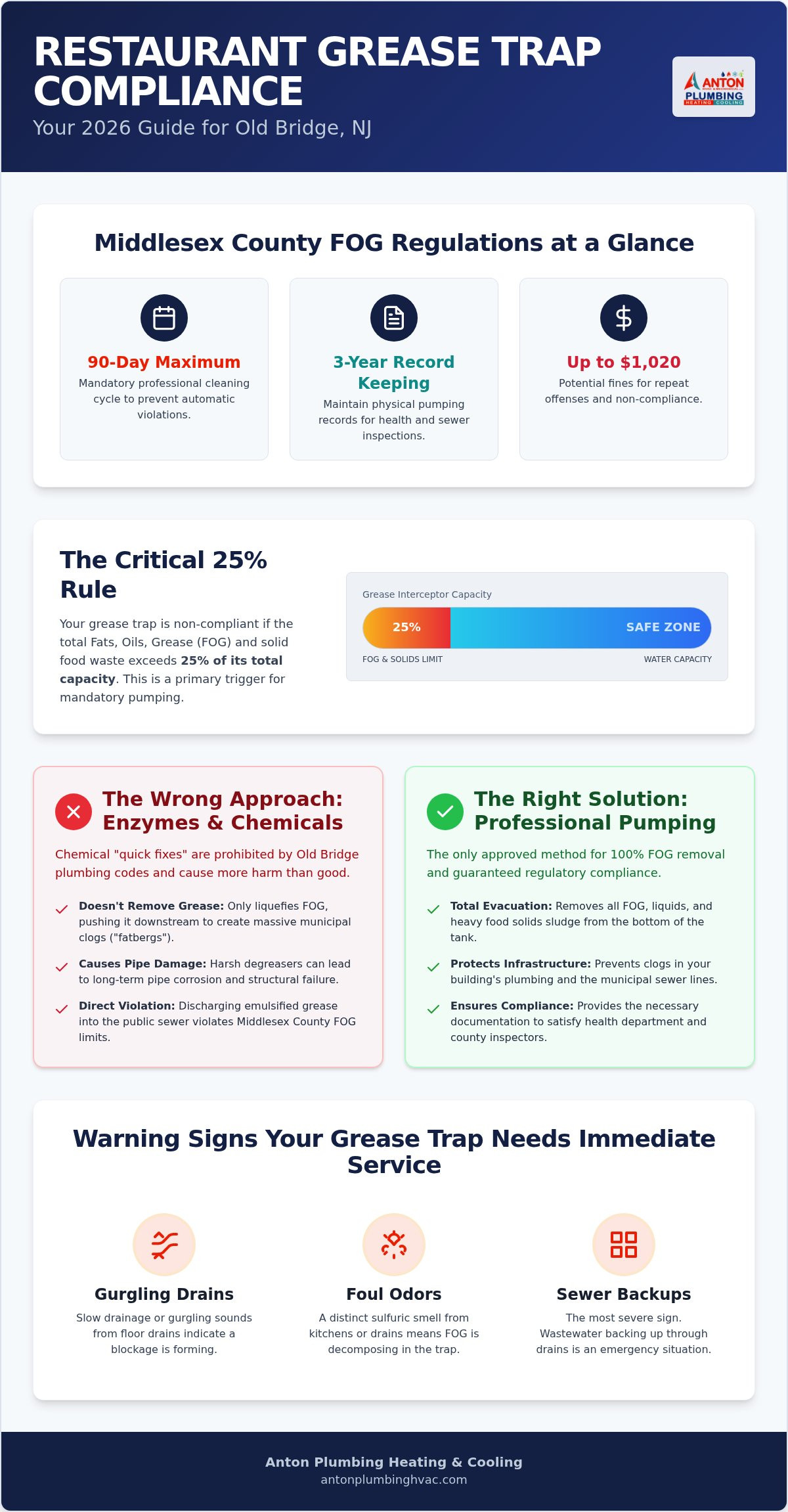
This 2026 compliance guide ensures your commercial kitchen stays compliant, odor-free, and fully operational through expert maintenance tailored to local regulations. Backed by over 28 years of industry experience, we’ll provide total clarity on the mandatory 90-day cleaning cycle, the critical 25% rule for FOG accumulation, and the specific documentation required to satisfy the $295 Middlesex County permit standards. We’ll preview exactly how to build a maintenance schedule that keeps your drainage system running clear while protecting your bottom line from heavy penalties.
Key Takeaways
- Learn the mandatory 90-day cleaning schedule and the 25% rule to stay ahead of local enforcement and avoid automatic violations.
- Understand why it’s vital to maintain physical pumping records for at least three years to prove compliance during surprise health inspections.
- Discover why chemical enzymes are an insufficient substitute for professional pumping under Old Bridge Township plumbing codes.
- Identify early warning signs of a system failure, such as gurgling floor drains, before they lead to an emergency closure on a busy night.
- Trust a licensed expert for grease trap cleaning for restaurants Old Bridge to keep your infrastructure safe and your Middlesex County permits valid.
The Importance of Regular Grease Trap Cleaning for Old Bridge Restaurants
A Grease trap (also known as a grease interceptor) serves as the primary line of defense between your commercial kitchen and the Old Bridge Township sewer system. For establishments along the Route 9 corridor, where foot traffic is high and kitchen volume is constant, these devices are under immense pressure. They work by slowing down incoming wastewater, allowing fats, oils, and grease (FOG) to cool and float to the top while food solids sink to the bottom. Without consistent grease trap cleaning for restaurants Old Bridge, these materials eventually bypass the interceptor and cause massive blockages in municipal lines. The Township Sewer Department holds business owners strictly accountable for these overflows. Neglect hurts your wallet. It leads to immediate financial pain, including Middlesex County fines that can reach $1,020 for repeat offenses.
How a Grease Trap Works to Protect Your Pipes
The mechanical process happens through a series of internal baffles. These plates act as speed bumps for your drainage. By slowing the water flow, they give enough time for lighter grease to separate from the heavier water. However, many owners forget about the solids. Over time, coffee grounds and food scraps settle into a thick sludge at the bottom of the tank. If this layer isn’t pumped out, it reduces the trap’s total capacity and forces grease out into your main sewer line. This leads to structural plumbing damage that often requires intensive hydro jetting to resolve. Regular maintenance keeps the separation process efficient and your pipes clear.
The Hidden Risks of Infrequent Pumping
Neglected traps are breeding grounds for more than just clogs. As FOG sits in the tank, it begins to decompose. This creates a distinct, sulfuric odor that can easily drift into your dining area. A foul-smelling restaurant is a fast way to lose customers and trigger a health department investigation. Beyond the smell, the organic buildup attracts pests like cockroaches and rodents. These creatures thrive in the nutrient-rich environment of a neglected trap. If left too long, the grease undergoes a chemical change and turns into a hardened, concrete-like block. Once the grease petrifies, a standard pump-out is no longer possible. You’ll face an expensive emergency situation where the entire unit needs specialized mechanical cleaning to restore flow.
Pumping vs. Enzymes: Why Professional Maintenance is Mandatory
Many restaurant owners look for shortcuts to manage kitchen waste, often turning to chemical additives or “grease-eating” bacteria. These products promise to liquefy fats and eliminate the need for physical pumping. However, these solutions are a dangerous myth. While enzymes might temporarily break down grease, they don’t actually remove it from your system. Instead, they emulsify the grease, allowing it to flow further down the line where it eventually cools and solidifies again. This creates massive blockages in the municipal sewer system, often called “fatbergs.” If Old Bridge Township traces a downstream clog back to your facility, the resulting fines and repair costs will far exceed the price of a scheduled service. Professional grease trap cleaning for restaurants Old Bridge remains the only recognized method for 100% FOG removal and regulatory compliance.
The Failure of Chemical Quick Fixes
Chemical degreasers and biological additives often do more harm than good. When grease is liquefied by these agents, it loses its ability to be trapped by the interceptor’s baffles. This means you are essentially dumping raw grease into the public sewer, which is a direct violation of Middlesex County FOG discharge limits. Over time, certain harsh degreasers can also lead to long-term pipe corrosion. This weakens your infrastructure and leads to pinhole leaks or total pipe failure. Relying on chemicals doesn’t just risk a fine; it risks the structural integrity of your building’s plumbing. For a truly clear system, a comprehensive approach to commercial plumbing maintenance is a far safer investment for your business.
What a Professional Pumping Service Includes
A true professional service is exhaustive. It isn’t just about skimming the top layer of grease. Our process involves a total evacuation of all liquids and solids from the interceptor. We don’t leave the heavy sludge at the bottom, which is often where the worst odors and bacteria reside. A high-quality service includes:
- Full Evacuation: Removing every gallon of waste so the trap starts with a clean slate.
- Wall and Baffle Scraping: Manually removing hardened buildup from the internal surfaces to restore full capacity.
- Structural Inspection: Checking for cracks, leaks, or failing baffles that could lead to a system bypass.
- Waste Manifest Documentation: Providing the legal paperwork required for 2026 inspections.
In Old Bridge, your waste manifest is your only legal proof of compliance. Inspectors require these documents to be kept on-site for a minimum of three years. Without a signed manifest from a licensed hauler, you have no way to prove you’ve met the mandatory 90-day cleaning cycle. We ensure your records are as clean as your pipes, protecting you from the $340 first-offense penalties and keeping your kitchen operational through every peak hour.
Navigating Old Bridge Township & Middlesex County FOG Regulations
Compliance in 2026 requires more than just a quick pump. The Old Bridge Township Sewer Department works alongside Middlesex County to enforce strict Fats, Oils, and Grease (FOG) standards. If you operate a commercial kitchen in this jurisdiction, you must maintain a valid Middlesex County FOG permit, which currently carries a $295 annual fee. This isn’t a suggestion. It’s a legal requirement to keep your business operational. Staying on top of grease trap cleaning for restaurants Old Bridge means understanding that multiple local agencies monitor your discharge levels to protect the municipal infrastructure.
Old Bridge Township Inspection Protocols
Inspectors from both Code Enforcement and the Sewer Department have the authority to enter your premises for unannounced checks. They primarily look for violations of the “25% Rule.” This regulation states that your interceptor is legally full once the combination of floating grease and settled solids reaches one-quarter of the tank’s total depth. Even if you haven’t reached your mandatory 90-day service interval, you must pump if you hit this limit. Surprise inspections are often triggered by neighbor complaints about foul odors or when the township identifies a blockage in the local sewer main. If an inspector finds you out of compliance, you’ll face an initial $340 fine. A second offense quickly escalates to $1,020.
NJ DEP Compliance for Food Service Establishments
The New Jersey Department of Environmental Protection (NJ DEP) sets the standard for how kitchen waste is transported and processed. You cannot legally dispose of grease trap waste yourself. You must hire a hauler with a valid New Jersey state plumbing license or specialized hauling credentials. This ensures that recovered fats and oils are recycled or processed at authorized facilities rather than dumped illegally. For restaurants in Laurence Harbor and Cheesequake, proximity to sensitive coastal waterways makes compliance even more critical. The state monitors these areas closely to prevent environmental contamination and sewer overflows.
Your waste manifests are your shield during an audit. You’re required to maintain all service records and pumping manifests on-site for a minimum of three years. These documents must include the date of service, the exact volume removed, and the signature of your licensed professional. During a routine check, an inspector will ask to see these logs immediately. If you can’t produce them, the township views you as non-compliant regardless of the actual condition of your trap. We help our partners manage this documentation so they’re always prepared for an unannounced visit from the health department or sewer authorities.
Signs Your Restaurant’s Grease Interceptor Needs Immediate Pumping
Your kitchen infrastructure usually works in the background, but it will start sending clear distress signals when the interceptor reaches its limit. Slow-moving drains in the dishwashing area or prep sinks are often the first sign that grease has begun to restrict the flow. If you notice water pooling around your feet during a busy shift, it isn’t just a nuisance; it’s a warning. Gurgling sounds from floor drains indicate that air is being trapped by a growing blockage of fats and oils. In some cases, you might even see grease appearing in secondary drains that aren’t directly connected to the trap. This suggests a systemic backup that requires professional grease trap cleaning for restaurants Old Bridge before the entire line fails.
Identifying the ‘Early Warning’ Signs
Don’t wait for a total shutdown to take action. A simple visual check can save you thousands in emergency repairs. Open the interceptor and look at the top layer. If the floating grease layer is more than 2 inches thick, you’re likely approaching the legal 25% limit. Another unmistakable sign is the smell. A persistent rotten egg or rancid grease odor near the trap means organic matter is decomposing. If your customers can smell the kitchen from the dining room, your brand reputation is already at risk. Proactive commercial plumbing maintenance ensures these odors never reach your guests and your drains stay clear during peak hours.
Emergency Situations: When to Call a 24/7 Plumber
Some problems can’t wait until Monday morning. A total sewage backup into your kitchen workspace is a health hazard that requires an immediate shutdown. If you see visible grease overflowing from an outdoor interceptor, you’re actively polluting the Old Bridge environment and risking heavy municipal fines. These high-stakes moments require an Emergency Plumber Old Bridge NJ to restore your operations and contain the damage. We provide 24/7 rapid response because we know that a Friday night backup is a direct threat to your livelihood. Acting fast prevents the grease from hardening into a petrified block, which makes the cleaning process much more complex and expensive. We act as the guardian of your kitchen, ensuring that a mechanical failure doesn’t turn into a permanent business closure.
Anton Plumbing Heating & Cooling: Your Partner for Commercial Drain Health in Old Bridge
Anton Plumbing Heating & Cooling has spent over 28 years protecting the infrastructure of Middlesex County businesses. We aren’t just a waste hauling company. We are NJ-licensed plumbing professionals who understand the complex hydraulics of your entire kitchen system. When you schedule grease trap cleaning for restaurants Old Bridge with our team, you’re getting more than a simple pump-out. You’re getting a comprehensive health check for your drains. We examine the connection points, the venting, and the downstream flow to ensure your business stays operational. Our deep roots in the community mean we treat every local restaurant like a neighbor, not just a contract.
The Anton Advantage: Hydro Jetting Technology
Pumping the trap removes the bulk of the waste, but it doesn’t address the grease already coating your pipes. We frequently recommend high-pressure hydro jetting for lines after every major service. This technology uses specialized nozzles to scour pipe walls with intense water pressure, removing the stubborn FOG that standard snakes can’t touch. By clearing these lines, we prevent future accumulation and significantly reduce the risk of emergency backups during your busiest shifts. If you’ve been dealing with recurring clogs or slow drainage, our Expert Drain Cleaning Services in Old Bridge provide the deep clean your system needs to function like new. We don’t just move the problem; we eliminate it.
Reliable Maintenance for Old Bridge Business Owners
Every kitchen has a different rhythm. A high-volume steakhouse on Route 9 fills a trap much faster than a small deli in Cheesequake. We don’t believe in one-size-fits-all solutions. Instead, we build customized maintenance schedules based on your specific kitchen volume and usage patterns. This transparent scheduling allows us to perform service during your off-peak hours. We work quickly and cleanly to ensure zero disruption to your staff or your guests. Our goal is to provide immediate relief for stressed owners who are tired of managing plumbing crises.
Our team also handles the heavy burden of documentation. We provide the detailed manifests and service logs required by local and state inspectors. You’ll never have to scramble for paperwork during a surprise audit or a health department visit. For a deeper look at how we protect your commercial assets and keep your facility running smoothly, consult our Commercial Plumbing Maintenance Guide. Anton Plumbing Heating & Cooling acts as your Protective Expert, guarding your kitchen against fines, odors, and the high cost of utility failures. Trust a veteran team that has been serving the local community for nearly three decades to keep your drainage system clear, compliant, and odor-free.
Secure Your Kitchen’s Success with Expert Maintenance
Staying on top of your kitchen’s infrastructure is about more than just avoiding a citation; it’s about ensuring your business survives the high-stakes environment of the local dining scene. By adhering to the mandatory 90-day pumping cycle and verifying your interceptor never exceeds the 25% accumulation limit, you protect your facility from the catastrophic backups that lead to emergency closures. Securing reliable grease trap cleaning for restaurants Old Bridge is a fundamental part of maintaining a healthy, odor-free commercial operation that keeps customers coming back.
Anton Plumbing Heating & Cooling has been the trusted guardian of local commercial kitchens since 1996. As a family-owned and operated team with NJ State Plumbing and HVACR licenses, we provide the technical precision and ethical standards necessary to keep your facility in total compliance. We offer 24/7 emergency response for those critical moments when a utility failure threatens your service, ensuring you always have a dependable partner ready to act at a moment’s notice. Schedule Your Professional Grease Trap Pumping with Anton Plumbing Heating & Cooling Today and invest in the long-term security of your infrastructure.
Frequently Asked Questions
How often does a restaurant grease trap need to be cleaned in Old Bridge?
In Old Bridge, grease interceptors must be cleaned at a minimum of every 90 days. This is a strict regulatory requirement enforced by the Township Sewer Department. However, high-volume establishments may need more frequent service to avoid reaching the 25% capacity limit. Regular grease trap cleaning for restaurants Old Bridge ensures you remain compliant with local codes and prevents the foul odors that can drive away your loyal customers during peak hours.
What is the ’25 percent rule’ for grease interceptors in New Jersey?
The 25% rule states that the depth of the combined grease and solids layers must not exceed one-quarter of the total liquid depth of the interceptor. Once you reach this threshold, the trap loses its ability to effectively separate FOG from wastewater. Inspectors measure these layers during unannounced visits. If your levels are over 25%, you’ll face immediate penalties regardless of when your last scheduled pumping occurred.
Can I use chemicals or enzymes to clean my grease trap instead of pumping?
No, chemical or enzyme treatments cannot replace physical pumping in Old Bridge. While some products claim to dissolve grease, they typically only emulsify it, allowing it to bypass the trap and clog municipal sewer lines. This practice is often illegal and can lead to massive fines. Professional pumping is the only way to fully remove waste and provide the required manifest documentation that state and local inspectors demand during their audits.
What happens if my restaurant fails a FOG inspection in Middlesex County?
Failing an inspection leads to significant financial penalties and increased scrutiny from local authorities. A first-offense violation in Middlesex County typically results in a $340 fine. A second offense jumps to $1,020. Beyond the fines, you may be required to perform immediate emergency cleaning and could face a temporary business closure if the violation is deemed a public health hazard or if it has caused a municipal sewer overflow.
Who is responsible for grease trap cleaning in a leased commercial space?
Responsibility for grease trap maintenance is typically defined within your commercial lease agreement. In most cases, the restaurant operator is responsible for routine cleaning and record-keeping as it’s a direct result of their business operations. However, structural repairs to an outdoor interceptor might fall on the property owner. It’s vital to clarify these duties in your lease to ensure your grease trap cleaning for restaurants Old Bridge stays on schedule.
Is there a difference between an indoor grease trap and an outdoor interceptor?
Yes, the primary differences are volume capacity and installation location. Indoor grease traps are smaller units, often installed directly under or near a three-compartment sink. They are designed for lower flow rates. Outdoor interceptors are large, underground tanks that handle the combined wastewater from the entire kitchen. While they both function on the same principle of separation, outdoor units require specialized vacuum trucks for proper evacuation and maintenance.
Can a grease trap backup cause my restaurant to be shut down by the health department?
Yes, a sewage or grease backup is considered a critical health violation. If waste water is bubbling up from floor drains or sinks, it creates an unsanitary environment for food preparation. Health inspectors have the authority to shut your doors immediately until the issue is resolved and the area is professionally sanitized. Proactive maintenance is a business survival strategy that prevents these high-stakes emergencies from ruining your restaurant’s reputation and revenue.
How much does professional grease trap pumping cost for a small cafe?
Costs for professional pumping vary based on the size of your trap and the frequency of your service. Smaller indoor units generally cost less to service than large outdoor interceptors that require heavy machinery. Factors like accessibility and the volume of accumulated solids also influence the final price. We recommend a professional assessment of your kitchen volume to establish a transparent, predictable maintenance schedule that fits your specific operational budget and compliance needs.