
Imagine walking down to your basement on a freezing morning only to find a growing puddle beneath your heating system. That sinking feeling of seeing your boiler leaking water in NJ isn’t just about the mess. It’s the immediate fear of a total system failure when your family needs warmth the most. Whether it’s a slow drip from a pipe or a steady stream from the tank, water where it shouldn’t be is a signal that your home’s infrastructure is under stress.
We know how quickly a small leak can turn into a source of major stress, especially when you’re worried about basement flooding or the sudden loss of heat. It’s natural to feel anxious about repair costs or the complexity of the fix. This article provides the clarity you need during a high-stakes moment. You’ll discover the most common reasons for boiler failure, the safety steps you must take immediately, and how to tell if a simple repair or a professional intervention is required. By the end, you’ll have a clear path to restoring your home’s security and ensuring your system runs efficiently all winter long.
Key Takeaways
- Learn the critical safety protocols to follow the moment you spot a boiler leaking water in NJ, starting with shutting off the electrical power to prevent shorts.
- Identify common culprits like faulty pressure relief valves or corroded heat exchangers before they lead to expensive basement flooding or property damage.
- Understand the difference between a minor loose fitting you can tighten and a complex component failure that requires a licensed NJ Master Plumber.
- Discover why annual system flushing and professional maintenance are the most effective ways to protect your home’s heating investment and prevent sudden leaks.
- Get insights on when to call for 24/7 emergency support from local experts who specialize in both steam and hot water boiler systems.
Immediate Steps: What to Do if Your Boiler is Leaking
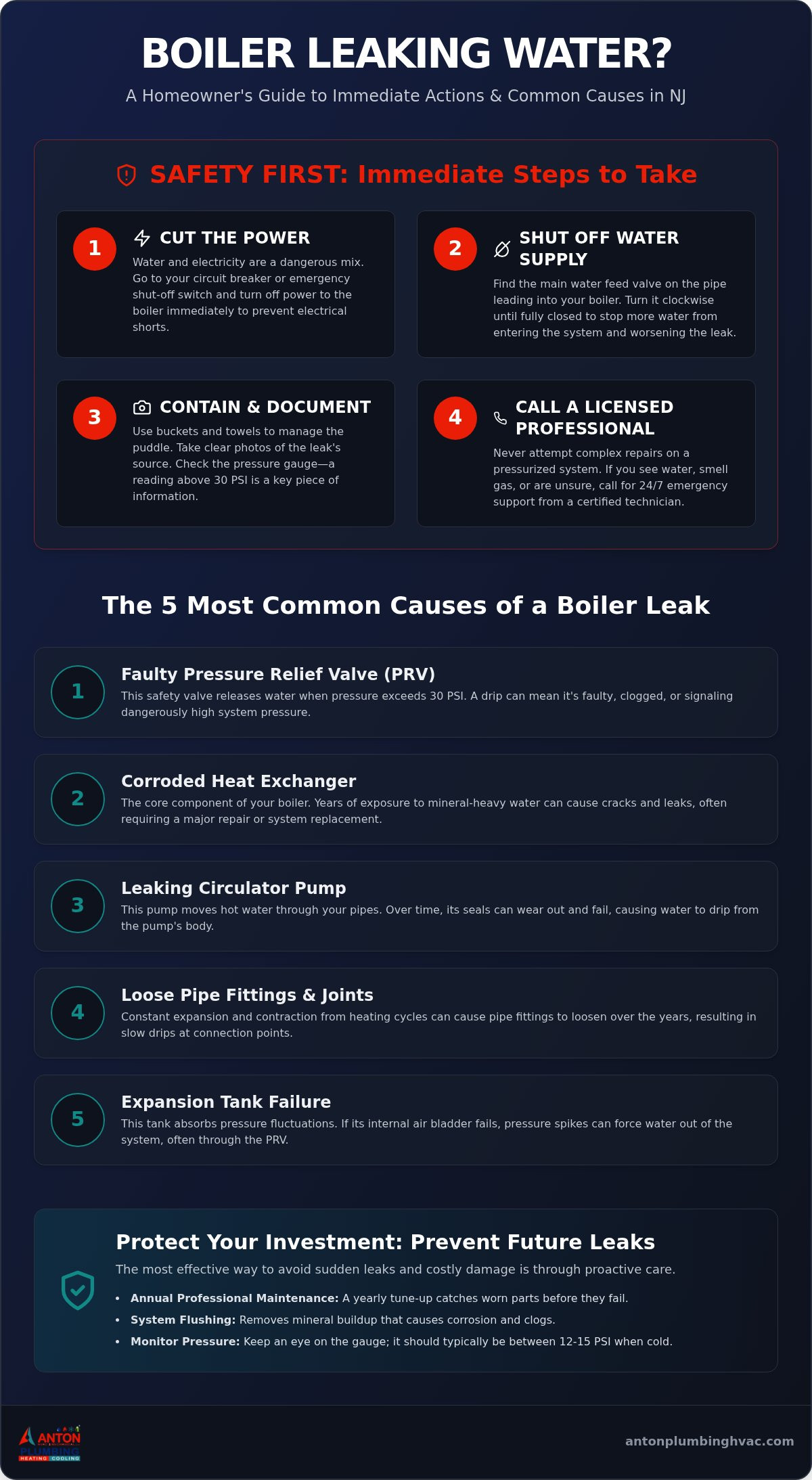
Discovering your boiler leaking water in NJ requires quick, decisive action to protect your home from structural damage. Don’t wait for a small puddle to become a basement flood. Your first priority is safety. Head to your circuit breaker or the emergency shut-off switch and cut the power to the unit immediately. Water and electricity are a dangerous combination. Turning off the power prevents electrical shorts that could destroy expensive components like the control board or the circulator pump. If you’re already standing in a puddle, do not touch any switches. Stay clear of the water and call for professional help right away.
Once the power is safely disconnected, identify the fluid. Most leaks involve system water, but if you notice an oily sheen or a sharp chemical smell, you may have a fuel or additive leak. If it’s just water, use buckets and towels to contain the spread. Be extremely careful when working near the unit. Boilers operate at high temperatures, and touching a hot pipe or the boiler casing can cause severe burns. Understanding How Boilers Work helps you realize these systems are under intense pressure. To stop the flow of water, locate the main water feed valve on the pipe leading into the boiler and turn it clockwise until it’s fully closed. This stops the leak from worsening while you wait for an emergency plumber in Old Bridge NJ to arrive.
Locating the Emergency Shut-off Valves
To effectively manage the situation, you need to know your system’s layout. The water feed valve is typically located on the cold water pipe bringing fresh water into the unit. It usually features a lever or a circular handle. If you smell gas or suspect a combustion issue, you should also find the gas shut-off valve. This is typically a yellow or red handle located on the gas line leading to the burner. Remember the golden rule of home safety: never touch electrical switches or valves if you are standing in water. If you can’t reach the valves safely, leave the area and wait for a licensed professional.
Documenting the Leak for Professional Repair
Before our technicians arrive, gather as much information as possible to speed up the diagnosis. Take clear photos of where the water is dripping. This helps Anton experts determine if the issue is a simple loose fitting or a major component failure. Check the pressure gauge on the front of the unit. If it reads above 30 PSI, the system is over-pressurized, which often forces the safety valve to open. Note whether the boiler leaking water in NJ is a constant drip or if it only happens when the heat is actively running. This data allows us to bring the right parts and restore your heat faster.
The 5 Most Common Causes of a Boiler Leaking Water in NJ
Identifying the root cause of a boiler leaking water in NJ is the first step toward restoring your home’s security. In our region, heating systems face unique stresses, from the mineral-heavy water found in many local municipalities to the grueling workload of a typical New Jersey winter. Whether you have an older steam system common in Jersey City or a modern high-efficiency unit in Old Bridge, leaks usually stem from one of five primary issues. Understanding these failures helps you communicate more effectively with your technician and prevents minor drips from escalating into major property damage.
- Faulty Pressure Relief Valve (PRV): This valve is designed to ‘vent’ excess pressure to prevent system failure.
- Corroded Heat Exchanger: Age and poor water quality can cause the internal metal to thin and crack.
- Leaking Circulator Pump: Seals that move water through your home eventually wear out and fail.
- Loose Pipe Fittings and Joints: Years of thermal expansion and contraction can loosen even the best connections.
- Expansion Tank Failure: If the internal air cushion disappears, pressure spikes will force water out of the system.
Pressure Relief Valve (PRV) Malfunctions
The Pressure Relief Valve is the boiler’s primary safety mechanism. It’s engineered to open and discharge water if the internal pressure exceeds safe limits, typically 30 PSI. If your PRV is dripping, it might be clogged with hard water sediment or responding to a genuine pressure surge. You should never cap or plug a leaking relief valve. Doing so creates a high-risk situation that ignores state boiler safety standards and puts your household at risk of a system explosion.
Internal Corrosion and Tank Failure
New Jersey’s water supply often contains oxygen and minerals that, over decades, lead to internal corrosion. This process creates ‘pinhole’ leaks in the boiler tank or the heat exchanger. While a leaking pipe or joint is usually a straightforward repair, a breach in the main tank or heat exchanger often signals that the unit has reached the end of its lifespan. Look for signs of rust or white, crusty ‘scaling’ around the base of your unit, as these are clear indicators of a slow, long-term leak that requires a professional assessment from a licensed NJ Master Plumber.
Pump and Seal Leaks
The circulator pump acts as the ‘heart’ of your hydronic heating system, constantly pushing hot water through your radiators or baseboards. These pumps rely on internal seals to keep water away from the electrical motor. After 10 to 15 years of operation, these seals naturally degrade. If you notice water dripping directly from the pump housing, it’s a sign that the seal has failed. If left unaddressed, water can enter the pump motor and cause a total system lockout, leaving you without heat during a freeze.
Assessing the Severity: Is Your Boiler Leak a DIY Fix?
Deciding how to handle a boiler leaking water in NJ requires a clear-eyed assessment of the situation. Not every puddle signals the end of your heating system, but every leak deserves attention. Start by categorizing the flow. A minor drip at an external pipe joint is often just a symptom of years of vibrations and temperature changes. A constant leak from within the unit’s casing usually points to a mechanical failure in a valve or pump seal. If you see gushing water, you are facing a critical emergency that requires an immediate professional response to prevent structural damage to your home.
Before you panic, check for “boiler sweat.” This is common condensation that forms on the outside of pipes or the tank when a cold system first fires up. It’s also a standard byproduct of modern high-efficiency units. If the moisture disappears as the system warms up, it’s likely just condensation. However, if the water continues to pool, you have a true mechanical leak that needs a professional eye.
When to Tighten vs. When to Call Anton
You can safely use a wrench to snug up a loose nut on an external plumbing joint. This is a common fix for older homes in Jersey City or East Brunswick. However, your DIY efforts must stop at the boiler’s casing. Never attempt to tighten or adjust internal components. Opening the unit without a New Jersey state HVACR license is dangerous and can void your warranty. We strongly advise against using “stop leak” additives. These chemicals are designed for automotive use and will quickly clog the narrow passages of a high-efficiency NJ boiler system, leading to a much more expensive heat exchanger replacement.
The ‘Pressure Spike’ Test
Your boiler’s pressure gauge is its most important diagnostic tool. Under normal conditions, your system should operate between 12 and 15 PSI. Watch the gauge while the heat is running. If you see the needle climb toward 30 PSI, your expansion tank has likely failed. When this “cushion of air” disappears, the water has nowhere to expand, forcing the pressure relief valve to open. In this scenario, the leaking valve isn’t the problem; it’s a symptom of a waterlogged expansion tank. Replacing this component requires specialized knowledge to ensure the new tank is properly charged and sized for your specific NJ home layout.
Preventing Boiler Leaks: Maintenance Tips for NJ Homeowners
Proactive care is the best defense against a boiler leaking water in NJ. While emergency repairs are necessary when failure occurs, annual maintenance offers a massive return on investment. It is the difference between a routine service call and a catastrophic basement flood. By identifying minor drips early, you protect your home’s structure and your family’s safety. Regular maintenance can extend a boiler’s life by 5 to 10 years, delaying the high cost of a total system replacement.
In many older New Jersey communities, sediment and “black sludge” naturally accumulate within radiators and pipes. This debris creates internal blockages that force the system to work harder, increasing pressure until seals eventually fail. Professional system flushing is critical for removing this buildup. To further protect your unit, we recommend installing a magnetic filter. This device catches metallic particles before they reach the heat exchanger, preventing the abrasive wear that leads to pinhole leaks. We also monitor the water’s pH and chemical inhibitor levels. If the water becomes too acidic, it will corrode the metal components from the inside out.
Professional Seasonal Tune-ups
A professional HVAC repair in East Brunswick involves a rigorous multi-point safety check designed for the NJ climate. Our technicians don’t just look for current leaks. We test valves, pumps, and thermostats under a full load to simulate the coldest nights of January. This certified safety inspection provides the peace of mind that comes from knowing your system is resilient. We verify that every safety control is responsive and that the combustion process is clean and efficient.
Upgrading to Protect Your Home
Modern technology offers new layers of domestic security. Installing smart water shut-off monitors provides automatic leak detection that can kill the water supply the moment moisture is sensed under the unit. We also suggest a strategy of “preventative replacement” for high-wear parts. Replacing an aging expansion tank before it fails prevents the pressure spikes that cause a boiler leaking water in NJ to “blow” its relief valve. These small upgrades act as a guardian for your household infrastructure.
Don’t wait for a puddle to appear before taking action. Contact us today for a comprehensive boiler maintenance plan tailored to your specific system and local water conditions.
Professional Boiler Repair and Installation in New Jersey
When you’re facing a boiler leaking water in NJ, you need more than a quick fix. You need a long-term partner who understands the specific demands of local infrastructure. Anton Plumbing Heating & Cooling has served families in Old Bridge, Jersey City, and across the state for over 28 years. Our deep roots in the community mean we’ve seen every possible configuration of steam, hot water, and high-efficiency combi-boilers. We don’t just treat the symptom; we protect the household. As licensed NJ Master Plumbers and HVACR contractors, we ensure every repair meets strict safety codes, especially when gas line integrity is involved. Choosing a veteran professional prevents the recurring failures that often plague cut-rate repairs.
Navigating the financial side of a major repair or upgrade shouldn’t add to your stress. For 2026, New Jersey homeowners can access significant incentives through state-sponsored Clean Energy Programs. These include rebates of up to $7,500 for high-efficiency installs, which can often be stacked with zero-interest financing options. We specialize in helping our neighbors maximize these benefits, turning a stressful utility failure into an opportunity for a modern, cost-saving upgrade. Our team handles the technical documentation, so you can focus on your family’s comfort.
Advanced Leak Detection and Diagnostic Technology
Our “Protective Experts” use modern tools to eliminate guesswork. We employ thermal imaging and precision pressure testing to locate hidden breaches within walls or beneath floors. This high-tech accuracy ensures we only replace what is necessary, saving you from the expense of unnecessary part swaps. We believe in total transparency. That’s why we provide clear, “no-surprise” pricing before any work begins. You’ll know exactly what the solution entails and what it costs, allowing you to make an informed decision for your home without the anxiety of hidden fees.
High-Efficiency Boiler Upgrades
Sometimes, a boiler leaking water in NJ is a clear sign that your unit has reached the end of its 20 to 30-year lifespan. If your system is frequently breaking down or showing signs of heavy internal corrosion, it’s time to consider a water heater or boiler replacement. Modern modulating-condensing boilers are significantly more efficient than older cast-iron models, often reducing monthly energy bills by 20% or more. These systems adjust their output based on the outdoor temperature, providing consistent warmth without wasting fuel. Reach out to us today for a professional consultation or 24/7 emergency support. We are ready to restore your home’s safety and efficiency at a moment’s notice.
Secure Your Home’s Warmth and Safety Today
A boiler leak is more than just a nuisance; it’s a direct threat to your home’s stability and your family’s comfort. By now, you know how to triage the situation safely and identify the likely culprits, from failing pressure relief valves to internal tank corrosion. Addressing a boiler leaking water NJ early is the most effective way to prevent catastrophic property damage and avoid the high cost of a total system failure during a freeze.
Anton Plumbing Heating & Cooling serves as your protective expert with over 28 years of industry tenure. As licensed Master Plumbers and HVACR contractors, we combine advanced diagnostic technology with a neighborly, community-focused approach. Whether you require a midnight emergency repair or a planned high-efficiency upgrade, our 24/7 emergency service in Old Bridge and Jersey City ensures you are never left alone in a crisis. Don’t let a small drip become a major disaster.
Schedule Your Professional Boiler Leak Inspection with Anton Plumbing Today. We’re ready to restore your peace of mind and keep your household running smoothly all winter long.
Frequently Asked Questions
Is a leaking boiler an emergency?
A leaking boiler is considered a high-priority emergency because it signals a breach in a pressurized system. If left unaddressed, even a small drip can lead to significant basement flooding or a total loss of heat during a New Jersey freeze. More importantly, leaks often stem from pressure imbalances that could result in a dangerous system failure. You should shut off the power and water immediately to protect your home’s infrastructure.
Why is my boiler leaking from the bottom?
Water pooling at the base often indicates internal corrosion of the boiler tank or a failure of the drain valve. If your unit is older than 20 years, the metal may have thinned enough to develop pinhole leaks. Another common culprit is the discharge pipe from the pressure relief valve, which vents water downward when the system is over-pressurized. A professional diagnostic is necessary to determine if the tank itself is breached.
Can I still use my boiler if it’s leaking water?
You should not operate a boiler that is actively leaking water. Continuing to run the system can cause electrical shorts in the circulator pump or control board, leading to much more expensive repairs. Additionally, if the leak is caused by high pressure, the system could be at risk of a critical failure. It is best to keep the unit powered down until a licensed NJ Master Plumber can verify its safety.
How much does it typically cost to fix a boiler leak in NJ?
Repair costs vary based on the source of the leak and the parts required. Minor issues like a faulty valve or loose fitting are generally more affordable than replacing a circulator pump or an expansion tank. If the heat exchanger or the main tank has corroded, a full system replacement may be the most cost-effective long-term solution. We provide transparent, upfront pricing after a thorough diagnostic to ensure there are no surprises for our customers.
Why does my boiler leak only when the heat is turned on?
Leaks that appear only during operation are usually caused by thermal expansion. As the water heats up, it expands, increasing the internal pressure. If your expansion tank is waterlogged or the pressure relief valve is weak, the system will force water out to compensate. Metals also expand when hot, which can cause small cracks in the heat exchanger or loose pipe joints to open up and drip only when the system is firing.
Will a leaking boiler cause my energy bills to increase?
Yes, a boiler leaking water NJ will almost certainly cause your energy bills to climb. Your system must work harder to heat the constant influx of cold “makeup” water required to replace what is lost through the leak. Furthermore, leaks often indicate that the unit is no longer operating at peak efficiency. Addressing these issues promptly prevents fuel waste and protects your monthly budget from unnecessary utility spikes.
What is the difference between a steam boiler leak and a hot water boiler leak?
Steam boilers, common in older Jersey City homes, often leak from sight glasses or air vents due to sediment buildup or incorrect water levels. Hot water boilers typically leak from circulator pumps, expansion tanks, or pressure relief valves. While both systems are pressurized, steam leaks can lead to rapid water loss and “dry firing,” which can crack a cast-iron boiler block in minutes. This makes immediate professional intervention even more critical for steam systems.
Does Anton Plumbing provide 24/7 boiler repair in Jersey City?
Yes, Anton Plumbing Heating & Cooling provides 24/7 emergency boiler repair services across Jersey City, Old Bridge, and East Brunswick. We understand that heating failures don’t follow a schedule, so our team of licensed experts is always on standby to respond to your call. With nearly three decades of experience serving the local community, we arrive equipped with the diagnostic technology needed to identify your boiler leaking water NJ and restore your home’s security.