
Your water heater shouldn’t be a financial drain on your household, yet traditional units often account for a massive portion of your monthly utility bill. It’s frustrating to watch energy rates climb while you’re stuck with outdated equipment that works harder for less. Many New Jersey homeowners worry that switching to newer technology won’t work in a chilly Garden State basement or that the upfront cost is simply too high to justify.
You can actually slash your annual water heating costs by 50% or more while securing significant stackable state incentives. Professional heat pump water heater installation NJ services from a licensed expert ensure your system performs perfectly, even in the middle of a cold winter. This 2026 guide breaks down how to navigate the NJ Clean Energy Program, stack utility rebates from providers like PSE&G or JCP&L, and choose a system that guarantees reliable hot water for your family. We’ll help you secure zero-interest financing options and high-efficiency equipment that protects both your budget and your home’s comfort.
Key Takeaways
- Understand how hybrid “refrigerator in reverse” technology moves heat from the air to your water tank to maximize household efficiency.
- Learn how to slash annual utility costs while keeping your NJ basement dry through the unit’s natural dehumidification process.
- Identify the critical airflow and drainage requirements needed for a successful heat pump water heater installation NJ to ensure long-term reliability.
- Discover why the First Hour Rating (FHR) is the most important metric when choosing between a 50-gallon or 80-gallon unit for your family.
- Navigate the 2026 NJ Clean Energy Program to secure maximum state rebates and access zero-interest financing for your upgrade.
What is a Heat Pump Water Heater and How Does it Work?
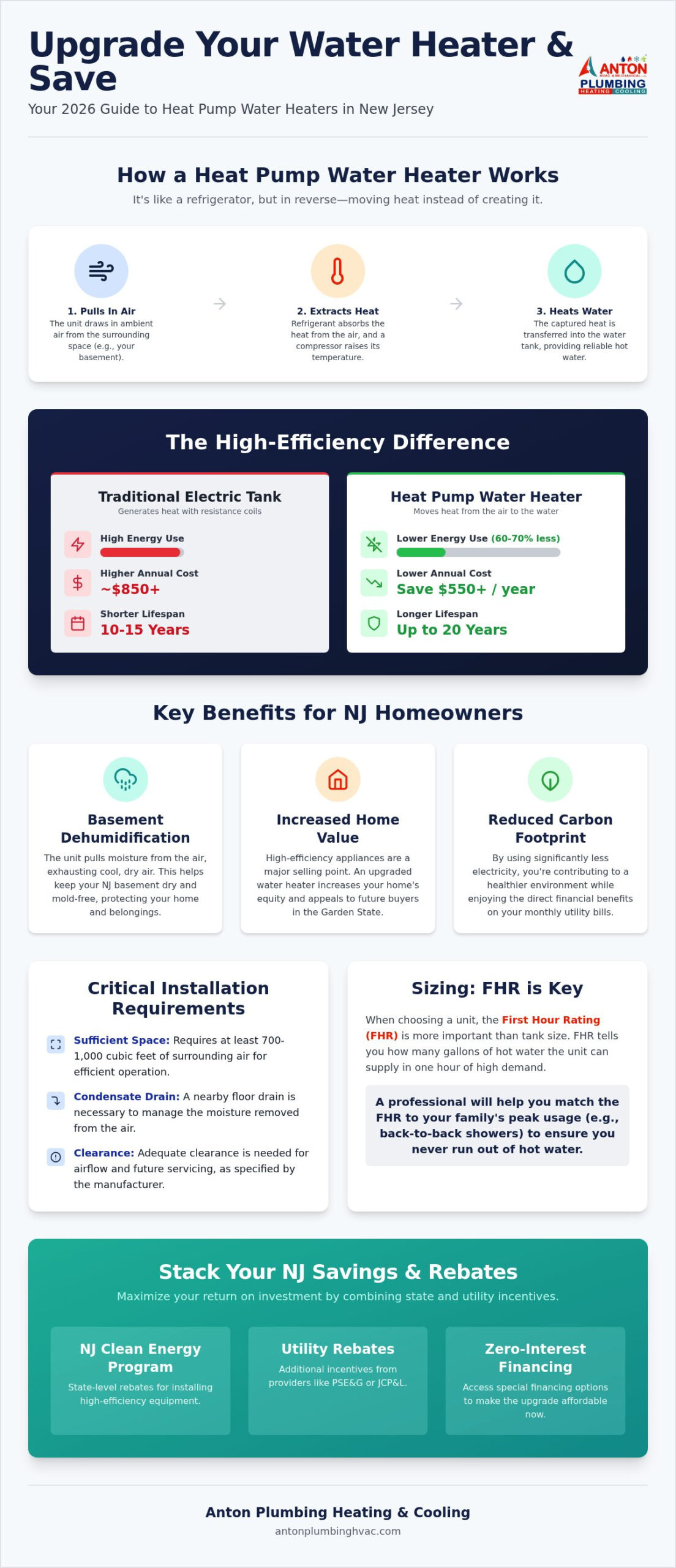
A heat pump water heater is a sophisticated hybrid system designed to move heat rather than create it. Unlike a standard electric tank that uses high-resistance coils to warm water, these units extract heat from the surrounding air and transfer it into the tank. This process is remarkably similar to how a refrigerator works, but in reverse. While your fridge pulls heat from the inside to keep food cold, a heat pump pulls heat from your basement or utility room to keep your water hot. Understanding how water heaters work is the first step in realizing why this technology is a game changer for New Jersey utility bills.
The core of the system is a compressor and refrigerant cycle. The unit pulls in ambient air, the refrigerant absorbs the heat, and the compressor increases the temperature before transferring it to the water. Because moving heat requires significantly less electricity than generating it, a professional heat pump water heater installation NJ can cut your water heating energy consumption by 60 to 70 percent. In 2026, we measure this efficiency through the Uniform Energy Factor (UEF). A higher UEF means more hot water for every dollar spent on your electric bill. These units are called hybrid because they still contain traditional electric heating elements as a backup, ensuring you never run out of hot water during periods of extreme demand.
The Three Operating Modes
Most modern units offer three distinct settings to balance comfort and savings. Heat Pump Only is the most efficient setting. It uses only the compressor to heat water, making it perfect for low-demand periods. Hybrid Mode is the default setting for most NJ families. It uses the heat pump for maximum efficiency but can activate the electric resistance elements if you have a high demand for hot water, like back-to-back showers. Electric Only acts as an emergency backup. If the air around the unit is too cold or the system needs to recover hot water instantly, it operates like a traditional electric heater to keep your family comfortable.
Heat Pump vs. Traditional Electric Tanks
The difference in performance is substantial. A traditional electric tank is essentially a giant kettle that stays plugged in all day. A heat pump unit is a smart appliance that manages energy use based on your habits. While traditional tanks might last 10 to 15 years, modern heat pump units are built with durable components that can reach a 20-year lifespan when maintained by a licensed professional. If you want to see how these units compare to other high-efficiency options, check out our detailed guide on water heater replacement for a full breakdown of your options. Choosing the right system is about more than just the tank; it’s about securing long-term domestic well-being and financial security.
The Benefits of Heat Pump Water Heaters for NJ Homeowners
Switching to a high-efficiency water heating system offers more than just a lower monthly bill; it provides a comprehensive upgrade to your home’s comfort and financial security. A family of four in New Jersey can save approximately $550 or more per year on energy costs by moving from a standard electric tank to an ENERGY STAR certified heat pump model. These savings are particularly impactful in the Northeast, where electricity rates often trend higher than the national average. By choosing a professional heat pump water heater installation NJ, you’re making a strategic investment that pays for itself through consistent, long-term utility reductions.
Beyond the direct financial gains, these units serve as a powerful tool for protecting your property. They contribute to a healthier domestic environment by reducing your household’s carbon footprint. In the 2026 real estate market, high-efficiency appliances are no longer just a luxury; they’re a significant selling point that increases overall home value. Prospective buyers in the Garden State prioritize energy-efficient infrastructure, making this upgrade a smart move for your home’s future equity.
Basement Climate Control
New Jersey basements are notoriously prone to dampness, especially in areas like Jersey City, Old Bridge, and across Middlesex County. A heat pump water heater provides a unique “double win” by acting as a built-in dehumidifier. As the unit pulls heat from the surrounding air, it naturally removes moisture and exhausts cool, dry air as a byproduct. This process helps keep your basement dry and mold-free, protecting your stored belongings and the structural integrity of your home. While the unit does release cooler air, its smart hybrid technology ensures it doesn’t over-cool your space during our cold NJ winters.
Long-Term Financial ROI
The return on investment for a heat pump system is accelerated by New Jersey’s aggressive incentive programs. When you stack the $750 WARMAdvantage rebate with utility-specific adders from PSE&G or JCP&L, the upfront cost becomes much more manageable. For many Middlesex County households, the energy savings alone cover the installation price within just a few years. To ensure your entire home is operating at peak efficiency, our specialists in HVAC repair East Brunswick can assess how a new water heater integrates with your existing heating and cooling systems. If you’re ready to secure these savings, contact a licensed NJ master plumber to discuss the best high-efficiency options for your specific layout.
Critical Installation Requirements and Considerations
Successful heat pump water heater installation NJ requires more than just connecting pipes; it’s about managing the environment where the unit lives. Unlike traditional tanks that sit silently in a closet, these systems need room to breathe. Most manufacturers specify a minimum of 1,000 cubic feet of surrounding air space to ensure the unit can extract enough heat to operate efficiently. If the space is too small, the heat pump will struggle to find warmth and will revert to its less efficient electric backup mode, erasing your potential utility savings.
Condensate drainage is another vital factor that many homeowners overlook. Because these units act like an air conditioner for your utility room, they produce a steady stream of water byproduct. This moisture must be managed via a floor drain or a dedicated condensate pump to prevent puddling and potential water damage. Additionally, while modern compressors are quieter than older models, they do produce a noticeable hum. Strategic placement away from bedrooms or living areas ensures that the high-efficiency performance doesn’t disrupt your household’s peace and quiet.
Space and Clearance Solutions
If your utility room doesn’t meet the 1,000 cubic foot requirement, you still have options. Installing louvered doors allows air to circulate from larger adjacent rooms, providing the necessary volume without moving the unit. For tighter spaces, many models allow for ducting, which lets us vent the cool exhaust air to another room or even outdoors. Old Bridge homes with large, unfinished basements are ideal candidates for this technology because they provide ample air volume and naturally benefit from the unit’s cooling and dehumidifying effects.
Electrical and Plumbing Upgrades
Electrical needs are often the biggest hurdle for older properties. A dedicated 30-amp, 240-volt circuit is standard for these units to power both the compressor and the backup heating elements. Older Jersey City properties often require a power upgrade from 120V to 240V before the installation can proceed. Beyond the wiring, New Jersey code requires a thermal expansion tank to manage pressure changes in the system. If your current setup is outdated or doesn’t meet modern safety standards, consulting an emergency plumber Old Bridge NJ ensures your installation is fully compliant and safe for your family. We specialize in these complex transitions, providing the technical expertise needed to turn a high-stakes utility failure into a long-term home improvement.
Selecting the Right Unit: Sizing and Brands
Choosing the right unit requires a shift in how you think about hot water capacity. While many homeowners focus on gallons per minute (GPM), the First Hour Rating (FHR) is the most critical metric for a successful heat pump water heater installation NJ. FHR measures the total volume of hot water the unit can deliver in one hour starting with a full tank. Because heat pump technology prioritizes efficiency, its recovery time is naturally slower than a standard gas heater. Selecting a tank with a high FHR ensures your family doesn’t experience a cold shock mid-shower during periods of peak demand.
In 2026, brands like AO Smith, Rheem, and Bradford White continue to lead the industry in Northeast performance. Each manufacturer offers unique strengths, from Rheem’s advanced leak detection sensors to Bradford White’s reputation for professional-grade durability. When evaluating these options, look closely at the warranty coverage for both parts and labor. A robust 10-year warranty is a hallmark of a high-quality unit that will protect your domestic well-being for years to come.
Sizing for NJ Groundwater Temperatures
Groundwater in East Brunswick and throughout Middlesex County drops significantly in temperature during the winter months. Cold incoming water forces the system to work harder to reach your set temperature, which can extend recovery times compared to units in warmer climates. For a family of four, we typically recommend sizing up to an 80-gallon tank rather than the standard 50-gallon model. This extra buffer provides the volume needed to handle simultaneous loads like laundry and dishwashers without relying heavily on the less efficient electric backup elements.
The Anton Professional Selection Process
Our family-operated business brings 28 years of field experience to every recommendation. We’ve seen which models stand up to NJ’s hard water and which ones fail prematurely. We prioritize units featuring accessible, easy-to-clean air filters because a clean system is a reliable system. Our commitment to integrity means we’ll never push the most expensive model; we recommend the specific unit your home needs based on your actual usage patterns. If you’re ready to upgrade to a system that balances performance with ethical standards, schedule your high-efficiency water heater consultation with our licensed experts today.
Maximizing ROI: NJ Rebates and Professional Installation
The financial landscape for energy upgrades shifted significantly in 2026. While the federal tax credit for these units expired at the end of 2025, New Jersey homeowners still have access to some of the most aggressive state and utility incentives in the country. Securing a professional heat pump water heater installation NJ is now primarily about “stacking” these local benefits to minimize your out-of-pocket costs. By navigating these programs correctly, you can often offset a substantial portion of the initial equipment price through direct cash back and long-term utility savings.
The NJ Clean Energy Program (NJCEP) WARMAdvantage program currently offers a base rebate of up to $750 for qualifying units. From there, your specific utility provider often adds significant value. PSE&G customers can access instant rebates up to $900, while JCP&L provides a $750 rebate for ENERGY STAR certified models. If you’re an Atlantic City Electric customer, you may be eligible for rebates up to $2,000 on specific high-efficiency models through December 31, 2026. When these are combined with the NJ Whole Home program, which offers up to $7,500 based on total energy savings, the financial return is immediate and substantial.
Attempting a DIY installation to save money is a dangerous gamble that usually voids these lucrative rebates. These systems involve complex refrigerant handling and, in many NJ homes, a difficult gas-to-electric conversion that requires precise electrical work. Improper venting or drainage can lead to structural damage or sudden system failure. To make the transition affordable and stress-free, we offer a zero-interest rebate program that allows you to start saving on your utility bills today without the burden of a large upfront payment.
Navigating the Paperwork
Claiming these incentives requires meticulous documentation and proof of installation by a licensed professional. Our team handles the heavy lifting by providing the technical data and certifications your utility provider requires. We coordinate directly with PSE&G, JCP&L, and NJCEP to ensure you don’t miss out on a single dollar. Having a licensed Master Plumber verify the installation isn’t just a safety requirement; it’s a mandatory condition for rebate eligibility in almost every New Jersey program.
The Anton Advantage in NJ
We’ve served our local community for over 28 years as a family-operated business. We don’t just drop off a tank and leave; we act as the guardian of your home’s infrastructure. Every system we install is backed by our 24/7 emergency response, giving you the peace of mind that your family’s hot water is always protected. We treat your home with the same care and ethical standards we’d use in our own basements. Contact Anton Plumbing Heating & Cooling today for a free heat pump water heater consultation!
Take Control of Your Home’s Energy Future
Upgrading your home infrastructure is one of the most effective ways to protect your family’s budget from rising utility costs. By leveraging the latest hybrid technology, you’re not just heating water; you’re investing in a system that keeps your basement dry and slashes your energy consumption by hundreds of dollars every year. A professional heat pump water heater installation NJ ensures your system is sized correctly for our local groundwater temperatures and remains fully compliant with state safety codes.
As an A+ rated family business with 28+ years of local NJ expertise, we understand the complexities of state rebate programs and high-efficiency equipment. Our licensed NJ Master Plumbers are dedicated to your domestic well-being, providing 24/7 emergency availability for every system we service. We make the transition to modern technology seamless by handling the technical paperwork and offering accessible financial options that fit your specific needs.
Your household deserves the security of reliable, low-cost hot water for years to come. Let our team help you navigate the 2026 incentives and secure your home’s comfort today.
Frequently Asked Questions
Do heat pump water heaters work in cold NJ basements?
Yes, they function effectively in typical New Jersey basement temperatures throughout the year. These units are designed to extract heat from ambient air as low as 40°F. If your basement drops below this threshold during a particularly harsh winter, the hybrid system automatically activates its electric resistance elements to ensure your family’s hot water supply remains uninterrupted.
How much can I save on my NJ electric bill with a heat pump water heater?
A family of four can save approximately $550 or more per year by switching from a standard electric water heater. Because a professional heat pump water heater installation NJ uses significantly less electricity to move heat rather than generate it, the system typically pays for itself through these consistent monthly utility reductions. These savings are even more pronounced in the Northeast, where electricity rates are often higher than the national average.
Are heat pump water heaters louder than traditional tanks?
They are slightly louder than traditional electric tanks because they utilize an onboard compressor. The noise level is comparable to a modern refrigerator or a dishwasher running in the next room. We recommend strategic placement in a basement or utility room away from bedrooms to ensure the compressor’s hum doesn’t disrupt your household’s peace and quiet.
What kind of maintenance does a hybrid water heater require?
Maintenance is straightforward but vital for protecting your investment. You need to clean the air filter every few months to ensure proper airflow and check the condensate drainage line for any blockages. We also recommend an annual tank flush to remove sediment buildup, which helps maintain peak efficiency and extends the overall lifespan of your unit.
Will I run out of hot water faster with a heat pump system?
You won’t run out of hot water if the unit is sized correctly based on your household’s First Hour Rating (FHR). While the heat pump mode recovers slower than a gas heater, the hybrid setting automatically triggers backup heating elements during periods of high demand. This ensures you have plenty of hot water for back-to-back showers or running multiple appliances simultaneously.
What NJ state rebates are available for heat pump water heaters in 2026?
New Jersey homeowners can access several stackable incentives through the NJ Clean Energy Program and local utilities. The WARMAdvantage program provides a base rebate of up to $750, while providers like PSE&G, JCP&L, and Atlantic City Electric offer additional adders that can total thousands of dollars. The NJ Whole Home program also offers significant rebates based on the total energy savings achieved across your property.
How much space do I need to install a heat pump water heater?
Most manufacturers require approximately 1,000 cubic feet of surrounding air space, which is roughly the size of a 10×12 foot room. This volume allows the unit to extract enough heat from the air to operate efficiently. If your installation site is smaller, we can use louvered doors or specialized ducting to pull air from larger adjacent rooms to meet the requirement.
Is it better to have a gas or heat pump water heater in New Jersey?
The best choice depends on your current setup and your goals for home efficiency. If you are currently using a standard electric tank, a heat pump is the most effective way to slash your monthly bills. For those looking to move away from fossil fuels, the combination of aggressive 2026 state rebates and zero-interest financing makes a heat pump water heater a highly competitive and environmentally responsible alternative to natural gas.


