
What if the most critical component of your new kitchen isn’t the high-end range you just bought, but the invisible network of pipes powering it? Many homeowners focus on appliance features while overlooking the technical precision required for a safe connection. When you start researching the cost to install a gas line for a stove Old Bridge residents must navigate, the numbers involve much more than just a length of pipe. You’re investing in your family’s safety and your home’s compliance with strict New Jersey building codes.
It’s natural to feel overwhelmed by the prospect of gas leaks or the maze of local regulations. You deserve a kitchen that functions perfectly without worrying if the cost to install a gas line for a stove Old Bridge quote you received covers all the necessary safety tests. This guide provides a clear roadmap for your project. You will learn about the $35 mechanical permit fee required by Old Bridge Ordinance 26-10 and why only a licensed Master Plumber should handle this high-stakes task. We will break down the labor drivers, material choices, and the specific variables that impact the cost to install a gas line for a stove Old Bridge families encounter during a renovation.
Key Takeaways
- Learn how pipe distance and wall accessibility influence the overall cost to install a gas line for a stove Old Bridge residents face when upgrading their kitchens.
- Discover the essential permit steps required by the Old Bridge Building Department to ensure your gas connection meets current New Jersey safety codes.
- Understand the critical role of BTU load calculations in preventing utility failures and ensuring your new appliance operates at peak efficiency.
- Identify the practical steps for converting from electric to gas, including how to handle existing utility lines before your new stove arrives.
- Gain peace of mind by learning why specialized pressure testing and expert oversight are the only ways to guarantee a leak-free home environment.
Factors Influencing the Cost to Install a Gas Line for a Stove
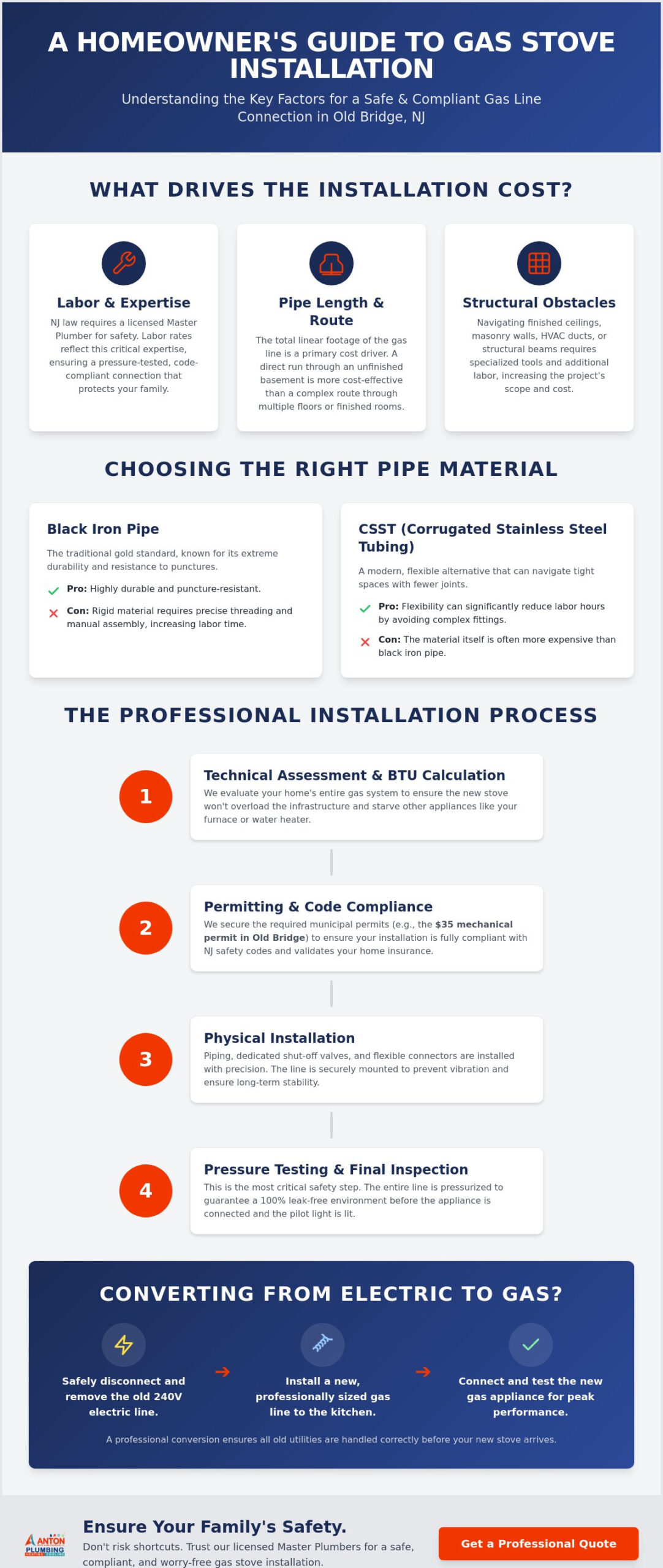
Every home tells a different story through its architecture. When you decide to upgrade to a professional grade gas range, the physical path from your meter to your kitchen determines the complexity of the job. The primary cost to install a gas line for a stove Old Bridge residents encounter is driven by the total linear footage of the line and how many barriers stand in its way. A straight run through an unfinished basement is the ideal scenario, while a route that requires navigating multiple floors or finished rooms increases the investment. We look at your home as a complete system, ensuring that every new connection maintains the integrity of your existing infrastructure.
For homeowners planning a more extensive kitchen overhaul alongside these utility upgrades, a full-service general contractor like Black Bear Construction can provide the comprehensive oversight needed to manage both structural changes and professional installations.
In New Jersey, safety is the non-negotiable priority. State regulations require a licensed Master Plumber to oversee gas installations to prevent hazardous leaks. While labor rates in the Old Bridge area reflect this high level of expertise, the assurance of a pressure tested, code compliant connection is what protects your family. Our professionals evaluate the total BTU load of your home to ensure your new stove doesn’t starve your furnace or water heater of fuel during the winter months. This technical precision is what distinguishes a professional installation from a risky shortcut.
Material Breakdown: Black Iron vs. CSST
Standard piping systems for residential gas typically utilize two main materials. Black iron pipe is the traditional choice, prized for its immense durability and rigid structure. It’s often considered the gold standard in New Jersey because it resists accidental punctures and stands the test of time. However, it requires precise threading and manual assembly, which takes more time. Corrugated Stainless Steel Tubing (CSST) is a flexible alternative that snakes through tight spaces with fewer joints. While the material itself is often more expensive, it can reduce labor hours significantly by bypassing the need for complex elbow fittings. We choose the material that best balances your budget with the structural needs of your house.
The “Obstacle” Factor in NJ Homes
Obstructions are the silent drivers of project timelines. If your kitchen sits above a finished basement with a sheetrock ceiling, your plumber must carefully create access points or use specialized tools to “fish” the line through. Drilling through masonry or foundation walls for exterior manifold connections also requires heavy duty equipment and additional sealing. Installations with a clear line of sight between the gas source and the appliance always result in the lowest labor costs. If we have to navigate around HVAC ducts or structural beams, the technical precision required naturally increases the project scope. Understanding these physical constraints helps us provide the most accurate and transparent expectations for your installation.
The Installation Process: From Permit to Pilot Light
Before a single pipe is cut, a professional installation begins with a rigorous technical assessment. This planning phase is a primary driver of the overall cost to install a gas line for a stove Old Bridge homeowners should expect. We don’t just look at where the stove sits; we evaluate how the new appliance interacts with your entire home infrastructure. Our team handles the administrative burden by securing the necessary municipal permits from the Old Bridge Building Department. This step is vital for your home’s insurance validity and ensures every connection meets the strict safety standards of New Jersey.
Once the paperwork is in order, the physical work begins. We install the main piping, dedicated shut-off valves, and flexible appliance connectors required for a modern kitchen. Every joint is sealed with precision. We ensure that the line is secured properly to floor joists or wall studs to prevent vibration or sagging over time. If you are planning a kitchen renovation, our team can provide a precise gas line installation assessment to ensure your project stays on track and remains fully compliant with local codes.
BTU Load Calculations and Pipe Sizing
Your existing gas infrastructure has a specific capacity. Adding a high-output professional range requires calculating the total demand of your boiler, water heater, and the new stove combined. Following the National Fuel Gas Code ensures that your home’s manifold can handle the simultaneous draw of all appliances. If the pipe is too small, your stove won’t reach its maximum temperature, and your furnace might struggle to stay lit during a cold New Jersey winter. We size your piping to guarantee consistent pressure, preventing these frustrating and potentially dangerous malfunctions.
Pressure Testing and Safety Verification
Safety is verified through data, not just visual checks. While some might rely on a simple soap bubble test to find large leaks, NJ code requires a formal gauge pressure test. We isolate the new line and subject it to a specific pressure hold for a duration mandated by state law. Anton Plumbing Heating & Cooling utilizes advanced diagnostic technology to monitor these pressure levels with high-tech accuracy. This process identifies even the most microscopic leaks that could go unnoticed for years. Only after the system proves it is 100% airtight do we introduce gas and light the pilot, giving you total peace of mind in your kitchen.
Permit and Safety Requirements in Old Bridge & Middlesex County
Legal compliance isn’t just about following rules; it is about protecting your property value and your family’s security. The Old Bridge Township Building Department maintains strict oversight on all fuel gas installations to prevent catastrophic failures. When calculating the total cost to install a gas line for a stove Old Bridge residents must account for the legal verification of the work. Skipping this step might seem like a shortcut, but it creates a massive liability. Most homeowners don’t realize that unpermitted gas work can completely void a homeowners insurance policy in the event of a fire or accident.
Local utility providers, such as New Jersey Natural Gas (NJNG), frequently require professional sign-offs and proof of inspection before they will activate or move a meter. They need to know that the downstream piping meets the standards of the NJ State Plumbing Code. We act as your liaison with these agencies, ensuring that all technical documentation is filed correctly and that your home remains fully compliant with municipal standards. This professional oversight bridges the gap between your utility provider and your kitchen appliances.
Local Permit Costs and Inspection Timelines
As of April 2026, the Township of Old Bridge Ordinance No. 26-10 established a mechanical permit fee of $35 per unit for gas piping. This is a small investment for the legal protection it provides. Once the work is finished, a municipal plumbing inspector will visit your home to verify the pressure test results and the physical installation. We handle the entire application process, so you don’t have to navigate the bureaucracy of Middlesex County on your own. This streamlined approach ensures your project stays on schedule and passes inspection the first time.
NJ State Plumbing Code Compliance
The state code dictates exactly how and where a gas line can be installed. For example, every gas stove must have a dedicated shut-off valve located in the same room as the appliance and within six feet of the connection point. This valve must remain easily accessible for emergency situations. Proper venting is also a critical requirement, as gas stoves produce combustion byproducts that must be safely managed within your kitchen layout. Because of these complex safety variables, New Jersey state law mandates that only a professional holding a valid NJ Master Plumber license can legally perform this type of high-risk infrastructure work. This ensures that every connection is sealed, tested, and vetted by a seasoned veteran of the trade.
Converting from Electric to Gas: Practical Considerations
Swapping an old electric range for a high-performance gas model is one of the most impactful upgrades you can make to your kitchen. However, this transition involves more than just a new appliance delivery. The total cost to install a gas line for a stove Old Bridge residents plan for must include the logistical shift from high-voltage electricity to fuel gas. While the plumbing is the centerpiece, you must also address the existing electrical infrastructure to ensure your new stove functions correctly and safely from day one.
Natural gas remains a preferred energy source in New Jersey due to its reliability and lower operational costs compared to standard electric heating. In the Old Bridge real estate market, a gas-equipped kitchen is a significant selling point that often increases a home’s resale value. Buyers view gas cooking as a premium feature, associating it with professional-grade performance and energy efficiency. To ensure these premium appliances continue to operate at peak efficiency, you can learn more about Reparatur24 Berlin and their approach to expert household equipment care. Making this switch now positions your home as a modern, high-value property for the future.
The Electrical Side of Gas Stoves
Most electric ranges run on a heavy-duty 240-volt circuit. Gas stoves, however, only require a standard 120-volt outlet to power the electronic igniters, digital clocks, and convection fans. This means your installation process includes capping off the old high-voltage line and ensuring a standard grounded outlet is available behind the stove. We coordinate these technical details to prevent delays. Managing this transition correctly ensures that you don’t have a bulky, unused 240-volt plug interfering with the flush fit of your new range against the wall.
ROI and Kitchen Performance
Professional chefs and home enthusiasts alike prefer gas for its immediate temperature control and visual flame feedback. Unlike electric coils that retain heat long after being turned off, gas provides an instant response that prevents overcooking. If you are already planning other home improvements, such as a water heater replacement or a furnace upgrade, adding a kitchen gas line is a strategic way to consolidate labor costs. A standard conversion in a typical Old Bridge suburban home can often be completed in a single day, minimizing the disruption to your daily routine.
A common question we hear is whether gas is as safe as modern induction cooktops. While induction is popular for its cool-to-the-touch surface, gas offers unmatched reliability during New Jersey’s frequent seasonal power outages. As long as you have a match, you can still cook for your family when the grid goes down. By choosing a professional installation, you eliminate the risks associated with fuel gas, gaining a versatile and dependable cooking platform. If you’re ready to make the switch, contact us for a professional gas line assessment to start your kitchen transformation.
Why Professional Installation with Anton Plumbing Heating & Cooling is the Safest Choice
Choosing a partner for gas infrastructure requires more than just technical skill; it demands an ethical commitment to your family’s safety. For over 28 years, Anton Plumbing Heating & Cooling has served as a guardian of the household for families across Old Bridge, East Brunswick, and Jersey City. We understand that your home is your sanctuary. Our fully licensed and insured professionals specialize in maintaining the integrity of gas systems, ensuring that every connection is a permanent solution rather than a temporary fix. When you’re evaluating the cost to install a gas line for a stove Old Bridge homeowners deserve a partner who prioritizes domestic security over high-volume turnover.
Transparency is the cornerstone of our service model. We provide clear, no-nonsense pricing that eliminates the uncertainty often associated with utility upgrades. By choosing a seasoned veteran of the New Jersey plumbing industry, you gain access to decades of specialized knowledge and a neighborly approach that larger corporate entities simply cannot match. We treat every project with the steady professionalism you expect from a long-term maintenance partner. Our commitment to 24/7 emergency availability ensures that you’re never left without support when it matters most.
The “Protective Expert” Advantage
We believe that professional service should be minimally invasive and exceptionally clean. Our technicians treat your property with the same respect they would their own, ensuring that the workspace is pristine once the job is complete. This protective approach extends to our deep understanding of local codes, which prevents the administrative friction that often plague unvetted contractors. Should you ever face an urgent utility failure or a suspected leak, our emergency plumber Old Bridge NJ services provide immediate relief and restore your home’s safety with high-tech accuracy.
Get a Professional Gas Line Quote Today
Starting your kitchen transformation is a straightforward process. When you schedule a site assessment with us, we perform a comprehensive review of your existing manifold and the intended route for your new line. To make your consultation as efficient as possible, please have your new stove’s BTU specifications and the location of your main gas meter ready. We will provide a detailed breakdown of the project scope, ensuring you have a clear understanding of the cost to install a gas line for a stove Old Bridge residents can trust for quality and safety. Don’t leave your home’s infrastructure to chance. Contact us today to secure a professional, code-compliant installation that protects your household for years to come.
Secure Your Kitchen Transformation with Expert Oversight
Your kitchen upgrade is about more than just aesthetics; it is about building a safe, high-performance foundation for your home. By understanding the permit requirements in Middlesex County and the technical necessity of proper pipe sizing, you are already ahead of the curve. While the cost to install a gas line for a stove Old Bridge homeowners invest in varies based on your specific layout, the value of a leak-free, code-compliant connection is immeasurable. You’ve learned that professional pressure testing and expert BTU calculations are the only ways to guarantee your new range performs at its peak without compromising your other gas appliances.
Anton Plumbing brings over 28 years of industry tenure to every project. Our fully licensed NJ Master Plumbers handle everything from municipal paperwork to advanced diagnostic testing. We provide 24/7 emergency gas leak support because your family’s security is our highest priority. Don’t leave your home’s infrastructure to chance. Schedule Your Professional Gas Line Installation in Old Bridge today and enjoy the peace of mind that comes with ethical, expert service. Your dream kitchen is just a safe connection away.
Frequently Asked Questions
How much does it cost to install a gas line for a stove in Old Bridge?
The total cost to install a gas line for a stove Old Bridge homeowners pay is determined by the length of the piping and the physical obstacles in the path. A straight run through an unfinished basement is the most economical scenario, while navigating finished ceilings or drilling through masonry adds to the labor requirements. We provide a clear, technical assessment of your home’s layout to ensure you have a transparent understanding of the project scope before we begin.
Do I need a permit to run a new gas line in New Jersey?
Yes, a municipal construction permit is mandatory for all gas line work in New Jersey to ensure the installation meets safety standards. In Old Bridge, Ordinance No. 26-10 established a $35 mechanical fee for gas piping units as of April 2026. This legal step protects your property value and ensures the work is vetted by a licensed plumbing subcode official during a final inspection.
Can I install a gas line for my stove myself?
No, New Jersey state law mandates that only a licensed Master Plumber can contract for and supervise gas line installations. Attempting this work yourself is extremely hazardous and can lead to utility failures or voided home insurance policies. The technical precision required for the cost to install a gas line for a stove Old Bridge residents expect includes specialized pressure testing that only a professional can certify.
How long does it take to install a gas line for a kitchen range?
Most residential gas line installations in the Old Bridge area are completed within a single day. A standard route from the gas meter to the kitchen typically takes between four to six hours of active labor. If your project involves complex manifold adjustments or running lines through multiple finished floors, we will provide a specific timeline during your initial site assessment.
What is the difference between black iron and flexible gas lines?
Black iron pipe is a rigid, heavy-duty material prized for its durability and resistance to accidental punctures. Flexible Corrugated Stainless Steel Tubing (CSST) allows for easier routing through tight spaces and requires fewer fittings, which can reduce labor time. We evaluate your home’s infrastructure to determine which material provides the highest level of safety and efficiency for your specific appliance.
Will my existing gas meter support a new high-BTU stove?
Your meter’s capacity depends on the combined BTU demand of your furnace, water heater, and any other gas appliances. High-output professional ranges require significant fuel volume that might exceed the capacity of an older manifold system. We perform detailed load calculations to ensure your new stove operates at peak performance without starving your heating system during the winter months.
Does a gas stove require an electrical outlet?
Yes, modern gas stoves need a standard 120-volt grounded outlet to power electronic igniters, oven lights, and convection fans. If you’re switching from an electric range, you’ll need to cap off the old 240-volt circuit and ensure a standard outlet is available behind the appliance. This ensures your stove has the consistent power required for its digital components and safety features.
What should I do if I smell gas after a new installation?
If you detect the smell of gas, evacuate everyone from the home immediately and do not touch any light switches or electronics. Once you are safely outside, call your utility provider and then contact a licensed professional for emergency leak repair. We maintain 24/7 emergency availability to respond to utility failures and restore the domestic security of the local families we serve.