
A single forgotten circuit breaker could be the difference between a simple post-storm restart and a complete system replacement after the next New Jersey hurricane. If you live in a flood-prone area, the 2026 REAL regulations mean your equipment’s safety is now a matter of professional resilience. Preparing your HVAC for a hurricane in NJ requires a proactive strategy that balances immediate storm tactics with long-term protection. We know the anxiety that builds when the wind picks up and the rain starts pooling near your foundation. It’s confusing to decide whether to cover your unit or leave it exposed, and the fear of a costly breakdown is a heavy burden for any homeowner.
This expert-led guide will help you protect your cooling system and prevent devastating flood damage with professional, field-tested advice. We’ll provide a clear, actionable checklist to secure your equipment, explain the exact moment you should shut off the power, and show you how to keep your home comfortable even if the grid goes down. You’ll also learn how to leverage NJ Clean Energy Program rebates of up to $7,500 to ensure your home remains a safe, resilient haven for your family.
Key Takeaways
- Anchor your outdoor condenser with hurricane straps or concrete bolts to prevent high winds from shifting or damaging the unit.
- Understand why preparing your HVAC for a hurricane in NJ requires shutting off power at the main circuit breaker to avoid “dirty power” and electrical surge damage.
- Protect indoor furnaces and boilers by ensuring your sump pump is fully operational, as basements remain the highest risk zone for flooding.
- Follow the “Visual Inspection First” rule after the storm hits to identify water intrusion before you attempt to restart your system.
- Recognize how your specific location impacts your strategy, from coastal surge threats in Jersey City to wind-blown debris risks in suburban Old Bridge.
Understanding the Hurricane Threat to NJ HVAC Systems
Preparing your HVAC for a hurricane in NJ starts with knowing exactly what you’re up against. In 2026, we’ve seen a shift in how storm systems move through the Garden State. While a homeowner in Jersey City might be bracing for a six-foot storm surge that threatens to submerge their outdoor condenser, someone in Old Bridge is likely more concerned about 80 mph gusts sending unsecured patio furniture into their unit. Both scenarios are equally capable of destroying your comfort system.
Don’t ignore the “Salt Air Factor” if you’re within five miles of the coast. Storm surges carry atomized salt that settles deep within your AC coils. This accelerates corrosion, often leading to refrigerant leaks long after the clouds have cleared. Understanding tropical cyclone preparedness means recognizing these invisible threats before they become expensive repairs. With the 2026 Atlantic season predicted to be active, early intervention isn’t just a suggestion; it’s a necessity for household security.
The Three Main Threats: Wind, Water, and Power
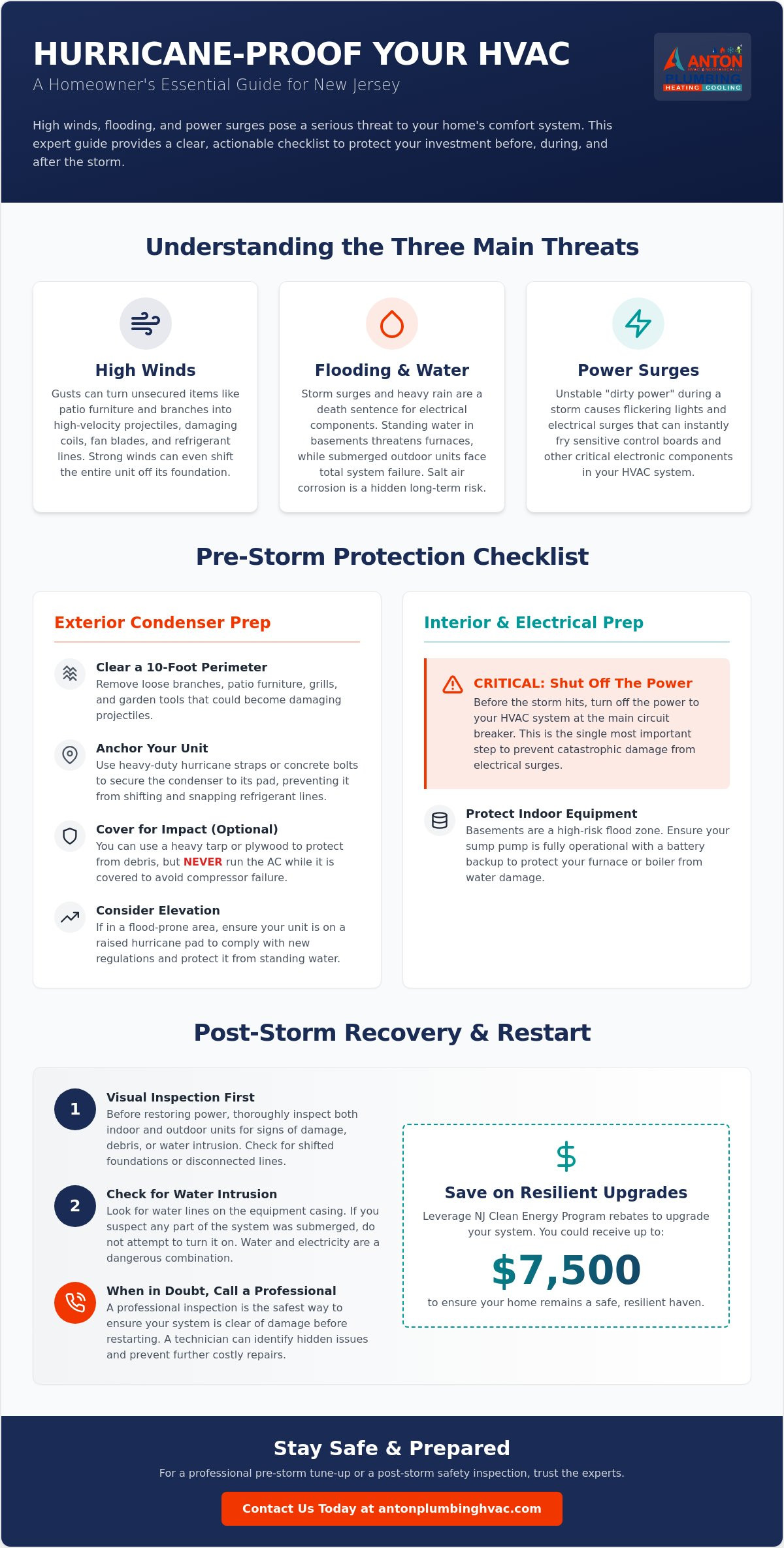
High winds are the most visible danger. In areas like East Brunswick, flying branches or loose shingles can pierce aluminum condenser fins or snap fan blades. Flooding is the second, more insidious threat. Standing water is a death sentence for electrical components. If your unit isn’t elevated according to the new REAL rules, which now require a 4-foot height increase in flood zones as of January 20, 2026, you’re at high risk. Finally, the NJ grid is notorious for “dirty power” during storms. Flickering lights are signs of surges that can fry your system’s control board in an instant.
When to Start Your NJ Storm Prep
Timing is everything. We recommend scheduling a pre-season tune-up in early June to ensure your system is at peak efficiency before the humidity peaks. Monitor NJ-specific weather alerts from the National Weather Service in Mt. Holly. Don’t wait for a Hurricane Warning. By the time a warning is issued, our service trucks may be restricted by local travel bans or hazardous road conditions. Professional help is much harder to secure once the rain starts falling, so take action while the skies are still clear.
Exterior Checklist: Securing the Outdoor Condenser
Your outdoor condenser is the most exposed component of your home’s infrastructure. Preparing your HVAC for a hurricane in NJ requires more than just a quick glance at the yard; you need to create a defensible space around the unit. Start by clearing a 10-foot perimeter. Remove loose branches, patio furniture, and garden tools that could become high-velocity projectiles in a storm. Even a small plastic planter can cause significant damage to aluminum fins when caught in 70 mph gusts.
Anchoring and Strapping Techniques
High winds don’t just blow debris. They can physically shift your condenser off its foundation. Check your concrete pad for cracks or tilting before the clouds roll in. If the base is unstable, your unit is at risk of snapping its refrigerant lines, which leads to costly leaks and environmental hazards. Use heavy-duty hurricane straps or concrete bolts to anchor the system firmly. These straps are specifically engineered to handle the wind loads we see along the Jersey Shore and inland corridors. If you’re unsure if your current setup meets the 2026 safety standards, a professional central air conditioning installation specialist can verify your mounting hardware to ensure it stays put.
Protecting Against Flying Debris
Trimming overhanging limbs is vital for suburban NJ homeowners with mature trees. A single falling branch can crush the fan cage or pierce the delicate coils. Many people ask if they should cover their unit with a tarp. You can use a heavy-duty tarp or plywood for temporary protection against impact, but there is one non-negotiable rule. Never run your air conditioner while it is covered. Doing so causes the system to overheat instantly, which will likely destroy the compressor. Consult this Homeowner’s Safety Guide for broader home securing tips, but remember that your HVAC requires its own specific protocol to avoid internal mechanical failure.
Finally, consider the height of your unit. Under the 2026 REAL rules, homes in flood-prone areas must now account for higher elevation requirements. If your condenser sits in a low spot where water typically pools during heavy NJ rain, it might be time to invest in a taller hurricane pad. This simple elevation change can save you from a total system loss when the storm surge arrives. Secure any loose panels and ensure your refrigerant lines are strapped tightly to the house structure to prevent vibration damage. Taking these steps now ensures your system stays where it belongs when the wind starts to howl.
Electrical Safety and Surge Protection for NJ Homes
Electrical instability is one of the most common causes of post-storm system failure in New Jersey. During a hurricane, the power grid often experiences rapid cycles of outages and restorations, commonly referred to as “dirty power.” In densely populated areas like Jersey City, these fluctuations can be severe as local infrastructure struggles with wind-blown debris and localized flooding. Coordinating with your local utility providers, such as PSE&G or NJNG, for safety alerts is vital, but you must take manual control of your equipment to ensure its survival. Preparing your HVAC for a hurricane in NJ involves more than just securing the unit; it requires a disciplined electrical shutdown strategy to prevent your control boards from frying.
The Safe Shutdown Procedure
Flipping a switch at the thermostat isn’t enough to protect your investment from a massive voltage spike. Follow this professional protocol to minimize risk:
- Step 1: Pre-cool your home. About 24 hours before landfall, lower your thermostat by several degrees to “bank” cold air in your home’s structure.
- Step 2: Shut down the thermostat. Once the storm starts, turn the system to the “Off” position to prevent it from trying to cycle during a brownout.
- Step 3: Cut the power at the breaker. Locate your dedicated HVAC circuit breaker and flip it to the off position. This physically disconnects the system from the grid, providing the ultimate shield against surges and supporting better Electrical Safety and Surge Protection.
Installing Professional Surge Protectors
While manual disconnection is the best immediate defense, whole-house surge protection is the gold standard for long-term reliability. A surge protector is a sacrificial device that intercepts voltage spikes before they reach the compressor. Unlike a standard power strip used for a laptop, a professional HVAC surge suppressor is wired directly into your system’s disconnect box or the main electrical panel. Professional installation is mandatory because these devices handle high-voltage loads and must be integrated correctly to offer genuine protection. Investing in this technology ensures that even if you aren’t home to flip the breaker, your system has a built-in guardian against the unpredictable NJ grid during the peak of storm season.
Relying on a simple fuse isn’t a strategy. Modern high-efficiency systems use sensitive electronic components that are far more vulnerable to voltage fluctuations than the older units of a decade ago. By combining a manual shutdown with professional-grade suppression, you provide a dual-layered defense that keeps your home’s infrastructure secure through the worst NJ weather.
Indoor Prep: Basements, Furnaces, and Sump Pumps
While most homeowners focus on the wind outside, the real battle for your home’s infrastructure often happens in the basement. NJ basements are the primary risk zone for furnaces and boilers during hurricane season. If floodwater reaches your heating system, the damage is often catastrophic and leads to a total system loss. Preparing your HVAC for a hurricane in NJ requires a rigorous defense of your lowest floor. We’ve seen countless systems destroyed not by the wind, but by rising groundwater that simple maintenance could have prevented.
Sump Pump Readiness for HVAC Protection
Your sump pump is the primary guardian of your furnace. Test it immediately by performing a “bucket test.” Pour water into the pit until the float rises and the motor kicks in. If it hesitates or makes unusual noises, it’s time for a professional check. A battery backup is non-negotiable for NJ hurricane season because the heaviest rain usually arrives just as the power grid fails. Without a backup, your pump is useless when you need it most. Ensure the discharge line is clear of leaves and debris to prevent backflow into your home. For comprehensive flood safety, see our guide on sump pump installation and repair to keep your basement dry.
Securing Indoor Units
If your furnace or boiler sits directly on the concrete, it’s vulnerable to even minor seepage. Consider raising these units on masonry blocks or a professional equipment stand. This extra few inches of clearance can be the difference between a dry system and a total replacement. Seal basement windows and vents with silicone caulk to prevent localized flooding from heavy NJ downpours. If your basement starts taking on water while the system is live, do not step into the water. Your safety is the priority. Reach for the main electrical panel only if it is in a dry location. If the water is already rising, wait for professional assistance to avoid electrical hazards. Protecting your ductwork from moisture is also critical; stagnant water leads to rapid mold growth that can contaminate your home’s air quality for months.
Don’t wait for the water to rise before you take action. If you’re concerned about your basement’s flood resilience, schedule a professional sump pump installation and repair assessment today to secure your home’s foundation and protect your heating equipment.
Post-Storm Recovery: Professional Inspection and Restart
Once the winds die down and the rain stops, your first instinct is likely to flip the breaker and restore comfort to your home. Resist that urge. Preparing your HVAC for a hurricane in NJ is a process that doesn’t end until you’ve verified the mechanical integrity of your entire system. A premature restart can turn a minor repair into a total system failure. Follow the “Visual Inspection First” rule to ensure your home remains safe and your equipment stays under warranty. Taking a few minutes to assess the situation now prevents a dangerous electrical event later.
Homeowner Damage Assessment
Walk the perimeter of your property before touching any electrical controls. You need to identify any obvious physical damage that occurred during the height of the storm. Look for these specific red flags:
- Shifted Units: If the outdoor condenser moved even an inch, the refrigerant lines may be compromised. Stress on these copper lines leads to leaks that are expensive to fix.
- Debris Blockage: Remove any branches, leaves, or mud that accumulated against the coils. You must restore full airflow before the system can operate efficiently.
- Frayed Conduits: High winds can whip electrical lines, causing them to crack or pull away from the house structure.
- High Water Marks: In the basement, look for a distinct line of silt or moisture on your furnace or boiler cabinet. If water reached the burner assembly or the control board, the unit is strictly unsafe to operate.
Why Professional Inspection is Mandatory After Flooding
If your unit was submerged or even partially splashed by a storm surge, do not flip the breaker. Floodwater in New Jersey often contains silt, sewage, and salt. These contaminants are highly conductive and corrosive. Even if the exterior looks dry, moisture trapped inside the electrical relays can cause a short circuit or an electrical fire the moment power is restored. Modern systems are far more sensitive to these contaminants than older models, and a single surge can fry the entire control logic.
High-wind vibrations can also loosen internal fittings that aren’t visible from the outside. A licensed technician uses specialized diagnostic technology to verify refrigerant levels and electrical resistance. If you’re in the Middlesex County area, schedule a professional hvac repair east brunswick specialist to perform a comprehensive safety check. They’ll ensure that the salt air hasn’t already started corroding your internal coils and that your system is truly ready to handle the NJ humidity again. A professional inspection provides more than just a repair; it provides the peace of mind that your family’s domestic well-being is secure. Taking an extra day to verify safety is a small price to pay for the long-term health of your home’s infrastructure.
Secure Your Home’s Resilience Before the Clouds Gather
Taking the time to anchor your outdoor condenser and test your sump pump’s battery backup creates a vital safety net for your home. These proactive steps, combined with a disciplined electrical shutdown, transform a potential disaster into a manageable event. Preparing your HVAC for a hurricane in NJ is about more than just protecting equipment; it’s about the security of your family and the long-term health of your household infrastructure. By addressing exterior anchors and basement flood risks now, you avoid the high-stakes stress of emergency replacements later.
For families with exotic birds or reptiles that require specific temperature ranges, the loss of climate control during a storm can be particularly dangerous; you can learn more about Garden State Pet Center for expert advice on maintaining pet safety during NJ storms.
Don’t wait for the first rain bands to arrive before identifying your system’s vulnerabilities. Schedule a Pre-Storm HVAC Safety Inspection with Anton Plumbing Heating & Cooling today. With over 28 years of New Jersey storm experience, our licensed NJ HVACR and plumbing professionals understand the unique challenges of our local weather. We offer 24/7 emergency availability for storm recovery, ensuring you never have to face a utility failure alone. You’ve worked hard to build a comfortable home. We’re here to help you keep it that way, no matter what the 2026 Atlantic season brings.
Frequently Asked Questions
Should I cover my AC unit during a hurricane in NJ?
You should only cover your outdoor unit if you have already shut off the power at the main breaker. A heavy-duty tarp or plywood can protect the delicate fins from flying debris and branches. However, running a covered system leads to immediate compressor failure because it cannot breathe. If you use a cover, ensure it’s removed immediately after the storm passes to prevent moisture buildup and rust.
Is it safe to run my HVAC during a tropical storm?
It’s generally unsafe to run your system during high-wind events and heavy rain. Power surges and rapid on-off cycling can damage sensitive electronic components. Preparing your HVAC for a hurricane in NJ involves cooling your home several degrees ahead of time. This allows you to leave the unit off while the worst of the weather passes through your neighborhood, keeping your equipment safe from grid instability.
What happens if my outdoor AC unit gets flooded?
Submerged units face critical electrical and mechanical risks that require professional attention. Water can ruin the fan motor and corrode the electrical controls, while silt and salt debris clog the delicate coils. If your unit is flooded, do not attempt to restart it. You must have a professional technician clean and inspect the internal components to ensure the system is safe to operate without causing a short circuit.
How do I protect my furnace from a basement flood during a storm?
The best defense for your furnace is a reliable sump pump equipped with a battery backup. Since most NJ basement floods occur when the power fails, a backup ensures the pump continues to clear water away from your heating equipment. You can also raise your furnace on masonry blocks to provide several inches of clearance. This simple elevation can be the difference between a dry system and a total replacement.
Do I need to turn off my HVAC breaker during a hurricane?
Yes, flipping the dedicated HVAC breaker is the most effective way to prevent catastrophic surge damage. Even if your thermostat is in the off position, a massive voltage spike from a downed power line can still reach your equipment’s control boards. Disconnecting the system at the panel provides a physical break. This protects your investment from the “dirty power” fluctuations that are common during New Jersey storms.
Can a hurricane wind blow over my outdoor AC unit?
High winds can definitely shift or overturn a unit that isn’t properly anchored. This movement often snaps the copper refrigerant lines, leading to a total system failure and a hazardous leak. Using hurricane straps or concrete bolts is essential for ensuring your condenser stays on its pad. These anchors are designed to withstand the 70 to 80 mph gusts that often impact our coastal and inland corridors.
How long should I wait to turn my AC back on after a storm?
You should wait at least 24 hours after the storm has passed and the unit appears dry. This allows time for a thorough visual inspection of the electrical conduits and refrigerant lines. If you suspect any water intrusion or see high water marks on your equipment, wait for a professional safety check. Turning the power back on too early can cause permanent damage to a damp electrical system.
Does NJ homeowners insurance cover hurricane damage to HVAC systems?
Most standard NJ homeowners insurance policies cover damage from wind and falling debris, but they often exclude damage caused by rising floodwaters. You should review your specific policy or check for a separate flood insurance rider. Documentation is key for any claim. Take photos of your system before and after preparing your HVAC for a hurricane in NJ to provide clear evidence of the unit’s condition to your adjuster.


