Your sewage pump is the most critical health barrier in your home, yet it’s often the most ignored until you’re suddenly facing a sewage pump repair crisis. When that basin starts making loud, metallic noises or a faint, foul odor begins to permeate your basement, the stakes feel incredibly high. You’re right to be concerned. A malfunctioning pump isn’t just a mechanical nuisance; it’s a direct threat to your household’s well-being and security.
We understand that facing a potential backup is stressful, especially when you’re uncertain about the technical details or the eventual costs. This guide provides the clarity you need to handle these failures with confidence, helping you distinguish between a simple adjustment and a hazardous mechanical breakdown. We’ll walk through the most common warning signs, essential troubleshooting steps, and the preventative maintenance habits that keep your home’s infrastructure secure and your family safe.
Key Takeaways
- Understand the vital role of your ejector pump and how it differs from a standard sump pump in managing household waste.
- Learn to identify the specific mechanical red flags that signal you need professional sewage pump repair before a backup occurs.
- Master the “Red Line” framework to safely troubleshoot power issues while knowing exactly when a situation requires expert intervention.
- Discover the professional containment protocols used during repair to protect your home’s air quality and sanitary environment.
- Implement a “Never Flush” strategy and a regular maintenance schedule to extend the lifespan of your plumbing infrastructure.
What is a Sewage Ejector Pump and How Does It Work?
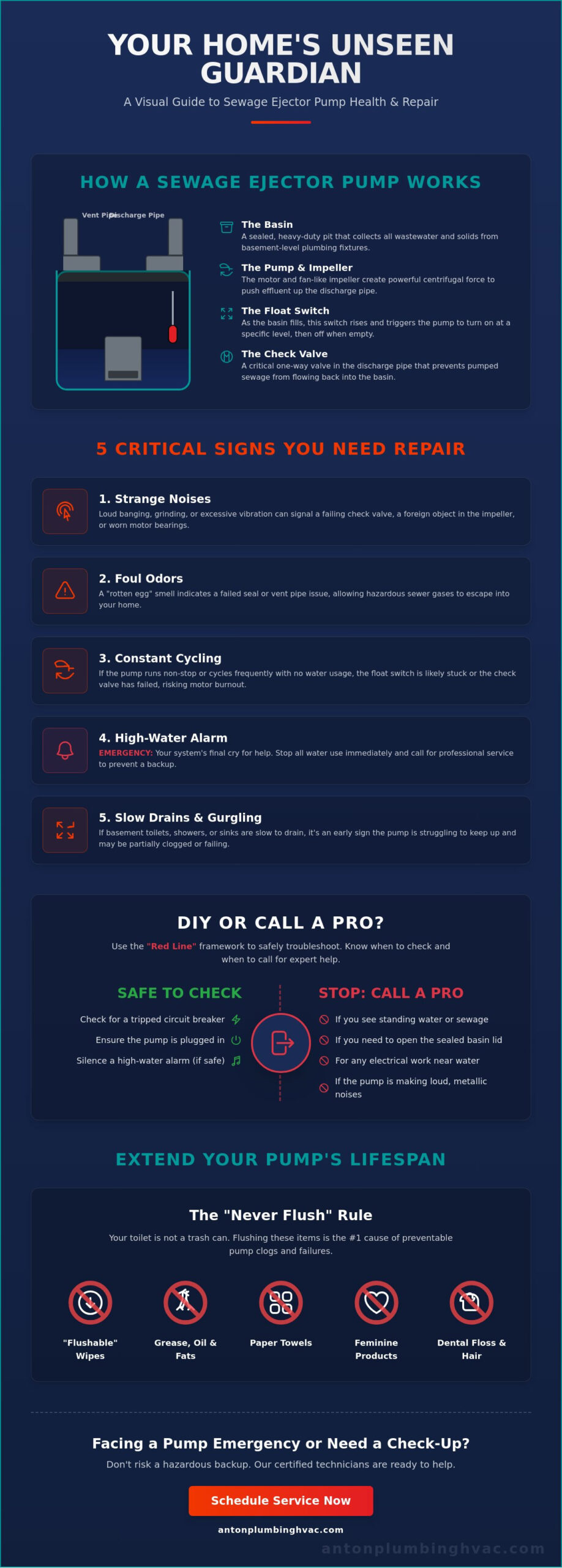
Your sewage ejector pump is the heart of your home’s below-grade plumbing system. If you have a bathroom, laundry room, or utility sink located in your basement, you rely on this system every single day. While a standard sump pump only handles groundwater to keep your basement dry, a sewage ejector pump is designed to move solids and wastewater up to your main sewer line. Think of it as your home’s primary shield against raw effluent; it’s the guardian that ensures waste moves out of your living space rather than backing up into it.
The system consists of three main components that must work in perfect harmony: the basin, the impeller, and the discharge pipe. The basin is a heavy-duty, sealed pit that collects waste from your basement fixtures. Inside, the impeller sits at the bottom of the pump, acting like a high-speed fan that pushes waste upward. This process relies on specific mechanical principles regarding How Sewage Pumps Work to ensure that heavy materials don’t clog the line. When these components wear down or seize, you’ll likely need professional sewage pump repair to restore your home’s sanitary security.
Ejector Pumps vs. Grinder Pumps
Most homes in the Old Bridge area utilize a standard sewage ejector pump. These units use centrifugal force to move waste through a two-inch discharge pipe. They’re efficient for typical residential use where waste only needs to travel a short distance to the main sewer line. Grinder pumps, however, work more like a heavy-duty garbage disposal. They macerate solids into a fine slurry before pumping them out. These are typically reserved for properties that must pump waste over very long distances or up steep inclines to reach a pressurized sewer main.
The Cycle of Operation
Your pump doesn’t run constantly. It waits for the float switch to signal that the effluent in the basin has reached a specific level. Once triggered, the motor kicks on and clears the pit in a matter of seconds. A critical component in this cycle is the check valve. This valve ensures that once waste is pumped out, it doesn’t flow back into the basin when the motor stops. Without a functioning check valve, your pump would cycle repeatedly, leading to premature motor failure and an urgent need for sewage pump repair. Finally, the vent pipe allows sewer gases to escape safely through the roof while preventing pressure imbalances that could slow down the drainage process.
5 Common Signs You Need Sewage Pump Repair
Early detection is your best defense against a basement disaster. As a homeowner, you don’t need to be a mechanical engineer to spot trouble; you just need to pay attention to the sensory cues your system provides. Catching these issues early often means a straightforward sewage pump repair rather than a complete system overhaul. By acting as a vigilant guardian of your home’s infrastructure, you can prevent the emotional and financial stress of a raw sewage backup.
Listen for anything out of the ordinary. A loud banging sound often points to a failing check valve, which prevents wastewater from crashing back into the basin. If you hear grinding or excessive vibration, something solid might be caught in the impeller, or the motor bearings could be failing. These sounds are early warnings that the mechanical integrity of your system’s shield is compromised and requires immediate attention.
Foul odors should never be ignored in a healthy home. Your sewage basin is a sealed environment designed to keep gases contained and safely vented. If a “rotten egg” smell begins to linger in your basement, it usually indicates a failed seal or a problem with the vent pipe. This isn’t just an olfactory nuisance; it’s a clear sign that hazardous sewer gases are breaching their containment and entering your family’s living space.
Watch for continuous cycling. If your pump runs non-stop or turns on and off every few minutes even when no water is running, the float switch is likely stuck or the check valve has failed. A pump that won’t stop is at high risk for total motor burnout. Addressing this behavior quickly with professional sewage pump repair ensures your pump remains ready for the next time you flush or run the laundry.
The Dreaded High-Water Alarm
The high-water alarm is your system’s final cry for help. If you hear that piercing beep, stop using all water in the basement immediately. Locate the silence button on the alarm box to stop the noise, then check the basin if it’s safe to do so. If the water level is near the top, you have a true emergency. If the basin is empty, you might have a faulty sensor, but you should still treat the alert with caution until a professional confirms the system is secure.
Slow Drains and Backups
Basement toilets and sinks are the canaries in the coal mine for your plumbing. If you notice water draining slowly or gurgling in these fixtures, it’s often the first sign that the pump isn’t keeping up with the demand. While this can sometimes be solved with professional drain cleaning services, persistent slow drainage in the basement specifically usually points toward a clogged impeller or a weakening motor. If your basement fixtures are acting up, it’s wise to schedule a professional inspection before the situation escalates into a flood.
Sewage Pump Troubleshooting: When to Call a Professional
Troubleshooting your system requires a clear understanding of the “Red Line.” This is the boundary between safe, external checks and hazardous internal repairs. Most homeowners can safely verify power and basic switch operation, but once the sealed basin needs to be opened, the situation shifts from a simple task to a professional sewage pump repair operation. Your priority is maintaining the sanitary barrier of your home while avoiding electrical or biological hazards.
Start with the power source. Check your electrical panel for a tripped circuit breaker. If the breaker is fine, inspect the GFCI outlet where the pump is plugged in. These outlets frequently trip in damp basement environments. Resetting a button is a simple fix that requires no tools. If the outlet has power but the pump remains silent, you can perform the “Piggyback Plug” test. Most sewage pumps have two cords: one for the motor and one for the float switch. Unplug both, then plug the motor cord directly into the wall outlet. If the motor hums or starts, your float switch has failed. If it remains dead, the motor itself is likely burnt out.
Never reach into the basin or attempt to disassemble the pump without professional grade personal protective equipment (PPE). The effluent inside contains concentrated levels of bacteria and pathogens that pose significant health risks. If the motor doesn’t respond to the piggyback test, stop immediately. Attempting to force a mechanical fix in a wet, contaminated environment is dangerous and often voids your equipment’s warranty.
Safe DIY Checks for Homeowners
Before calling for help, ensure the float switch isn’t simply stuck. Sometimes the vibration of the pump causes the unit to shift, pinning the float against the basin wall. If you can see the float, use a long stick to gently nudge it. If it drops and the pump starts, you’ve solved the problem without a service call. You can also clean the exterior of the pump cords and the top of the basin lid to ensure no debris is interfering with the seals, provided you don’t disconnect any plumbing or break the airtight seal of the basin.
Why Pro Intervention is Essential for Mechanical Failure
Mechanical failures involve risks that go far beyond basic plumbing. Dealing with 115V or 230V electrical systems in a wet environment is a recipe for serious injury if you lack the proper diagnostic tools. Beyond the electrical danger, exposure to E. coli and other raw sewage bacteria is a major concern. Professional technicians use specialized containment strategies to keep your home’s air and surfaces clean during the process. Relying on an expert general plumber ensures the job is done safely and that your sewage pump repair is documented to maintain your manufacturer’s warranty.
The Sewage Pump Repair and Replacement Process
When you choose a professional for your sewage pump repair, you aren’t just paying for a mechanical fix; you’re investing in a systematic restoration of your home’s safety. Our approach begins with a strict containment protocol. Before any tools touch the basin, we establish a clean zone with specialized floor protection and bio-containment barriers. This ensures that pathogens stay within the work area and never compromise your family’s living space.
The diagnostic phase is where technical precision meets ethical service. We don’t guess. Our technicians use advanced diagnostic equipment to test the motor’s electrical draw and the capacitor’s startup torque. We also verify the mechanical range of the float switch to ensure it isn’t just stuck or misaligned. Once we identify the root cause, we present a clear plan for component replacement or a full pump installation, depending on what provides the most long-term security for your household.
Testing is the final, non-negotiable step of the process. We fill the basin with clean water to observe the pump’s cycle under load. During this process, we verify that the check valve holds firmly against backflow and that the discharge pressure is sufficient to clear the line. If your system is showing signs of failure, contact our expert team today to restore your peace of mind and protect your basement from future utility failures.
Repairing vs. Replacing Your Pump
Deciding between a repair and a full replacement often comes down to the 7-10 year rule. Most residential sewage pumps have a design life within this range. If your unit is approaching its eighth year, a major component failure often signals that the rest of the system is close to its end. In these cases, replacing the unit is usually more cost-effective than paying for multiple service calls over the next few months. If we discover that your discharge lines are also compromised, we may recommend an upgrade to a system compatible with trenchless sewer repair to ensure your entire waste management infrastructure is modern and efficient.
Post-Repair Sanitation
A professional repair doesn’t end when the pump kicks on. We perform a thorough sanitation of the immediate area to eliminate any bacteria introduced during the backup. This includes restoring the airtight seal on the basin lid, which is your primary defense against sewer gas. We also inspect the vent pipe to ensure it’s clear of obstructions, guaranteeing that your basement remains odor-free and safe for your family. By the time we leave, your system is not only functional but also fully sanitized and secure.
Preventing Future Failures in Your Old Bridge Home
Maintaining your sewage system is about more than just fixing leaks; it’s about protecting the long-term well-being of your family. The most effective way to avoid an unplanned sewage pump repair is to strictly control what enters the system. Your ejector pump is a powerful mechanical shield, but it isn’t a garbage disposal. Educate everyone in your household on the “Never Flush” list. This includes “flushable” wipes, which don’t actually break down in the basin, as well as feminine hygiene products, dental floss, and cooking fats. These materials quickly wrap around the impeller, causing the motor to seize and the basin to overflow.
Professional annual maintenance is the second pillar of a secure home. During a tune-up, a technician looks for the subtle signs of wear that homeowners might miss, such as a slight increase in the motor’s electrical draw or a float switch that’s beginning to catch. We also highly recommend installing a battery backup system specifically designed for sewage pumps. In Old Bridge, where summer storms can knock out power for hours, a backup ensures your waste management system continues to function even when the grid fails, preventing a backup during the worst possible timing.
Maintenance Checklist for Homeowners
Quarterly “flush tests” are a simple way to stay ahead of trouble. Fill a bucket with water and pour it into the basin to trigger a cycle. Listen closely to the motor’s hum; any new grinding or rattling sounds indicate a problem that requires sewage pump repair. Even for residential systems, following the rigorous standards of commercial plumbing maintenance provides an extra layer of reliability that protects your property value and sanitary environment.
Emergency Planning for NJ Storms
Living in Middlesex County means dealing with high water tables, especially during the spring thaw or heavy rain events. This environmental pressure puts extra stress on your pump’s motor and check valves as they work harder to move effluent against external pressure. If you find yourself in a crisis despite your best efforts, knowing how to reach an emergency plumber Old Bridge NJ is essential for a rapid recovery. Our team remains committed to local families, acting as your seasoned guide through the complexities of home infrastructure to keep your basement dry and your household secure.
Secure Your Home’s Sanitary Shield
Your sewage pump is more than a mechanical fixture; it’s the primary barrier protecting your home from biohazards and property damage. By recognizing early warning signs like grinding noises or foul odors and respecting the “Red Line” between safe checks and professional intervention, you can prevent a minor issue from becoming a basement disaster. Remember that consistent maintenance and strict adherence to the “Never Flush” list are your best defenses against an unexpected sewage pump repair.
When the safety of your household is on the line, you need a partner with the technical expertise and ethical standards to do the job right. Anton Plumbing Heating & Cooling brings over 28 years of NJ plumbing experience to every service call. As licensed and insured professionals, we provide the reliable, high-tech accuracy your home infrastructure deserves. Don’t wait for a high-water alarm to sound. Schedule your sewage pump inspection with Anton Plumbing Heating & Cooling today! We are proud to offer 24/7 emergency availability in Old Bridge to ensure your family remains safe and secure, no matter when trouble strikes. Your peace of mind is our highest priority.
Frequently Asked Questions
How much does it typically cost to repair a sewage pump?
Repair costs vary significantly based on the specific component failure and the accessibility of your unit. While minor switch adjustments are less intensive, a complex mechanical failure or component replacement requires more labor and specialized diagnostic tools. You should request a professional onsite evaluation to receive an accurate quote tailored to your system’s specific needs.
Can I use a regular sump pump to replace my sewage pump?
You cannot use a standard sump pump to replace a sewage ejector pump. Sump pumps are engineered strictly for moving clear groundwater and lack the heavy-duty impeller design required to process solids. Attempting this swap will result in a clogged discharge line and immediate motor burnout, which often leads to a hazardous backup in your basement.
Why does my sewage pump alarm keep going off when there is no flood?
A high-water alarm that sounds without a visible flood often indicates a faulty sensor or a float switch that’s stuck in the “on” position. This is a critical early warning signal that your system’s monitoring hardware is failing. It’s a proactive prompt to schedule a professional sewage pump repair before a real emergency occurs.
How long do sewage ejector pumps usually last before needing replacement?
Most residential sewage ejector pumps provide reliable service for approximately 7 to 10 years. Factors such as the frequency of use and the quality of the original installation influence this timeline. If your pump is nearing the end of this decade-long window, it’s wise to consider a proactive replacement to avoid a sudden mechanical failure during a storm.
What are the most common things that clog a residential sewage pump?
The most common culprits for clogs include “flushable” wipes, feminine hygiene products, and cooking grease. These materials don’t break down like toilet paper and quickly entangle the pump’s impeller. Keeping these items out of your drains is the single best way to ensure your plumbing infrastructure remains clear and functional for years to come.
Is it safe to sleep in a house with a broken sewage pump?
It’s generally safe to stay in the home if the sewage is contained within the sealed basin and no overflow has occurred. However, if you detect a strong odor of rotten eggs or see standing wastewater, you’re dealing with hazardous sewer gases and pathogens. In these cases, you should limit your time in the basement until the system is professionally restored.
Can a sewage pump be repaired, or does it always need to be replaced?
Many sewage pump issues, such as a failed check valve or a faulty float switch, are straightforward to repair. However, if the motor itself has seized or the pump is more than eight years old, a full replacement is usually the more ethical and cost-effective recommendation. A new unit provides a fresh warranty and long-term security for your household.
How do I stop my sewage pump from smelling like rotten eggs?
To stop foul odors, you must ensure the basin lid is completely airtight and the vent pipe is clear of obstructions. A broken seal allows sewer gases to escape directly into your living space rather than being vented through the roof. Replacing a worn gasket or resealing the lid is a standard part of a professional sewage pump repair.