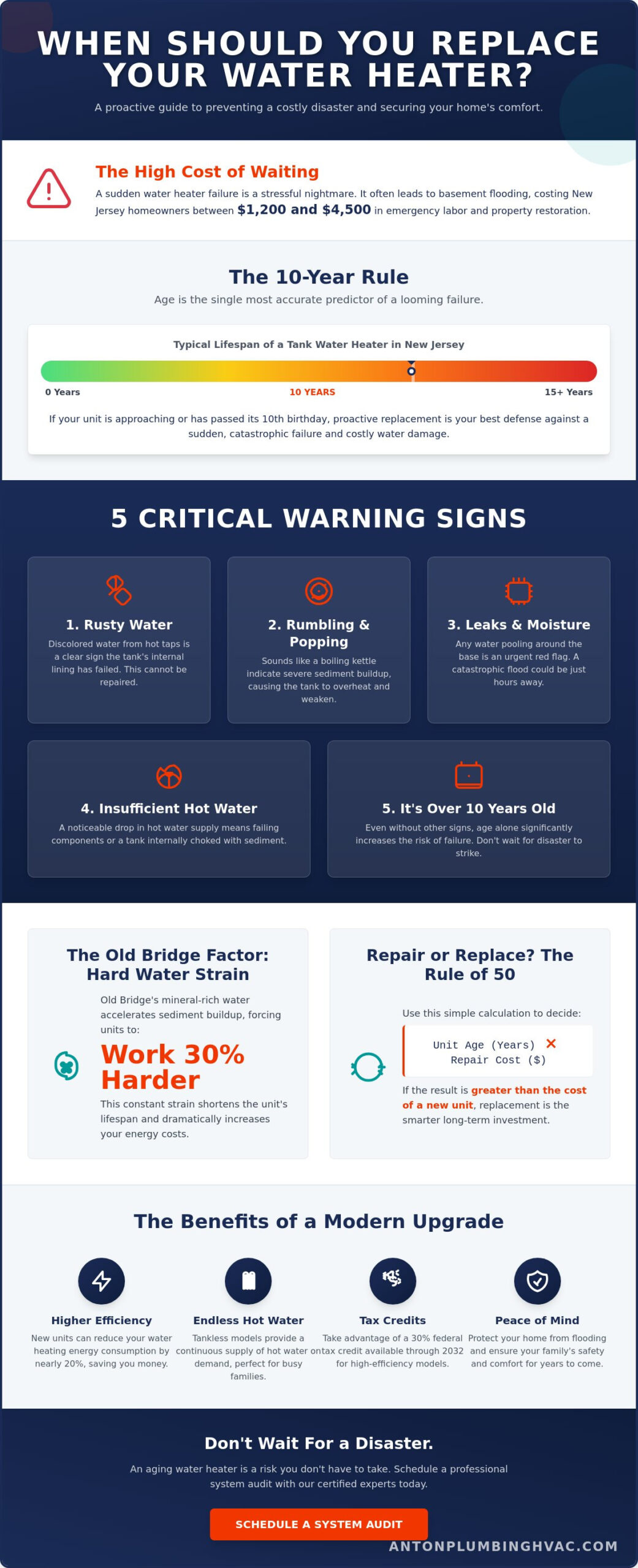
Imagine waking up to two inches of standing water in your Old Bridge basement because a ten year old tank finally gave out at 3:00 AM. It is a stressful, expensive nightmare that often costs New Jersey homeowners between $1,200 and $4,500 to resolve once you factor in emergency labor and property restoration. You shouldn’t wait for a flood to ask, when should you replace a water heater? Taking a proactive approach is the smartest way to protect your home and your wallet.
We understand that you want to get every last drop of value out of your current system, but ignoring the signs of failure leads to high-stakes anxiety. This guide provides the professional clarity you need to make an informed decision. You’ll learn about the critical warning signs, the impact of Old Bridge’s mineral-heavy groundwater, and how the new October 6, 2026, federal efficiency standards affect your options.
We will walk you through a clear replacement checklist, explain the 30% federal tax credits available through 2032, and discuss how the February 2026 New Jersey Bill A4272 simplifies your installation process. By the end, you will have the confidence to choose the right system for your family’s safety and comfort.
Key Takeaways
- Identify the “10-Year Rule” and specific warning signs like rumbling noises or rusty water that signal your tank’s internal lining is failing.
- Learn how Old Bridge’s mineral-rich water and freezing NJ winters accelerate sediment buildup, forcing your unit to work 30% harder.
- Use the “Rule of 50” to calculate exactly when should you replace a water heater versus attempting a repair that only delays the inevitable.
- Explore high-efficiency and tankless upgrades that eliminate standby heat loss while providing endless hot water for your household.
- Protect your home from catastrophic basement flooding by replacing aging units before they reach a point of critical failure.
5 Critical Warning Signs Your Water Heater is Failing
Identifying the exact moment your appliance is about to quit can save you thousands in water damage. Conventional storage water heaters are designed to last about a decade, but environmental factors in Old Bridge often shorten that window. If you see discolored, “rusty” water appearing only when you turn on the hot taps, the internal glass lining of your tank has likely breached. This allows the steel jacket to oxidize, which is a clear signal that a total failure is imminent. Unlike a simple heating element replacement, a corroding tank cannot be repaired.
You should also monitor your unit’s performance. A significant decrease in hot water recovery time or total volume suggests that the heating components are struggling or that the tank is filled with debris. In modern units, frequent pilot light failures or electrical “tripping” often indicate that internal sensors are detecting unsafe conditions, such as overheating or venting issues. Understanding when should you replace a water heater depends on recognizing these small red flags before they turn into a 3:00 AM emergency.
The Sound of Sediment: Why Popping Noises Matter
If your water heater sounds like a tea kettle or a popcorn machine, you have a serious problem. As calcium and scale buildup from our local water supply settle at the bottom, they trap water beneath thick layers of mineral crust. When the burner ignites, this trapped water boils and bubbles through the debris, creating the “kettle effect” that causes tank overheating and metal fatigue. This constant expansion and contraction weaken the steel, eventually leading to a structural breach. Sediment calcification is the primary killer of NJ water heaters.
Visual Inspection: Distinguishing Leaks from Condensation
Visible moisture or pooling water around the base of the unit is the most urgent warning sign. Start by checking the Temperature and Pressure (T&P) valve; if it is dripping, it might be a simple valve failure or a sign of dangerous internal pressure. Don’t ignore “hidden” leaks tucked behind insulation blankets, as these often hide slow-growing corrosion points. Finally, inspect the burner assembly. If you see signs of moisture or heavy rust in the combustion chamber, the tank is likely weeping from the bottom. When these symptoms appear together, the question of when should you replace a water heater becomes a matter of timing before a flood occurs. If your unit is already showing active leaks or has stopped producing hot water entirely, our emergency water heater repair in Old Bridge, NJ team is available 24/7 to respond before the situation escalates.
The 10-Year Rule: Why Age is the #1 Predictor of Replacement
Most Old Bridge homeowners don’t think about their water heater until the shower goes cold. However, age is the single most accurate predictor of a looming disaster. In Middlesex County, traditional tank heaters typically offer 8 to 12 years of reliable service. If your unit is approaching its tenth birthday, the question of when should you replace a water heater becomes an urgent matter of home safety rather than a simple maintenance task. Older units also lack the insulation and efficiency of modern systems, meaning a 12 year old unit costs significantly more to operate than a 2026 compliant model.
Following guidance from the U.S. Department of Energy, upgrading an aging unit can reduce your energy consumption by nearly 20%. This is particularly relevant as we approach the October 6, 2026, deadline for new federal manufacturing standards. These regulations push the industry toward condensing technology and heat pump models, making older, non-condensing units effectively obsolete. Replacing your system now allows you to choose a high-efficiency model on your own terms, rather than rushing into a purchase during an emergency flood.
The Science of Internal Corrosion
Every steel tank relies on a process called electrolysis to stay intact. A sacrificial anode rod, usually made of magnesium or aluminum, sits inside the tank to attract corrosive elements. It literally “sacrifices” itself so the tank doesn’t rust. Once this rod is completely depleted, which usually happens within 5 to 7 years, the corrosive minerals begin attacking the tank’s glass lining. When that lining cracks, the steel shell begins to rust from the inside out. Once the tank itself rusts through, replacement is the only professional solution. If you’re unsure about your unit’s condition, you can schedule a professional system audit with our team to verify your tank’s integrity.
How to Read Your Manufacturer Date
You can find your unit’s birth date by looking at the rating plate, which is usually a large sticker on the side of the tank. Look for the serial number, as the date is often hidden in the first few characters. For Rheem units, the first four digits typically represent the month and year; for example, “0516” means May 2016. AO Smith often uses a letter for the month followed by two digits for the year, where “B24” would indicate February 2024. If your serial number is faded or confusing, our Master Plumbers can quickly decode the technical data for you during a routine inspection.
Repair vs. Replace: Calculating the Real Cost of Hot Water
Deciding between a quick fix and a full upgrade often feels like a gamble. To remove the guesswork, we use the “Rule of 50.” If a repair estimate exceeds 50% of the cost of a new unit, investing in a replacement is the smarter financial move. This is especially true for units with expired warranties, where you’re essentially paying for a “band-aid” on a system that no longer has manufacturer protection. When considering when should you replace a water heater, remember that modern 2026 models are significantly more efficient. A high-efficiency tank can often pay for itself in energy savings within 3 to 5 years, whereas sinking money into an old, inefficient unit is a classic “sunk cost” trap.
The financial impact of hard water is another critical factor. A Water Quality Research Foundation study highlights that mineral buildup can cause up to a 48% loss in appliance efficiency. This means that even if your old unit is still “working,” it might be costing you nearly double on your monthly utility bills compared to a new, clean system. We focus on providing a clear cost-benefit analysis so you can protect your household budget from the hidden drain of an aging appliance.
When a Repair Still Makes Sense
Minor issues don’t always demand a full overhaul. If your unit is less than 6 years old and the problem is a faulty thermocouple, a broken heating element, or a simple pipe connection leak, a professional repair is the right path. Maintaining your overall plumbing health is also vital. Services like Expert Drain Cleaning Services in Old Bridge, NJ help prevent back pressure issues that can stress your entire system. If the tank itself is structurally sound, we will always prioritize the most cost-effective repair to keep your home comfortable.
The Hidden Costs of Waiting for Failure
Waiting for a total system collapse is a high-risk strategy. In New Jersey, emergency after-hours labor rates can turn a standard installation into a major financial burden. Beyond the plumbing bill, a burst tank in a finished basement often leads to mold remediation and floor replacement costs that dwarf the price of a new heater. Proactive replacement allows you to choose your new equipment calmly. This ensures you get the best pricing and the exact model that fits your home’s needs before an emergency strike. When you ask when should you replace a water heater, the answer is usually “before it decides for you.” However, if your system has already failed, our 24/7 emergency water heater repair service in Old Bridge can restore your hot water fast and help you avoid the worst of those after-hours costs.
How Old Bridge’s Hard Water Shortens Your Water Heater’s Lifespan
Living in Middlesex County offers many perks, but our local water quality isn’t one of them. The groundwater sources used by the Old Bridge Municipal Utilities Authority contain high levels of calcium and magnesium. These minerals don’t just stay in the water; they solidify as they heat up, creating a thick layer of rock-like scale at the bottom of your tank. This sediment acts as an insulator between the burner and the water, forcing your unit to run longer to reach the desired temperature. When you consider when should you replace a water heater, you must account for this local environmental tax on your appliance’s longevity.
New Jersey winters add another layer of stress. During the coldest months, the water entering your home from underground pipes can drop to near-freezing temperatures. Your water heater must work approximately 30% harder to raise that water to a comfortable 120 degrees compared to the milder summer months. This seasonal strain accelerates the wear on internal components, especially if the unit is already struggling with sediment buildup. Many NJ homes also operate on “closed-loop” plumbing systems. These systems require a properly functioning expansion tank to absorb the pressure created by thermal expansion. Without one, the constant pressure spikes can cause your tank to crack prematurely.
Combating Middlesex County Mineral Deposits
Annual maintenance is the most effective way to fight back against local water conditions. We recommend flushing your tank at least once every 12 months to remove accumulated silt and scale. This simple step prevents heating element burnout and can extend the life of your unit by 2 to 3 years. For homeowners who want total peace of mind, professional maintenance ensures that every safety sensor and valve is verified. If your system is also linked to your home’s climate control, you might benefit from reviewing our guide on HVAC Repair in East Brunswick, NJ to ensure your entire household infrastructure is ready for the next cold snap.
Local Compliance and Safety Standards
Replacing a water heater in Old Bridge isn’t just about the plumbing; it’s about legal compliance. The township requires specific permits for new installations to ensure that venting and drainage meet current safety codes. Improper venting can lead to carbon monoxide buildup, a life-threatening risk that our Master Plumbers take very seriously. DIY installations often void New Jersey homeowners insurance policies. If an unpermitted unit bursts and causes $20,000 in water damage, your insurance provider may deny the claim. To protect your home and your family, always consult with a licensed professional before making a major equipment change. Our team ensures every installation is fully permitted and code-compliant from day one.
Upgrading to Efficiency: Modern Water Heater Options for NJ Homes
Choosing a new system is your opportunity to turn a home maintenance headache into a long term investment. While the question of when should you replace a water heater often arises from necessity, the 2026 market offers technology that was unavailable just a few years ago. High efficiency traditional tanks remain the cost effective standard for many households, providing reliable performance with improved insulation that meets the latest federal standards. If you opt for a qualifying ENERGY STAR gas model, you can take advantage of the Energy Efficient Home Improvement Credit, which offers a tax credit of 30% of the project cost, up to a $600 maximum, through 2032.
Heat pump water heaters have emerged as the 2026 gold standard for New Jersey energy savings. These systems pull heat from the surrounding air to warm your water, making them two to three times more energy efficient than standard electric tanks. For homeowners looking to future proof their property, these units align with the upcoming May 6, 2029, Department of Energy standards that will require heat pump technology for most large electric tanks. Integrating these units with smart leak detection sensors provides an extra layer of security. Our team specializes in installing Wi-Fi enabled systems that send immediate alerts to your smartphone if moisture is detected, preventing the basement floods we discussed earlier.
Is Tankless Right for Your Old Bridge Home?
Tankless water heaters are an excellent choice for high demand families who are tired of running out of hot water mid shower. These units are 24% to 34% more energy efficient than traditional tanks because they eliminate standby heat loss. However, converting from a tank to a tankless system in older NJ homes often requires significant retrofitting. You may need to upgrade your gas line diameter or install specialized stainless steel venting to handle the higher BTU output and acidic condensate. For a complete breakdown of what this upgrade involves for your specific home, our detailed guide on tankless water heater installation in Old Bridge, NJ covers local water chemistry, venting codes, and everything you need to know before making the switch. We provide a transparent assessment of these installation requirements so you understand the total investment before work begins.
The Anton Advantage: Quality You Need, Honesty You Deserve
With over 28 years of experience serving the Old Bridge community, Anton Plumbing Heating & Cooling understands the unique infrastructure of local neighborhoods. We don’t just swap out equipment; we act as guardians of your household well being. As a family operated business, we prioritize your safety by ensuring every Master Plumber on our team follows strict code compliance and utilizes advanced diagnostic tools like thermal imaging. We offer 0% financing options to ensure that a proactive replacement fits comfortably within your family’s budget. Don’t wait for a utility failure to disrupt your life. Schedule your water heater inspection with Anton Plumbing today!
Secure Your Home Comfort Before the Next Cold Snap
Don’t let a failing water heater dictate your schedule or your budget. By identifying warning signs like sediment noise and respecting the 10-year rule, you can transition to a high-efficiency system on your own terms. Acting before a tank breach occurs protects your finished basement and your peace of mind. Proactive replacement is the most reliable way to avoid the high costs of emergency NJ property restoration and the stress of a flooded home.
When you find yourself wondering when should you replace a water heater, trust the local experts who have protected Old Bridge families for over 28 years. Our Licensed Master Plumbers provide the technical precision you need and the honesty you deserve. While we offer 24/7 emergency service for sudden failures, we prefer helping you avoid the crisis entirely with a professional system health audit.
Need a Water Heater Expert? Call Anton! We are ready to help you upgrade to a safer, more efficient home today.
Frequently Asked Questions
How long does a typical water heater last in New Jersey?
Traditional tank water heaters in New Jersey typically last between 8 and 12 years. This lifespan is often shorter than the national average due to the high mineral content in Middlesex County groundwater and the extreme temperature swings during our winters. Regular maintenance can extend this window, but once a unit passes the 10 year mark, the risk of a catastrophic tank failure increases significantly. It is best to evaluate when should you replace a water heater before you reach the 12 year limit.
What are the signs that my water heater is about to burst?
The most urgent signs include active pooling water around the base, heavy corrosion on the bottom of the tank, and persistent rumbling or popping noises. These sounds indicate that sediment has hardened at the bottom, causing the metal to overheat and weaken. If you see a damp spot on the floor that doesn’t dry, the internal lining has likely breached. Don’t ignore these red flags, as they suggest the tank’s structural integrity is compromised.
Is it worth repairing a 12-year-old water heater?
Repairing a 12 year old unit is rarely a sound investment because most traditional tanks are designed with a 10 year service life. Sinking money into a new heating element or thermostat won’t fix the underlying issue of internal tank corrosion. Choosing a proactive replacement now avoids the high costs of an emergency after-hours service call and potential water damage. It’s almost always more cost effective to invest that repair money into a new, efficient model.
Can I replace my own water heater in Old Bridge, NJ?
Old Bridge township regulations and New Jersey state laws strongly favor professional installation for safety and insurance reasons. Licensed Master Plumbers must ensure the gas lines, venting systems, and drainage meet strict safety codes to prevent carbon monoxide leaks. Additionally, many New Jersey insurance providers will deny water damage claims if the unit was not installed by a licensed professional and properly permitted through the municipality. Professional installation protects your home’s value and your family’s safety.
What is the most energy-efficient water heater for 2026?
Heat pump water heaters are currently the most energy efficient option available in 2026. These hybrid systems are up to three times more efficient than standard electric models because they move heat rather than generating it. They are specifically designed to meet the rigorous Department of Energy standards effective as of October 6, 2026. These units offer the fastest return on investment through significantly lower monthly utility bills and qualify for substantial federal tax credits.
Why does my hot water smell like sulfur or rotten eggs?
A rotten egg smell usually indicates that sulfur bacteria are reacting with the magnesium sacrificial anode rod inside your tank. This reaction produces hydrogen sulfide gas, which is common in homes using mineral heavy municipal sources in Central Jersey. Replacing the standard magnesium rod with a zinc or aluminum alloy version often resolves the odor. However, persistent smells are also a sign that your unit requires a professional flush and a health inspection to determine when should you replace a water heater.
Do I need a permit to replace a water heater in Middlesex County?
Yes, a plumbing permit is required for all water heater replacements in Old Bridge and throughout Middlesex County. This permit ensures that a local inspector verifies the safety of the gas connections and exhaust venting. Failing to obtain a permit can complicate your home’s resale process and may result in fines from the township. Our team handles the entire permitting process for you to ensure your installation is 100% legal and meets all local safety standards.
How much does a new water heater installation cost in Old Bridge?
For a professional installation in Old Bridge, homeowners typically spend between $1,200 and $4,500 depending on the unit type and installation complexity. A standard 40 gallon gas tank usually falls on the lower end of that range, while high efficiency tankless or heat pump models require a larger initial investment. These verified 2026 figures include the cost of the unit, professional labor, permits, and the disposal of your old equipment. We provide upfront pricing to ensure there are no surprises.


